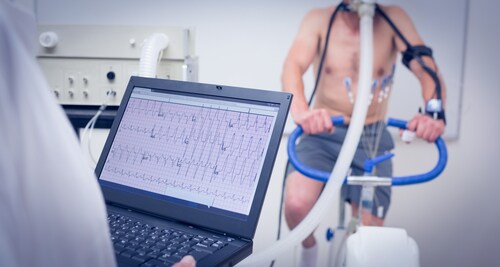
 A number of modifiable lifestyle factors are associated with chronic disease. These include diet and physical activity. Given the significant government costs that arise as a direct result of preventable chronic diseases, Ali et al. (2016) examined the acute impact of exercise on individual metabolomes.1 In doing so, they hoped to match the most beneficial exercise type to the individual.
The study consisted of 10 healthy, active adults: 2 female and 8 male. Each participant completed two cycling exercise trials in the laboratory, 5 to 10 days apart. The first trial was an incremental exercise test until exhaustion in order to determine aerobic capacity (VO2max), and the second was a 45 minute submaximal exercise test. Subjects collected urine the day before the submaximal test, on the day, and on the day after (at standardized times). The investigators designated the samples as follows: D = day and S = sample number within a day (e.g., D1S1 = day 1, sample 1).
To perform liquid chromatography–mass spectrometry (LC-MS) analysis, Ali et al. used a Dionex 3000 HPLC coupled to a Exactive mass spectrometer (both Thermo Scientific) in both positive and negative mode at 50,000 resolution. They used a ZIC-pHILIC column for separation. To obtain MS2 spectra, they used an LTQ-Orbitrap mass spectrometer under the same conditions as for the Exactive instrument.
By collecting samples on the pre-exercise day, the investigators observed metabolite variations that occurred as a diurnal rhythm. Furthermore, they averaged the areas for each metabolite across all the time points for day one and day two. Then they divided each metabolite area at each time point by the average to give the proportion contributed to the total output during the day.
Cardiorespiratory fitness can be expressed as the maximal rate of oxygen consumption, which can be determined during exercise by measuring respiratory variables during an incremental exercise test to exhaustion. The investigators used the two cycling exercise trials described earlier to determine this. They then used orthogonal partial least squares modeling to predict VO2max from the metabolic pattern in urine post-exercise.
Ali et al. found higher levels of the purine metabolites hypoxanthine, guanine, deoxyinosine, inosine and xanthosine post-exercise. They note that increases in purine metabolites following exercise are consistent with the current literature. Nonanoyl carnitine, decanoyl carnitine and ketodecanoyl carnitine all increased as a response to exercise. Furthermore, the researchers found that the difference between the first urine sample and the first post-exercise sample is most predictive of VO2max.
The approach Ali et al. used, collecting longitudinal urine samples, is simple and non-invasive and provided an overview of metabolism in action, which could aid in assessing overall fitness and diagnosing underlying diseases.
Reference
1. Ali, A.M., et al. (2016) “Metabolomic profiling of submaximal exercise at a standardised relative intensity in healthy adults,” Metabolites, 6(1), ii: E9. doi: 10.3390/metabo6010009.

Novel Huntington’s Disease Biomarkers
Huntington’s disease (HD) is a genetic neurodegenerati...
Read More
Toxicant Biomarkers: Urinary Exposure Marker Discovery
Industrialization brings exposure to potentially dangerous c...
Read More
Whole-Body Imaging of Drugs and Metabolites in Mice
Okutan, Hansen and Janfelt present a new method for whole-bo...
Read More
Treating Diabetes Mellitus with Radix Puerariae: Is There Evidence?
Diabetes mellitus (DM) is a metabolic disease caused by insu...
Read More
Leave a Reply