Search



Zitierungen und Referenzen (43)
Gibco™
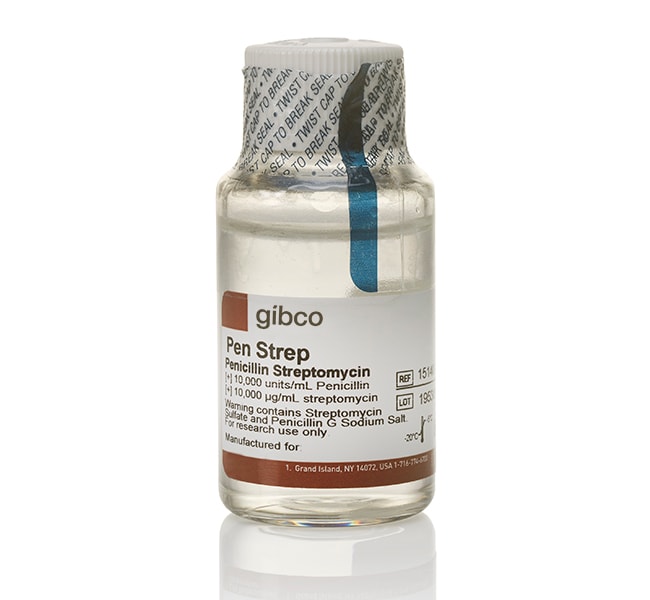
Penicillin-Streptomycin (10.000 U/ml)
Diese Lösung enthält 10.000 Einheiten/ml Penicillin und 10.000 μg/ml Streptomycin. Die Antibiotika Penicillin und Streptomycin verhindern mit ihrer kombinierten WirkungWeitere Informationen
Have Questions?
Ansicht ändern

| Katalognummer | Menge |
|---|---|
| 15140148 auch als 15140-148 bezeichnet | 20 mL |
| 15140122 auch als 15140-122 bezeichnet | 100 mL |
| 15140163 auch als 15140-163 bezeichnet | 20 x 100 mL |
Katalognummer 15140148
auch als 15140-148 bezeichnet
Preis (EUR)
19,65
Exklusiv online
20,24Ersparnis(3%)
Each
Menge:
20 mL
Preis (EUR)
19,65
Exklusiv online
20,24Ersparnis(3%)
Each
Diese Lösung enthält 10.000 Einheiten/ml Penicillin und 10.000 μg/ml Streptomycin. Die Antibiotika Penicillin und Streptomycin verhindern mit ihrer kombinierten Wirkung gegen grampositive und gramnegative Bakterien eine bakterielle Kontamination von Zellkulturen. Penicillin, das ursprünglich aus dem Pilz Penicillium gewonnen wurde, wirkt direkt, indem es den Neuaufbau der bakteriellen Zellwand stört, sowie indirekt, indem es die Freisetzung von Enzymen auslöst, die die Zellwand weiter verändern. Streptomycin wurde ursprünglich aus Streptomyces griseus isoliert. Es wirkt, indem es sich an die 30S-Untereinheit des bakteriellen Ribosoms anlagert, was zu einer Hemmung der Proteinsynthese und anschließendem Absterben sensitiver Bakterien führt.
Wir bieten eine breite Palette an Antibiotika und Antimykotika in Pulver- und flüssiger Form an. Erfahren Sie mehr über die folgenden Produkttypen:
• Zellkultur Antibiotika-Auswahl
• Selektive Antibiotika (einschließlich empfohlener Arbeitskonzentrationen)
Erfahren Sie mehr über die Verwendung von Antibiotika und Antimykotika in der Zellkultur und lesen Sie Richtlinien für die Dekontamination von Kulturen.
Wir bieten eine breite Palette an Antibiotika und Antimykotika in Pulver- und flüssiger Form an. Erfahren Sie mehr über die folgenden Produkttypen:
• Zellkultur Antibiotika-Auswahl
• Selektive Antibiotika (einschließlich empfohlener Arbeitskonzentrationen)
Erfahren Sie mehr über die Verwendung von Antibiotika und Antimykotika in der Zellkultur und lesen Sie Richtlinien für die Dekontamination von Kulturen.
Nur für Forschungszwecke. Nicht zur Verwendung bei diagnostischen Verfahren.
Specifications
Konzentration100X
Zur Verwendung mit (Anwendung)Zur Prävention von Zellkulturkontaminationen
Menge20 mL
Haltbarkeit12 Monate
VersandbedingungTrockeneis
FormFlüssig
ProdukttypAntibiotikum
SterilitätSteril gefiltert
Sterilization MethodSterile-filtered
Unit SizeEach
Inhalt und Lagerung
Lagerbedingungen: -5 bis -20 °C
Versandbedingungen: Haltbarkeit
Tiefkühlprodukte: 12 Monate ab Herstellungsdatum
Versandbedingungen: Haltbarkeit
Tiefkühlprodukte: 12 Monate ab Herstellungsdatum
Häufig gestellte Fragen (FAQ)
My Penicillin-Streptomycin solution is not colorless. Is this normal?
How can I decontaminate my cultures?
What antibiotics do you offer to help control or eliminate cell culture contamination?
Zitierungen und Referenzen (43)
Zitierungen und Referenzen
Abstract
Identification of a novel redox-sensitive gene, Id3, which mediates angiotensin II-induced cell growth.
Journal:Circulation
PubMed ID:12021231
BACKGROUND: Reactive oxygen species, such as superoxide (O(2)(-)), are involved in the abnormal growth of various cell types. Angiotensin II (Ang II) is one of the most potent inducers of oxidative stress in the vasculature. The molecular events involved in Ang II-induced proliferation of vascular smooth muscle cells (VSMCs) are
Functional interaction of caveolin-1 with Bruton's tyrosine kinase and Bmx.
Journal:J Biol Chem
PubMed ID:11751885
'Bruton''s tyrosine kinase (Btk), a member of the Tec family of protein-tyrosine kinases, has been shown to be crucial for B cell development, differentiation, and signaling. Mutations in the Btk gene lead to X-linked agammaglobulinemia in humans and X-linked immunodeficiency in mice. Using a co-transfection approach, we present evidence here
Repression of activator protein-1-mediated transcriptional activation by the Notch-1 intracellular domain.
Journal:J Biol Chem
PubMed ID:11739397
'Developmental decisions that control cell fate are commonly regulated by the Notch signaling pathway. Activation of transmembrane Notch receptors results in proteolytic liberation of the intracellular domain of Notch, which translocates into the nucleus, binds a repressor (C promoter binding factor 1/RBP-Jkappa, Su(H), and Lag-1 (CSL)), and induces target genes.
A differential role for the mitogen-activated protein kinases in lipopolysaccharide signaling: the MEK/ERK pathway is not essential for nitric oxide and interleukin 1beta production.
Journal:J Biol Chem
PubMed ID:11786532
'Endotoxin (lipopolysaccharide, LPS) is a component of the outer membrane of Gram-negative bacteria and promotes the activation of macrophages and microglia. Although these cells are highly LPS-responsive, they serve unique tissue-specific functions and exhibit different LPS sensitivities. Accordingly, it was of interest to evaluate whether these biological differences reside in
Cholesteryl ester is transported from caveolae to internal membranes as part of a caveolin-annexin II lipid-protein complex.
Journal:J Biol Chem
PubMed ID:11733519
'We previously demonstrated that in Chinese hamster ovary cells scavenger receptor, class B, type I-dependent selective cholesteryl ester uptake occurs in caveolae. In the present study we hypothesized that cholesteryl ester is transported from caveolae through the cytosol to an internal membrane by a caveolin chaperone complex similar to the