Search


Zitierungen und Referenzen (16)
Gibco™
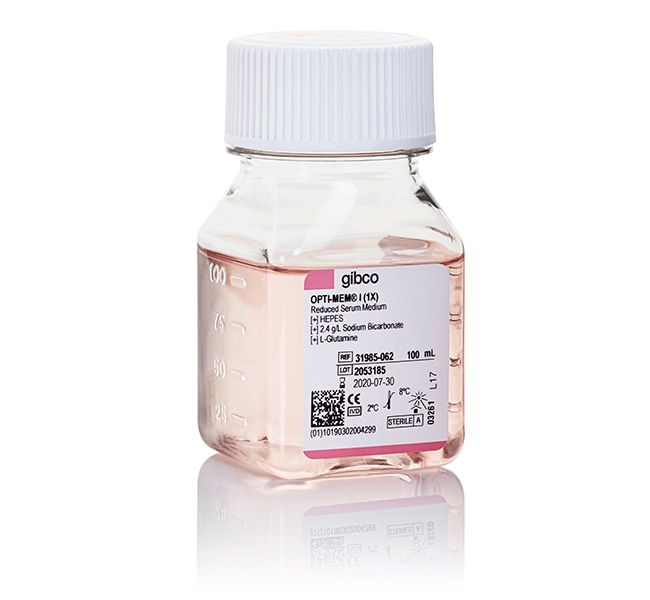
Opti-MEM™ I Serumreduziertes Medium
Opti-MEM™ I Reduced-Serum Medium ist ein verbessertes Minimal Essential Medium (MEM), das eine Reduktion der Supplementation von fötalem Rinderserum umWeitere Informationen
Have Questions?
Ansicht ändern

| Katalognummer | Menge |
|---|---|
| 31985062 | 100 mL |
| 31985070 | 500 mL |
Katalognummer 31985062
Preis (EUR)
23,64
Each
Menge:
100 mL
Preis (EUR)
23,64
Each
Opti-MEM™ I Reduced-Serum Medium ist ein verbessertes Minimal Essential Medium (MEM), das eine Reduktion der Supplementation von fötalem Rinderserum um mindestens 50 % ohne Änderungen der Wachstumsrate oder Morphologie ermöglicht. Opti-MEM™ I Medium wird auch zur Verwendung mit Reagenzien für die Transfektion kationischer Lipide (z. B. Lipofectamine™ Reagenz) empfohlen. Opti-MEM™ I Medium kann mit einer Vielzahl von Zellen in Suspension sowie von adhärenten Säugetierzellen, einschließlich Sp2, AE-1, CHO, BHK-21, HEK, und primären Fibroblasten verwendet werden. Wir bieten eine Vielzahl von Opti-MEM™ I Modifikationen für eine Vielzahl von Zellkulturanwendungen an.
Dieses Opti-MEM™ I wird wie folgt modifiziert:
Die vollständige Formulierung ist streng vertraulich. Für weitere Informationen wenden Sie sich bitte an den Technischen Kundendienst.
Verwendung von Opti-MEM™ I Medium
Opti-MEM™ I Reduced-Serum Medium ist ein einzigartiges Medium, das Insulin, Transferrin, Hypoxanthin, Thymidin und Spurenelemente enthält. Diese Zusatzkomponenten ermöglichen eine Reduzierung der Serumsupplementation um mindestens 50 %. Opti-MEM™ I Medium verwendet ein Natriumbikarbonat-Puffersystem (2,4 g/l) und erfordert daher eine 5 bis 10%ige CO–2-Umgebung, um den physiologischen pH-Wert aufrechtzuerhalten.
cGMP-konformes Herstellungs- und Qualitätssystem
Opti-MEM™ I wird in einer cGMP-konformen Einrichtung in Grand Island, New York, hergestellt. Die Einrichtung ist von der US-Arzneimittelbehörde FDA als Hersteller von Medizinprodukten zugelassen und nach ISO 13485-zertifiziert. Für eine kontinuierliche Versorgung bieten wir auch ein identisches Opti-MEM™ I-Produkt an, dass an unserem Standort in Schottland hergestellt wird (31985-047). Diese Einrichtung ist ebenfalls von der USA-Arzneimittelbehörde FDA zur Herstellung medizinischer Geräte zugelassen und ISO 13485-zertifiziert.
Dieses Opti-MEM™ I wird wie folgt modifiziert:
| Mit |
| • L-Glutamin |
| • Phenolrot |
Die vollständige Formulierung ist streng vertraulich. Für weitere Informationen wenden Sie sich bitte an den Technischen Kundendienst.
Verwendung von Opti-MEM™ I Medium
Opti-MEM™ I Reduced-Serum Medium ist ein einzigartiges Medium, das Insulin, Transferrin, Hypoxanthin, Thymidin und Spurenelemente enthält. Diese Zusatzkomponenten ermöglichen eine Reduzierung der Serumsupplementation um mindestens 50 %. Opti-MEM™ I Medium verwendet ein Natriumbikarbonat-Puffersystem (2,4 g/l) und erfordert daher eine 5 bis 10%ige CO–2-Umgebung, um den physiologischen pH-Wert aufrechtzuerhalten.
cGMP-konformes Herstellungs- und Qualitätssystem
Opti-MEM™ I wird in einer cGMP-konformen Einrichtung in Grand Island, New York, hergestellt. Die Einrichtung ist von der US-Arzneimittelbehörde FDA als Hersteller von Medizinprodukten zugelassen und nach ISO 13485-zertifiziert. Für eine kontinuierliche Versorgung bieten wir auch ein identisches Opti-MEM™ I-Produkt an, dass an unserem Standort in Schottland hergestellt wird (31985-047). Diese Einrichtung ist ebenfalls von der USA-Arzneimittelbehörde FDA zur Herstellung medizinischer Geräte zugelassen und ISO 13485-zertifiziert.
Für die Verwendung in der Forschung oder die Weiterverarbeitung. Nicht zur Diagnosestellung oder direkten Anwendung bei Menschen oder Tieren geeignet.
Specifications
ZelllinieSP2, AE-1, CHO, BHK-21 und HEK
ZelltypPrimäre Fibroblasten
Konzentration1 X
Fertigungsqualität, HerstellungsqualitätcGMP-compliant under the ISO 13485 standard
ProduktlinieGibco, Opti-MEM
ProdukttypOpti-MEM I
Menge100 mL
Haltbarkeit18 Monate ab Herstellungsdatum
VersandbedingungRaumtemperatur
KlassifikationMenschlicher Ursprung
FormFlüssig
SterilitätSteril gefiltert
Sterilization MethodSterile-filtered
Mit AdditivenGlutamin, Phenolrot
Unit SizeEach
Inhalt und Lagerung
Lagerbedingungen: 2 bis 8 °C. Vor Licht schützen
Versandbedingungen: Haltbarkeit bei
Raumtemperatur: 18 Monate ab Herstellungsdatum
Versandbedingungen: Haltbarkeit bei
Raumtemperatur: 18 Monate ab Herstellungsdatum
Häufig gestellte Fragen (FAQ)
What should I use to dilute my RNAi duplexes and Lipofectamine RNAiMAX before complexing?
Do you offer an alternative for Opti-MEM I Reduced Serum Medium (Cat. No. 31985070)?
My OpitMEM Reduced Serum Medium (Cat. No. 31985070) was accidentally frozen. Can I still use it?
Is there any other difference between Opti-MEM I Reduced Serum Medium and Opti-MEM I Reduced Serum Medium, no phenol red besides the presence/absence of phenol red?
Where can I find the osmolality for my lot of Opti-MEM I Reduced Serum Medium?
Zitierungen und Referenzen (16)
Zitierungen und Referenzen
Abstract
Regulation of cortical dendrite development by Slit-Robo interactions.
Journal:Neuron
PubMed ID:11779471
Slit proteins have previously been shown to regulate axon guidance, branching, and neural migration. Here we report that, in addition to acting as a chemorepellant for cortical axons, Slit1 regulates dendritic development. Slit1 is expressed in the developing cortex, and exposure to Slit1 leads to increased dendritic growth and branching.
Identification of a novel redox-sensitive gene, Id3, which mediates angiotensin II-induced cell growth.
Journal:Circulation
PubMed ID:12021231
BACKGROUND: Reactive oxygen species, such as superoxide (O(2)(-)), are involved in the abnormal growth of various cell types. Angiotensin II (Ang II) is one of the most potent inducers of oxidative stress in the vasculature. The molecular events involved in Ang II-induced proliferation of vascular smooth muscle cells (VSMCs) are
Vinexin beta Regulates the Anchorage Dependence of ERK2 Activation Stimulated by Epidermal Growth Factor.
Journal:J Biol Chem
PubMed ID:11825889
'ERK is activated by soluble growth factors in adherent cells. However, activation of ERK is barely detectable and not sufficient for cell proliferation in non-adherent cells. Here, we show that exogenous expression of vinexin beta, a novel focal adhesion protein, allows anchorage-independent ERK2 activation stimulated by epidermal growth factor. In
Hypoxia induces cyclooxygenase-2 via the NF-kappaB p65 transcription factor in human vascular endothelial cells.
Journal:J Biol Chem
PubMed ID:8995303
'The inducible cyclooxygenase, COX-2, has been associated with vascular inflammation and cellular proliferation. We have discovered that hypoxia increases expression of the COX-2 gene in human vascular endothelial cells in culture independent of other stimuli. Western analysis of human umbilical vein endothelial cells (HUVEC) revealed a greater than 4-fold induction
The proximal promoter of the human transglutaminase 3 gene. Stratified squamous epithelial-specific expression in cultured cells is mediated by binding of Sp1 and ets transcription factors to a proximal promoter element.
Journal:J Biol Chem
PubMed ID:8626812
'The transglutaminase 3 enzyme is expressed during the late stages of the terminal differentiation of the epidermis and in certain cell types of the hair follicle. The enzyme is thought to be critically involved in the cross-linking of structural proteins and in the formation of the cornified cell envelope, thereby