Search

Invitrogen™
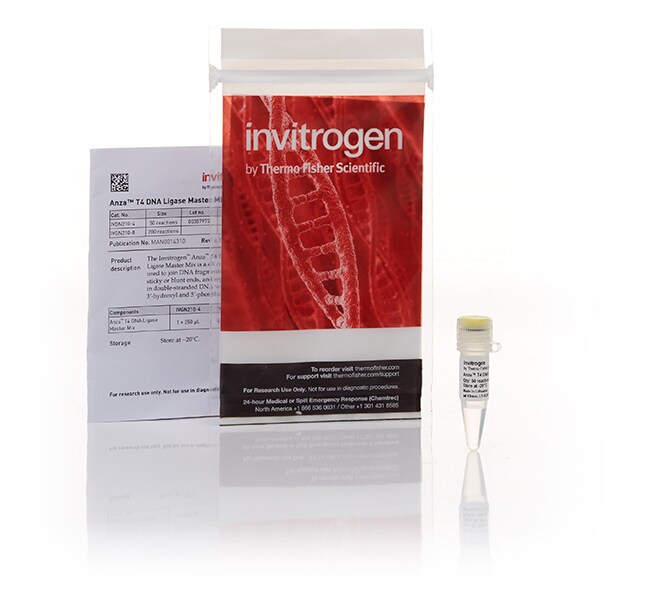
Master Mix d’ADN ligase T4 Anza™
Le Master Mix d’ADN ligase T4 Invitrogen Anza™ facilite la jonction des extrémités de soutien 5’-phosphate et 3’-hydroxyle dans l’ADNAfficher plus
Have Questions?
Modifier l'affichage

| Référence | Quantité |
|---|---|
| IVGN2104 | 50 réactions |
| IVGN2108 | 200 réactions |
Référence IVGN2104
Prix (EUR)
283,65
Online Exclusive
308,00Économisez 24,35 (8%)
Each
Quantité:
50 réactions
Prix (EUR)
283,65
Online Exclusive
308,00Économisez 24,35 (8%)
Each
Le Master Mix d’ADN ligase T4 Invitrogen Anza™ facilite la jonction des extrémités de soutien 5’-phosphate et 3’-hydroxyle dans l’ADN duplex par la formation d’une liaison phosphodiester. Il peut être utilisé pour joindre des fragments d’ADN avec des extrémités cohésives ou franches, et pour réparer des entailles dans de l’ADN bicaténaire avec des extrémités 3’-hydroxyle et 5’-phosphate. L’ADN ligase T4 Anza est formulée sous forme de Master Mix avec une concentration 4X. La ligature peut être réalisée avec de l’ADN dans de l’eau, TE, tampon d’élution ou tampons 1X Anza™.
Avantages :
• Ligature complète en 15 minutes à température ambiante
• Un seul Master Mix de ligase pour les réactions de ligature à extrémités cohésives et à extrémités franches
• Le format de Master Mix prêt à l’emploi réduit les étapes de pipetage
• La concentration 4X permet d’utiliser plus d’ADN dilué dans la réaction de ligature sans concentration
Le Master Mix d’ADN ligase T4 Anza fait partie du système de clonage d’enzymes de restriction Anza™, unifiant les procédés de clonage traditionnels. D’autres enzymes de modification de l’ADN Anza incluent le kit Anza T4 PNK, le kit Anza DNA Blunt End et le kit Anza DNA End Repair.
Avantages :
• Ligature complète en 15 minutes à température ambiante
• Un seul Master Mix de ligase pour les réactions de ligature à extrémités cohésives et à extrémités franches
• Le format de Master Mix prêt à l’emploi réduit les étapes de pipetage
• La concentration 4X permet d’utiliser plus d’ADN dilué dans la réaction de ligature sans concentration
Le Master Mix d’ADN ligase T4 Anza fait partie du système de clonage d’enzymes de restriction Anza™, unifiant les procédés de clonage traditionnels. D’autres enzymes de modification de l’ADN Anza incluent le kit Anza T4 PNK, le kit Anza DNA Blunt End et le kit Anza DNA End Repair.
Usage exclusivement réservé à la recherche. Ne pas utiliser pour des procédures de diagnostic.
Spécifications
Tampon compatibleTampon d’élution, tampon Anza 1X
Type de produitMaster Mix d’ADN ligase T4
Quantité50 réactions
Conditions d’expéditionHomologué pour des expéditions sur de la glace carbonique ou mouillée
Concentration4X
EnzymesADN ligase T4
Gamme de produitsAnza
Unit SizeEach
Contenu et stockage
250 μl de Master Mix de Ligase d’ADN Anza T4
Conserver entre -5 et -30°C.
Conserver entre -5 et -30°C.