Search
Bioss
Bax Monoclonal Antibody (3C1)
{{$productOrderCtrl.translations['antibody.pdp.commerceCard.promotion.promotions']}}
{{$productOrderCtrl.translations['antibody.pdp.commerceCard.promotion.promocode']}}: {{promo.promoCode}} {{promo.promoTitle}} {{promo.promoDescription}}. {{$productOrderCtrl.translations['antibody.pdp.commerceCard.promotion.learnmore']}}
{{$ctrl.translations['antibody.pdp.skuNotes.additionalInformation']}}:

FIGURE: 1 / 2
Bax Antibody (BSM-33283M) in ICC/IF
Tissue/cell: Hela cell; 4% Paraformaldehyde-fixed; Triton X-100 at room temperature for 20 min; Blocking buffer (normal goat serum, C-0005) at 37°C for 20 min; Antibody incubation with (Bax) monoclonal Antibody, Unconjugated (bsm-33283M) 1:100, 90 minutes at 37°C; followed by a CY3 conjugated Goat Anti-Mouse IgG antibody at 37°C for 90 minutes, DAPI (blue, C02-04002) was used to stain the cell nuclei.

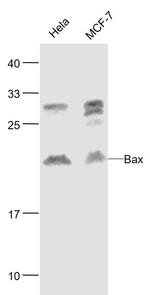
Please note: We are reviewing Western blot images included in the antibody testing data in our catalog, including those provided by third parties. Unless expressly labeled or annotated as “raw-unedited”, Western blot images included in the antibody testing data in our catalog may have been edited, optimized or otherwise adjusted for presentation.


Product Details
BSM-33283M
Applications
Tested Dilution
Publications
Product Specifications
Species Reactivity
Human,
Mouse,
Rat
Host/Isotype
Mouse
/ IgG
Class
Monoclonal
Type
Antibody
Clone
3C1
Immunogen
KLH conjugated synthetic peptide derived from human Bax
Conjugate
Unconjugated
Unconjugated
Unconjugated
Form
Liquid
Concentration
1 mg/mL
Amount
100 µg
Purification
Protein G
Storage buffer
TBS, pH 7.4, with 50% glycerol, 1% BSA
Contains
0.03% ProClin 300
Storage conditions
-20°C, Avoid Freeze/Thaw Cycles
Shipping conditions
Ambient (domestic); Wet ice (international)
Target Information
BAX is a members of the Bcl-2 Family and plays an important role in regulation of apoptosis. Whereas Bcl-2 is commonly regarded as an anti-apoptotic protein, BAX is considered to have a pro-apoptotic function. Regulation of apoptosis is supposed to involve both homo- and heterodimerization of different isoforms of BAX and Bcl-2. The Bax gene encodes different isoforms including Bax alpha (21 kDa) and Bax beta (24 kDa), whereas both isoforms contain the BH1, BH2 and BH3 domains, Bax beta has a unique carboxyl terminus and does not contain a hydrophobic transmembrane domain. Bcl-2 is also expressed in different Isoforms. Bcl-2 beta differs in the 3' UTR and coding region compared to variant alpha. Bcl-2 beta is shorter (22 kDa) and has a distinct C-terminus compared to Bcl-2 alpha (26 kDa). BAX is a member of the BCL-2 family of proteins, which function as regulators of apoptosis. Overexpression of BAX functions to promote cell death. BAX can form homodimers and is also able to heterodimerize with other BCL-2 related proteins.
For Research Use Only. Not for use in diagnostic procedures. Not for resale without express authorization.
References (0)
Have you cited this product in a publication?
Let us know so we can reference it here.
Bioinformatics
Protein Aliases: alternatively spliced; apoptosis inducer; Bax zeta; Baxdelta2(G7); Baxdelta2(G8)-RFS protein; Baxdelta2G9; Baxdelta2G9omega; Baxdelta2omega; bcl-2-like protein 4; BCL2 associated X protein; Bcl2-associated X protein; BCL2-associated X protein omega; bcl2-L-4; unnamed protein product
Gene Aliases: BCL2L4
UniProt ID: (Human) Q07812, (Mouse) Q07813
Entrez Gene ID: (Human) 581, (Rat) 24887, (Mouse) 12028
B cell apoptotic process
release of cytochrome c from mitochondria
apoptotic process
mitochondrial fusion
extrinsic apoptotic signaling pathway via death domain receptors
intrinsic apoptotic signaling pathway in response to DNA damage
apoptotic mitochondrial changes
response to toxic substance
establishment or maintenance of transmembrane electrochemical gradient
negative regulation of mitochondrial membrane potential
positive regulation of protein complex assembly
negative regulation of protein binding
endoplasmic reticulum calcium ion homeostasis
release of matrix enzymes from mitochondria
cellular response to stress
cellular response to unfolded protein
regulation of apoptotic process
positive regulation of apoptotic process
negative regulation of apoptotic process
regulation of neuron apoptotic process
positive regulation of neuron apoptotic process
mitochondrial fragmentation involved in apoptotic process
regulation of mitochondrial membrane potential
intrinsic apoptotic signaling pathway in response to endoplasmic reticulum stress
positive regulation of release of cytochrome c from mitochondria
apoptotic signaling pathway
extrinsic apoptotic signaling pathway
extrinsic apoptotic signaling pathway in absence of ligand
intrinsic apoptotic signaling pathway
execution phase of apoptosis
fibril organization
cellular response to virus
positive regulation of apoptotic DNA fragmentation
regulation of intracellular signal transduction
positive regulation of IRE1-mediated unfolded protein response
B cell receptor apoptotic signaling pathway
regulation of apoptotic signaling pathway
positive regulation of intrinsic apoptotic signaling pathway
ovarian follicle development
response to hypoxia
neuron migration
leukocyte homeostasis
T cell homeostatic proliferation
B cell homeostasis
kidney development
blood vessel remodeling
myeloid cell homeostasis
B cell negative selection
B cell homeostatic proliferation
positive regulation of B cell apoptotic process
response to ischemia
glycosphingolipid metabolic process
regulation of nitrogen utilization
cellular response to DNA damage stimulus
mitochondrion organization
mitochondrial membrane organization
inner mitochondrial membrane organization
outer mitochondrial membrane organization
germ cell development
spermatogenesis
nervous system development
sex differentiation
cell proliferation
negative regulation of cell proliferation
male gonad development
response to xenobiotic stimulus
fertilization
response to wounding
response to salt stress
post-embryonic development
response to ionizing radiation
response to gamma radiation
positive regulation of calcium ion transport into cytosol
hypothalamus development
cerebral cortex development
negative regulation of endoplasmic reticulum calcium ion concentration
negative regulation of peptidyl-serine phosphorylation
regulation of mammary gland epithelial cell proliferation
glial cell apoptotic process
cellular response to UV
limb morphogenesis
ectopic germ cell programmed cell death
swimming behavior
response to cocaine
odontogenesis of dentin-containing tooth
negative regulation of neuron apoptotic process
development of secondary sexual characteristics
cellular respiration
retinal cell programmed cell death
response to copper ion
positive regulation of developmental pigmentation
negative regulation of fibroblast proliferation
spermatid differentiation
post-embryonic camera-type eye morphogenesis
response to axon injury
homeostasis of number of cells
homeostasis of number of cells within a tissue
protein insertion into mitochondrial membrane
positive regulation of release of sequestered calcium ion into cytosol
neuron apoptotic process
response to corticosterone
regulation of cell cycle
Sertoli cell proliferation
retina development in camera-type eye
positive regulation of apoptotic process involved in mammary gland involution
vagina development
thymocyte apoptotic process
cellular response to hydrogen peroxide
intrinsic apoptotic signaling pathway by p53 class mediator
response to anesthetic
regulation of mitochondrial membrane permeability involved in apoptotic process
positive regulation of mitochondrial membrane permeability involved in apoptotic process
apoptotic process involved in patterning of blood vessels
apoptotic process involved in embryonic digit morphogenesis
regulation of mitochondrial membrane permeability involved in programmed necrotic cell death
response to insulin-like growth factor stimulus
negative regulation of apoptotic signaling pathway
positive regulation of extrinsic apoptotic signaling pathway in absence of ligand
Disclaimer

Clicking the images or links will redirect you to a website hosted by BenchSci that provides third-party scientific content. Neither the content nor the BenchSci technology and processes for selection have been evaluated by us; we are providing them as-is and without warranty of any kind, including for use or application of the Thermo Fisher Scientific products presented.

Performance Guarantee
If an Invitrogen™ antibody doesn't perform as described on our website or datasheet,we'll replace the product at no cost to you, or provide you with a credit for a future purchase.*
Learn more
We're here to help
Get expert recommendations for common problems or connect directly with an on staff expert for technical assistance related to applications, equipment and general product use.
Contact tech support