How to deliver absolutely attainable digital PCR, simply and affordably
This is the second in a six part series to introduce you to digital PCR (dPCR). In this edition, we’ll take a look at how QuantStudio™ 3D dPCR from Thermo Fisher Scientific offers simplicity, affordability, and most importantly, absolute quantification attainability.
QuantStudio™ 3D Digital PCR System helps expand the use of dPCR
Cumbersome workflows and costly implementation have long been barriers to dPCR adoption in the lab. Thermo Fisher Scientific has made progress in bringing load-and-go simplicity to dPCR and significantly lowering the price of entry with the introduction of its QuantStudio™ 3D Digital PCR System.
dPCR expands the application boundaries of traditional real-time PCR by enabling absolute quantification without the use of a standard curve. The ability to move beyond measuring Ct values to detecting individual DNA molecules provides researchers with additional sensitivity and precision for a variety of experiments. QuantStudio™ 3D research experiments include, but not limited to: Rare cancer mutation quantification, copy number variation (CNV) analysis, pathogen detection and load determination, absolute quantification of standards,
library quantification for next-generation sequencing (NGS), characterization of low-fold changes in mRNA and miRNA expression, and GMO detection and contamination assessment.
Simplicity, affordability, and absolute quantification at a fraction of the size, cost, and number of hands-on steps compared to other digital PCR and real-time qPCR methods sets the stage for an increasing number of labs to optimize their nucleic acid detection and quantification capabilities.
A simpler-is-better workflow improves process efficiencies
Seeing is believing. To view a brief video demonstration of how easy it is to load and read chips on the QuantStudio™ 3D, click here.
QuantStudio™ 3D is designed to minimize the level of expertise needed to perform dPCR. Users simply load the reaction mix onto the uniquely tagged chip, amplify on a dual flat block thermal cycler, and read the target concentration (reading takes less than 30 seconds). Up to 24 chips can be loaded at one time.

When performing dPCR, a nucleic acid mixture is partitioned into many reaction wells, with some wells receiving a target molecule and some not. Reactions are then subjected to standard PCR and then scanned to identify wells that have not received target molecules.
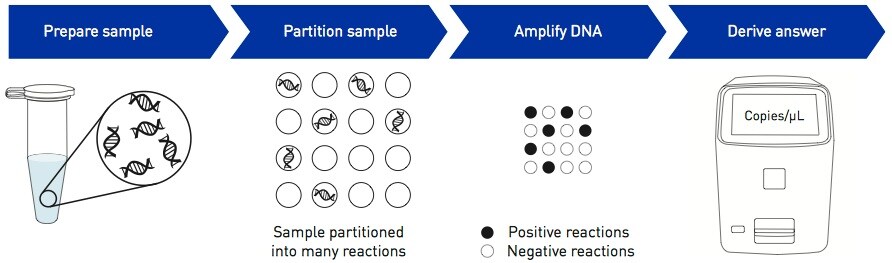
A standard statistical correction, or Poisson model, accounts for wells that may have received more than a single target molecule, and a final concentration value is determined. Given that dPCR doesn’t rely on Ct values to quantify copy number, comparison to a known standard is not required for absolute quantification.
The QuantStudio™ 3D leverages high-density nanofluidic chip technology to partition a sample into as many as 20,000 independent reaction wells. Comprised of consistently sized wells etched in a solid silicon substrate, the chip enables straightforward and robust sample partitioning that allows thousands of data points to be analyzed per run.
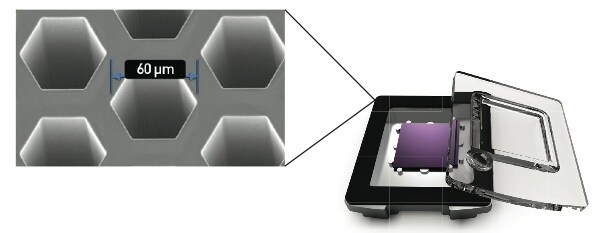
Samples and amplification products remain completely contained throughout the streamlined process, and an easily interpretable answer – in target copies/μL – is produced.
The QuantStudio™ 3D is capable of detecting both TaqMan® and SYBR™ chemistries. TaqMan® chemistry minimizes false positives in quantitative PCR experiments and minimizes the need for melt curve analysis. Over 8 million predesigned TaqMan® Assays are available for dPCR applications using the QuantStudio™ 3D.
Perform absolute quantification with confidence
The QuantStudio™ 3D makes a data quality assessment for each calculation that determines absolute number copies/μL. Data considered marginal or failing are flagged for further review in secondary analysis using Thermo Fisher AnalysisSuite™ Cloud Software. The software supports secondary analysis from any computer connected to the Internet through a personalized, cloud-based ThermoFisher Scientific user account. Data transfer is seamless and fully automated, but can also be transferred over an internal network or via USB flash drive.
Analysis Suite™ software is also available for further data QC and multichip analysis for specific applications. Chip data are uploaded to a secure environment and analyzed using different application modules such as absolute quantification and relative quantification, with visualizations allowing for chip inspection, clustering, and CNV calculation.
Affordable enough to enable dPCR in any lab
Compared to its closest dPCR competitor, it would take at least 10 years of average use, i.e. 1000 sample runs per year, to equal the savings achieved with the QuantStudio™ 3D. At this low price point it opens the door for more labs to upgrade and streamline their nucleic acid detection and absolute quantification capabilities. Because we offer more than 8 million TaqMan® assays available for dPCR, labs can further reduce time and procurement costs.
dPCR Augmented Reality App puts cutting-edge technology at your fingertips
Take a virtual tour of the QuantStudio™ 3D to experience its innovative features and sealed, chip-based workflow.
Once you’ve completed the tour, you can download the augmented reality app to your iOS™ or Android™
device, print the augmented reality (AR) target, and practice using it in your spare time to hone your dPCR skills.
The app provides a good overview of and firsthand interaction with QuantStudio™ 3D absolute quantification capabilities, including:
• Augmented reality learning module to guide you through the key areas of dPCR, including absolute quantification and rare target detection
• 17-minute video, with easy-to-understand illustrations
• Interactive workflow guide showcasing chip-based technology
• Snap and share photos of the virtual QuantStudio 3D right from your lab
• Connection to online learning resources from Thermo Fisher Scientific, including the Applied Biosystems™ User Community
Conclusion
That’s a lot to absorb in such a short time, so I’ll wrap up with the highlights and leave you to explore more about how to move your lab beyond real-time qPCR to dPCR with QuantStudio™ 3D.
From the top, simpler is better. QuantStudio™ 3D uses a chip-based workflow with minimal hands-on steps and sample manipulation to help increase precision and sensitivity.
Next, it puts absolute quantification at your fingertips with the help of precision controlled nanofluidic technology that can deliver up to 20,000 individual partitions in copies/μL per chip, without the use of a standard curve.
And, finally, QuantStudio™ 3D is available to labs at a cost that’s less than half the price of competing platforms.
Learn More about QuantStudio™ 3D Digital PCR
Learn more about how the QuantStudio™ 3D Digital PCR System is delivering simplicity, affordability, and absolute quantification attainability to a growing number of labs everywhere. Plus, find a full complement of dPCR instrument support needs in a single online source, including relevant technical information, tips and tricks when starting an experiment, and fixes for common instrument and software errors.
Beginner and intermediate level dPCR Webinars are also available on demand to provide a deeper level of understanding of the full range dPCR benefits and a more in-depth look at the QuantStudio™ 3D.
Read all of the Let’s Go Digital PCR Series:
Go Digital PCR: Pt 1 – Next-Gen Quantification
Go Digital PCR: Pt 2 – QuantStudio™ 3D
Go Digital PCR: Pt 3 – Copy Number Variation
Go Digital PCR: Pt 4 – NGS Libraries
Go Digital PCR: Pt 5 – Rare Mutations
Go Digital PCR: Pt 6 – Emerging Analyses

When PCR Gets Dirty – Tackling PCR Inhibitors
In this first Absolute Gene-ius: Science Snapshot episode, h...
Read More
Multiplex vs. Singleplex qPCR: What do I need to know?
Real-time PCR (qPCR) has transformed how scientists detect a... John Pfeifer, PhD
Read More
Thermo Fisher Scientific’s Absolute Q Digital PCR system now a supported system for reporting results to the NWSS
For Research Use Only. Not for use in diagnostic procedures....
Read More
Your IVDR Transition, Now With the 3500-Series Genetic Analyzers
In-Vitro Medical Devices Regulation Clarity and Confidence W...
Read More
Leave a Reply