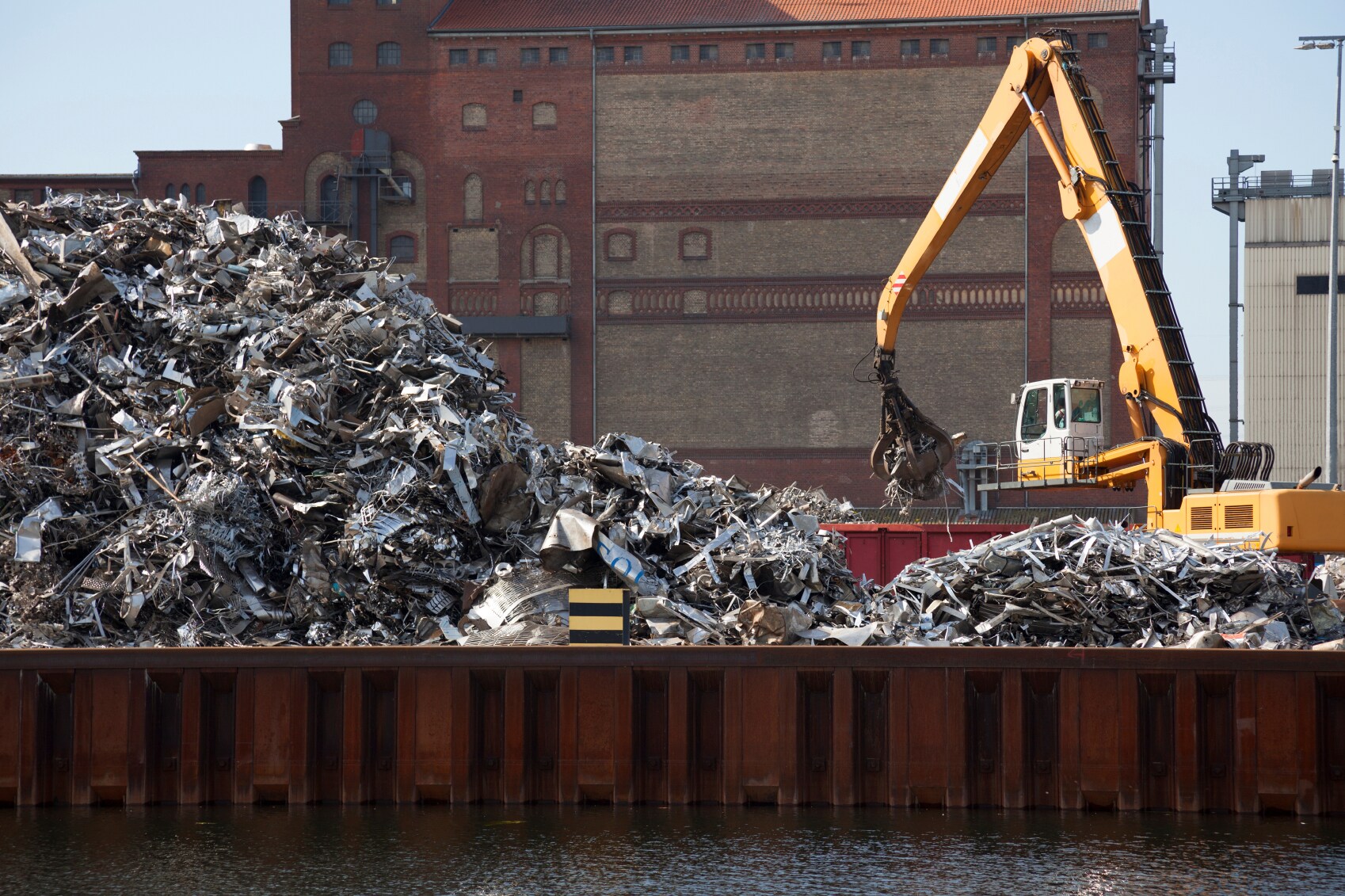
 The Steel Recycling Institute (SRI) reported that steel is North America’s most recycled material. This past year alone, over 63 million tons of steel have been recycled. SRI reports the latest figures on their website and you can see the approximations grow second by second.
Steel scrap is an essential raw material in making new steel. In fact, according to SRI, in each of the past 50 years, more than 50 percent of the steel produced in this country has been recycled through the steelmaking process. A well-established network of more than 2,000 ferrous scrap processors and more than 70 end markets help meet the steel industry’s demand for steel scrap.
Those figures prove how important steel is to the scrap recycling yards. There’s one problem, however: steel scrap is usually mixed with other materials. So how much of that scrap is not steel, and what else is it? It could be a variety of metals.
- Food cans — sometimes called tin cans, metal cans or aluminum cans — are usually made of steel with a tin-coating or they may contain some chromium or nickel.
- Appliances are a major source of scrap steel and SRI reports that a typical appliance is produced using about 65 percent steel, as well as aluminum, zinc and copper.
- A typical passenger car consists of about 60 percent steel and iron, and other metals. Cars can even contain precious metals like Platinum, Palladium, and Rhodium found in their automotive catalytic converters
Many steels have coatings applied to them. A zinc coating is applied by hot dip galvanizing (HDG), a process by which the steel is passed through a bath of molten liquid zinc or zinc alloy resulting in a protective layer. Other coating materials include cadmium, aluminum, chrome, nickel, nickel-chromium, iron oxide, and silver. Coating choice depends on the type of steel, and the type of corrosion you’re trying to prevent. (See more about steel coatings.)
“Stainless” steel is actually a generic term referring to a variety of steel types. Like all other kinds of steel, stainless steel is made primarily from iron and carbon in a two-step process. What makes stainless steel different is the addition of chromium (Cr) and other alloying elements such as nickel (Ni) to create a corrosion-resistant product. (You can learn more about stainless steel in this previous article.)
With steel recycling being such an important business, scrap yards must ensure that their inventory is identified precisely and sorted appropriately. Manufacturers who are buying their scrap will insist that the metal is identified accurately because the quality and the costs associated with manufacturing their produced goods depends on it.
- 17-4 stainless steel is used in the food and aerospace industries,
- 300 series of stainless steel will not stick to a magnet,
- 304 stainless steel is commonly found in kitchen equipment,
- 310 stainless steel is often used in high temperature equipment
- 316 stainless steel is used in food and boat industries
- 321 stainless steel is used in aircrafts and exhaust systems
- 400 series stainless steel contains no nickel, is magnetic, and is used for high temperatures
Accurately ID’ing the type of steel is especially important to the amount of money a scrap yard will pay for incoming metals, and charge for its inventory. Prices for different types of metals can vary dramatically from material to material, as well as day to day. If you check out this iscrap application page, you will see that steel scrap, especially stainless steel, is organized into different categories because different industries need certain metals to be present, or missing from the melt.
Scrap yards use portable X-ray fluorescent analyzers to identify the various elements contained in the metals and then grade and sort them appropriately. The XRF analyzers can help determine the metal composition, discover tramp/trace elements, and positively identify numerous alloys at material transfer points to help ensure product quality. It’s a non-destructive technology, so the metals do not have to be melted down first. (If you want to know how portable XRF analyzers work, download this free ebook, Portable XRF Technology for the Non-Scientist.)
Best practices for scrap yard operations should include inspection of all metals that come into the facility against paperwork, quality checks after metals are sorted and throughout the process, and then final analysis before the metals leave the facility. In addition, the exact chemical composition of scrap, including the existence of contaminants or hazardous elements, must be determined for quality, safety and regulatory compliance. A scrap yard’s reputation depends on the integrity of the metal scrap that reaches the customer.
Additional Resources:
- Download our free eBook: A Practical Guide to Improving Steel Manufacturing Processes and Production Methods
- Visit our center for Improving Steel Manufacturing Processes and Production

INFOGRAPHIC: 8 Fun Facts About Copper
What do pennies, asparagus and police officers have in commo...
Read More
Why Sinter Chemistry is Important and How to Get it Right
When sinter chemistry fluctuates, it can significantly impac... Kevin Gordon
Read More
I Use XRF Analyzers on Metals… Is it Safe?
Do you use portable x-ray fluorescence (XRF) analyzers for...
Read More
Why Scrap Metal Recycling Companies Are Getting Partnership Offers from Mining Operators
There are reports that there is a new trend in mining – th... Pete Anzalone
Read More

Thanks for pointing out how knowing what type of metal can help you what is important. I will have to see what kind of recycling centers are in the area. Hopefully I will be able to get the metals that are sitting in the backyard and shed out and into something useful.
I really appreciate the list of different types of stainless steel. It is really nice that you separated the qualities that they would have. Since I have been wanting to get into recycling metal, I’ll definitely be using this to separate everything out. Hopefully that will make it easier for me to estimate how much I can make.
Thanks for your comment, Maggie. We have many articles on scrap metal recycling; you can sort them right from the menu: https://www.thermofisher.com/blog/metals/scrap-metal-recycling/
It is also a very profitable metal with China’s steel industry taking a hit and prices are high for now.
Elliot– We’ve been advocating for increase scrap usage in China for quite awhile now. Here’s an article about a presentation one of our scrap metal experts gave.
Advocating for Increased Scrap Usage at China’s International Aluminium Conference
It’s beyond the imagination of how much metals are still dumped into a landfill instead of being recovered. That’s why urban mining idea is so accelerating right now. Not to mention that in many cases it is cheaper to recover than to mine.
Thanks for your comment, Alex. You might enjoy this article about recycling ewaste and a number of globally-focused e-waste recycling projects. The Electronic Afterlife: E-waste Recycling
Alex– People are getting more concerned about recycling. Steel manufacturers are even starting to recycle their steel dust. https://www.thermofisher.com/blog/metals/xrf-and-xrd-help-make-steel-dust-recycling-a-reality/
I did not understand the importance of knowing different steels for people who recycle. It is interesting to learn that food cans can contain some chromium or nickel. It would be a good idea to start recycling things like paper and plastic and work up to recycling metal when the rules are clear.
Jade–
It is important to know the content of all metals being scrapped. This article may interest you: Concerns in the Aluminium Scrap Industry
Great post! Thanks for sharing. For info on Steel building kits, construction and services, visit our site: http://www.steelcobuildings.com/
I had no idea that cars might contain certain types of precious metals. I can see why it would be so helpful for a scrap metal recycler to be able to recognize all the different types of material they might come across. I bet this is even more important when you are salvaging materials other than metal as well. I would imagine that they would need to know all about the different kinds of lumber and other building materials as well.
Kairi — Even a car’s catalytic converter contains precous metals. Take a look at this article:
Catalytic Converter Recycling Is Still Big Business
It’s interesting that different weights and types of steel need to be recycled differently. It makes sense that 310 steel might be a lot harder to melt down than something like 316. It’s something I’ll have to keep in mind when looking at different weights to buy so I can make sure to keep them organized in case I ever recycle them.
Tyler–
Not only do you have to worry about different types of steel, but you also have to worry about other materials as well. You might be interested in this article:
Does Your Scrap Metal Contain A Trace of the Wrong Material?
I agree that it is important to know the types of metal you sell or buy since this determines how much it is worth. It is important to remember that finding the right company to work with can help you get the most out of your scrap. I would want to find a company that is honest and understands how to do business.
I really appreciate this article because before I read it I would have never been able to tell the difference between the different kinds of metals. After all, isn’t the point of scrapping metal to make money? A lot of scrap metal companies will come and pick your metal up for you as well!
I didn’t know that stainless steel was made mostly of iron and carbon. When I was getting new frying pans, I wanted to make sure that I got stainless steel pans so they would be less of a hassle. If you are thinking of getting new pans then you might want to consider looking at your options and figuring out which ones will be easier for you.
John–
If you want to know more about Stainless Steel, you might find this two-part series interesting:
What Is Stainless Steel? Part I – An Introduction to the World’s Most Popular Metal
What is Stainless Steel? Part II – The Stainless Steel Extended Family
It’s great that resources like these are available online for people to refer to. Scrap metal recycling started years ago and some weren’t that knowledgeable on how to do it. It’s now a booming industry that also helps the environment.
We accept and collect a broad range of scrap metal from worksites, factories, farms, manufacturing facilities, and demolition sites. We collect both ferrous and non-ferrous metals from various sources.
My dad has a lot of coppers in his garage area, and since he has no idea how to recycle them, he has decided to start looking for a service that focuses on handling scrap metals. Well, thank you for sharing here most of the steels have coatings in them; therefore, galvanizing is necessary. It is also good to know that there is such a thing as a portable X-ray fluorescent analyzer that will help determine the metal composition.
Selling my unused devices and appliances as well. and making money while cleaning up my backyard.
I didn’t know that scrap yards have to make sure their inventories are precise. They can’t afford to give someone a type of metal that isn’t what they wanted. That’d be bad for business and they’d be punished for it.
Excellent post. I want to thank you for this informative, I really appreciate sharing this great post. Thanks for sharing this…
We are leading Steel Traders in UAE in Dubai and would be privileged to tell you that reading this blog has been an amazing experience. Highly precise and very informatory awaiting for the upcoming blogs.
Scrap metal recycling is crucial for sustainability. Let’s continue to promote eco-friendly practices for a cleaner future!