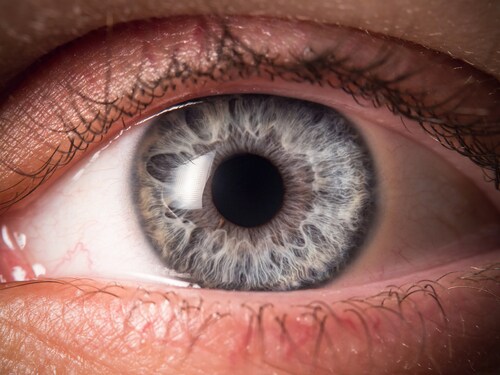
 The aqueous humor is a clear fluid filling the space in the anterior compartment of the eye between the lens and the cornea. The fluid is produced from a combination of small capillaries in the front of the eye that filter blood plasma and nearby tissues that produce proteins and lipids. Proteomic studies of aqueous humor are helpful for understanding the mechanisms of eye diseases and identifying potential drug targets. In the past, some studies have suggested that protein changes within the aqueous humor correlate with certain eye conditions. Recently, Kliuchnikova et al. analyzed 29 aqueous humor samples from patients with cataracts and glaucoma, with and without pseudoexfoliation syndrome (deposits of whitish-gray protein on the lens, iris, ciliary epithelium, corneal endothelium and trabecular meshwork). For this analysis, the team adopted a shotgun proteomics strategy using liquid chromatography high-resolution mass spectrometry.
Researchers collected aqueous humor samples from the ophthalmological department of Botkin Moscow City Clinical Hospital in Russia. Using a paracentesis tract with a 25 gauge needle, they collected 16 specimens during cataract surgery and 13 samples from glaucoma patients during sinus trabeculectomy surgery. The authors note that collecting this fluid is a fairly invasive procedure and not ideal for routine collections.
Rather than pooling samples, the team analyzed each sample separately to estimate the protein variation between individuals. They estimated the total protein in each sample using a NanoDrop ND-1000 spectrophotometer (Thermo Scientific). Next, the researchers digested proteins with trypsin prior to the proteomic analysis. To analyze proteins, the team used a Q Exactive mass spectrometer (Thermo Scientific) and then compared spectra to results found in the human UniProt database.
They identified a total of 269 proteins, with 154 proteins common to all samples of aqueous humor. They also identified 32 proteins that had not previously been seen in aqueous humor. Using gene ontology, they determined that the majority of proteins played a role in proteolysis regulation, particularly in endopeptidase inhibitor activity. Label-free protein quantification showed no significant difference between glaucoma and cataract aqueous humor proteomes; however, label-free quantification intensity helped determine that decreased Apolipoprotein D is a putative biomarker in pseudoexfoliation syndrome. The researchers report that other investigations have implicated Apolipoprotein D expression in other age-related diseases.
Reference
1. Kliuchnikova, A.A., et al. (2016) “Human aqueous humor proteome in cataract, glaucoma, and pseudoexfoliation syndrome,” Proteomics, 16(13) (pp. 1938–1946).
Proteomic Changes in Glaucoma
Glaucoma is a degenerative eye disease causing damage to the...
Read More
Cataloging the Proteome of Healthy Retrobulbar Optic Nerve and Sclera
The optic nerve is made up of retinal ganglion cell axo...
Read More
Biomarker Discovery from the Uveal Melanoma Secretome
Angi et al. (2016) present a nano-liquid chromatography–ta...
Read More
Illuminating Pathophysiology: Ocular Proteomics and Wet AMD Biomarkers
Koss and co-authors (2014) have responded to the call for bi...
Read More
Leave a Reply