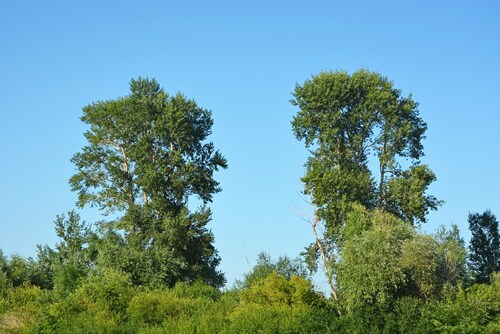
 Poplar trees are a valuable model system for studying changes in biomass. Recently, Szuba et al. published the results of a proteomics workflow for investigating differences in poplars growing on separate plots.1 The team wanted to determine if there were any differences in growth or any evidence of stress when they grew poplars in grassland irrigated for 40 years with wastewater left over from the potato industry.
Szuba et al. planted one-year rooted cuttings with a single stem and of similar height in early March. Within each site (potato-irrigated grassland and normal-conditioned forest), they planted trees using a randomized block design and included five types of poplar trees: Populus alba Villafranca (P. VF), Populus deltoides × maximowiczii Eridano (P. ER), Populus maximowiczii × trichocarpa NE-42 (P. NE), Populus × interamericana Hoogvorst (P. HOO) and Populus × euramericana Robusta (P. ROB). The authors selected two tree species (P. VF and P. ER) for proteomic analysis.
The trees grew for four years, during which the researchers gave no supplementary nutrients or water to the trees. After this time passed, the authors collected specimens from the trees, first collecting leaves from one individual tree. Afterwards, they utilized a “mixed sample” procedure where they collected leaf material from 10 to 15 specimens and then pooled samples, each containing a mix of three to five randomly selected leaves.
To identify any significant changes in protein levels, they extracted proteins from leaves and roots and isoelectrofocused and separated proteins using two-dimensional electrophoresis with coomassie staining. They identified spots of interest in the gel using a maximum analysis of variance (ANOVA) of 0.01 and ratio ≥1.2 prior to analysis with an Orbitrap Velos mass spectrometer (Thermo Scientific) working in the regime of a data-dependent MS to MS/MS. The team also measured tree growth, the mycorrhizae, the chlorophyll concentration, and the amount of soluble carbohydrates and starch.
In the forest, researchers found P. ER and P. VF trees were taller. P. ER saplings showed lower diameter at breast height (DBH) values, while P. VF did not differ in DBH between plots. In the grassland, the team observed losses among P. VF trees as a result of an infestation from the small poplar borer (Saperda populnea L.).Trees grown in grassland also had a decreased mycorrhization frequency.
Looking at the protein content, the majority of proteomes (with the exception of P. ER leaf proteomes) in both environments had increased abundance of stress response proteins connected with plant defense. In P. ER leaf proteomes, the most representative group was carbon fixation, which was mainly a consequence of the high percentage of these proteins in the grassland protein profile. The forest environment also had a large number of proteins connected to protein transport and proteolysis.
The researchers note that many challenges exist in field studies. For example, it can be near impossible to eliminate variables in setting up the experiment. Despite these challenges, the researchers maintain that proteomics is a valuable tool for plant environmental studies.
Reference
1. Szuba A, et al. (2015) “Utilization of proteomics in experimental field conditions – A case study of poplars growing on grassland affected by long-term starch wastewater irrigation,” Journal of Proteomics, 3(126) (pp. 200–17), doi: 10.1016/j.jprot.2015.06.002.

Assessing Ion Interference Using a Triple Knockout Standard Diagnostic Tool
Researchers use isobaric tandem mass tag (TMT) reagents as a...
Read More
Identifying Metal Species with Electrospray Ionization and Tandem Mass Spectrometry
Elemental transition metals iron (Fe), zinc (Zn), nickel (Ni...
Read More
Setting BPA Free: Bisphenol Fragmentation Pathways
Bisphenols are common additives in everyday products like pl...
Read More
Creepy Science: Black Widow Silk
Spiders possess a singular ability to strike irrational fear...
Read More
Leave a Reply