Search


Citations & References (3)
Invitrogen™
1 Kb Plus DNA Ladder
Invitrogen 1 Kb Plus DNA Ladder is designed for sizing and approximate quantification of double-stranded DNA in the range ofRead more
Have Questions?
Change view

| Catalog Number | Quantity |
|---|---|
| 10787018 | 500 Applications |
| 10787026 | 2000 Applications |
Catalog number 10787018
Price (USD)
219.65
Online exclusive
239.00Save 19.35
Each
Quantity:
500 Applications
Price (USD)
219.65
Online exclusive
239.00Save 19.35
Each
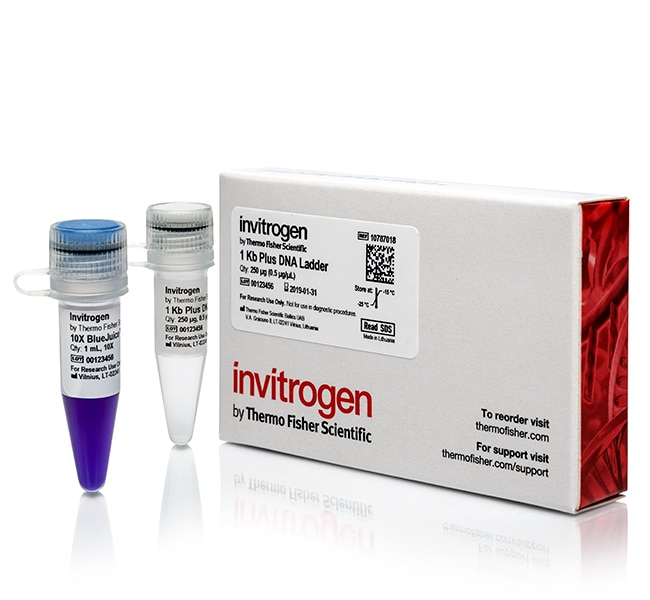
Invitrogen 1 Kb Plus DNA Ladder is designed for sizing and approximate quantification of double-stranded DNA in the range of 100 bp to 15,000 bp. 1 Kb Plus DNA Ladder consists of 18 individual chromatography-purified DNA fragments and has a reference band at 1,500 bp for easy orientation.
1 Kb DNA Ladder is ideal for separation on 0.8–1% agarose gels.
Highlights of 1 Kb Plus DNA Ladder:
• Sharp, clear bands—chromatography purified fragments for consistent and reliable results
• Convenient—provided with 10X BlueJuice Gel Loading Buffer for tracking of sample DNA migration
• Precise—an exact amount of DNA in each band
Product use
The double-stranded DNA ladder can be visualized on 0.8–1% agarose gels after ethidium bromide or SYBR Safe staining. The ladder is designed with a uniform intensity of DNA bands for a clear view of each band. An exact amount of DNA in each band allows approximate quantification of DNA samples.
This ladder can be radiolabeled with T4 polynucleotide kinase or T4 DNA polymerase.
1 Kb DNA Ladder is ideal for separation on 0.8–1% agarose gels.
Highlights of 1 Kb Plus DNA Ladder:
• Sharp, clear bands—chromatography purified fragments for consistent and reliable results
• Convenient—provided with 10X BlueJuice Gel Loading Buffer for tracking of sample DNA migration
• Precise—an exact amount of DNA in each band
Product use
The double-stranded DNA ladder can be visualized on 0.8–1% agarose gels after ethidium bromide or SYBR Safe staining. The ladder is designed with a uniform intensity of DNA bands for a clear view of each band. An exact amount of DNA in each band allows approximate quantification of DNA samples.
This ladder can be radiolabeled with T4 polynucleotide kinase or T4 DNA polymerase.
For Research Use Only. Not for use in diagnostic procedures.
Specifications
Concentration0.5 μg/μL
Gel CompatibilityAgarose gel
Kit Contents500 μL DNA Ladder (250 μg), 1 mL Sample Loading Buffer, 500 Applications
No. of Reactions500 Applications
Quantity500 Applications
Ready to LoadNo
Sample Loading Volume1 mL
Shipping ConditionApproved for shipment at Room Temperature or on Dry Ice
TechnologyIndividual chromatography-purified DNA fragments
Volume (Metric)500 μL
Gel TypeAgarose
Product TypeDNA Ladder
Size Range100 to 15000 bp
Unit SizeEach
Contents & Storage
• 500 µL 1 Kb Plus DNA Ladder
• 1 mL 10X BlueJuice Gel Loading Buffer
Store at -20°C.
• 1 mL 10X BlueJuice Gel Loading Buffer
Store at -20°C.
Frequently asked questions (FAQs)
Can I know the sequences of Invitrogen DNA ladders?
Are Invitrogen DNA ladders composed of linear or circular/supercoiled DNA?
Are Invitrogen DNA ladders composed of single-stranded or double-stranded DNA fragments?
Why are the DNA bands from my molecular weight ladder smearing?
I'm seeing anomalous migration of my DNA ladder. What happened?
Citations & References (3)
Citations & References
Abstract
Efficient intracellular assembly of papillomaviral vectors.
Journal:J Virol
PubMed ID:14694107
Although the papillomavirus structural proteins, L1 and L2, can spontaneously coassemble to form virus-like particles, currently available methods for production of L1/L2 particles capable of transducing reporter plasmids into mammalian cells are technically demanding and relatively low-yield. In this report, we describe a simple 293 cell transfection method for efficient
Activation of protein kinase C beta II by the stereo-specific phosphatidylserine receptor is required for phagocytosis of apoptotic thymocytes by resident murine tissue macrophages.
Journal:J Biol Chem
PubMed ID:12114511
We showed previously that protein kinase C (PKC) is required for phagocytosis of apoptotic leukocytes by murine alveolar (AMø) and peritoneal macrophages (PMø) and that such phagocytosis is markedly lower in AMø compared with PMø. In this study, we examined the roles of individual PKC isoforms in phagocytosis of apoptotic
Bisindolylmaleimide VIII enhances DR5-mediated apoptosis through the MKK4/JNK/p38 kinase and the mitochondrial pathways.
Journal:J Biol Chem
PubMed ID:12034736
Bisindolylmaleimide VIII (Bis VIII) has been previously shown to enhance Fas-mediated apoptosis through a protein kinase C-independent mechanism. In the present study, we examined the effect of Bis VIII on apoptosis induced by DR5 (TRAIL-R2), using an agonistic anti-human DR5 monoclonal antibody, TRA-8. Our results demonstrated that Bis VIII was