Search




Thermo Scientific™
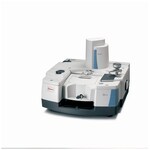
Nicolet™ iS50 FTIR Spectrometer
Featuring purpose-built accessories and integrated software to easily solve analytical issues, the Thermo Scientific™ Nicolet™ iS50 is an all-in-one materials analysis system.
| Catalog Number | Performance Verification | Spectral Range |
|---|---|---|
| 912A0760 | ASTM E1421 to meet customer ISO/GLP requirements | 15 to 27,000 cm-1 |
Catalog number 912A0760
Price (MXN)
-
Performance Verification:
ASTM E1421 to meet customer ISO/GLP requirements
Spectral Range:
15 to 27,000 cm-1
Solve analytical challenges with ease using the Thermo Scientific™ Nicolet™ iS50 FTIR Spectrometer, featuring purpose-built accessories and integrated software — making it an all-in-one materials analysis workstation.
Designed to be highly flexible, the Nicolet iS50 FTIR Spectrometer can be upgraded from a simple FTIR bench to a fully-automated multi-spectral range system that can acquire spectra from far-infrared to visible. You can initiate novel ATR, Raman and NIR modules at the touch of a button, enabling access to these techniques without manually changing system components.
For more information on how users can address applications like pharma, forensics, polymers and material science with the Nicolet iS50 Spectrometer, click here.
The Nicolet iS50 FTIR Spectrometer gives you definitive answers when fast, easy workflows in your analytical laboratory are crucial.
Nicolet iS50 FTIR Spectrometer Features:
- Dual Source capable
- The Polaris™ long-life IR source
- Tungsten-Halogen white light source
- Three detectors for the main sample compartment
- High-resolution standard
- Validation wheel standard
- All gold optics standard (aluminum available)
- Full support for existing accessories
- Energy screens for high-res motorized (standard)
- Optional purge shutters
- Optional motorized filters
- Optional motorized polarizer
- Collimated or focused emission port
Offerings you have come to know, like Smart Accessories, are augmented by the following optional modules:
- Built-in mid- and far-IR capable diamond ATR
- Automated Beamsplitter Exchanger (ABX)
- Sample compartment Raman accessory
- NIR module with Integrating Sphere and Fiber Optic connections
- TGA-IR accessory
- GC-IR module
Find more information by visiting the technical library and viewing the spec sheet and brochure.
- Footprint - Base Only: 25 x 27 x 11in. (62.6 x 69.8 x 27.6cm)
- Weight - Base Only: 132 lb. (60kg)
- Footprint - Including ABX: 25 x 27 x 20in. (62.6 x 69.8 x 50.8cm)
- Weight - Base Only: Including ABX: 141 lb. (64kg)
- No footprint added for Raman and dedicated ATR
- Only 11in. (27.9cm) more with Nicolet iS50 NIR Module
Recommended for:
- Polymers and Rubbers
- Forensics
- Pharmaceuticals
- Pigments/Paints/Inks
- Food/Flavors/Oils
- General Laboratories
Cloud-enabled FTIR spectroscopy
All Nicolet FTIR spectrometers now allow you to store, share and interpret spectral data anytime, anywhere and on any device. Researchers, lab technicians, educators and their students can all use their Thermo Fisher Connect account, powered by the Thermo Fisher Cloud, to gain easy access to their data with the OMNIC Anywhere App.
- Export, view and share data – view your Nicolet .spa spectral files, label spectral peaks, and correct spectral baseline all in the OMNIC Anywhere App on your PC, Apple computer, Android or iOS device
- Add more storage space – start with 10 GB of storage for free, and then scale up storage as needed for a nominal fee. You can store OMNIC .spa files as well as other files (e.g., report documents, .xls, etc.) to your Thermo Fisher Connect account
- Secure your data – Thermo Fisher Connect uses Amazon Web Service™, the industry-leading security and data protection cloud-computing platform – so no lost or stolen data
Specifications
Beam SplitterAutomated Beamsplitter Exchanger (ABX)
ComponentsSources; Detectors; Beamsplitters
Depth (English)27 in.
Depth (Metric)69.8 cm
DescriptionFeaturing purpose-built accessories and integrated software to easily solve analytical issues, the Nicolet iS50 is an all-in-one materials analysis system.
Detector TypeUp to 9 user-selectable detectors
Electrical Requirements100/240 V, 50/60 Hz
For Use With (Application)Polymers and Rubbers; Forensics; Pharmaceuticals;
For Use With (Equipment)SMART Accessories, TGA-IR, Continuum Microscope, Photoacoustic, Most standard accessories; Gas Cells; GC-IR; FT-Raman; ABX; NIR; Built-in ATR
Height (English)11 in.
Height (Metric)27.6 cm
HumidityTightly sealed to resist ambient humidity.
InterfacePC USB 2.0
LaserHeNe
Product TypeNicolet iS50 Analytical FTIR Spectrometer and Software
Source TypeDual Source capable: Polaris™ long-life IR source
Spectral Range15 to 27,000 cm-1
Spectral ResolutionBetter than 0.09cm1
Weight (English)132 lb.
Weight (Metric)60 kg
Width (English)25 in.
Width (Metric)62.6 cm
Performance VerificationASTM E1421 to meet customer ISO/GLP requirements
Voltage100/240 V
Unit SizeEach