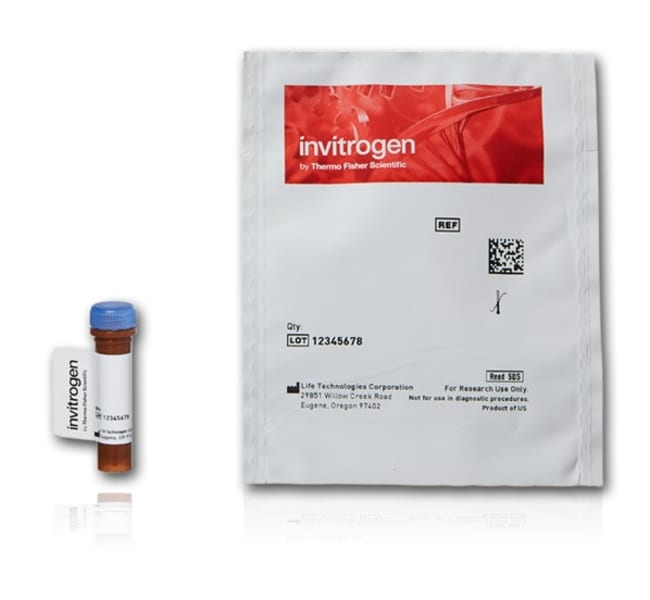
Azida Alexa Fluor™ 647, sal de trietilamonio
Invitrogen™

Azida Alexa Fluor™ 647, sal de trietilamonio

La azida Alexa Fluor® 647 fluorescente de color rojo lejano reacciona con alquenos terminales mediante una reacción clic catalizada conMás información
Have Questions?
Número de catálogoCantidad
A102770,5 mg
Número de catálogo A10277
Precio (MXN)
-
Cantidad:
0,5 mg
La azida Alexa Fluor® 647 fluorescente de color rojo lejano reacciona con alquenos terminales mediante una reacción clic catalizada con cobre. El fluoróforo brillante y fotoestable puede usarse con citometría de flujo, microscopía y HCS
Para uso exclusivo en investigación. No apto para uso en procedimientos diagnósticos.
Especificaciones
Reactividad químicaAlquino
Método de detecciónFluorescente
Emisión665
Excitación650
FormatoSólido
Etiqueta o tinteAlexa Fluor™ 647
Peso molecular∼850 g/mol
Tipo de productoAzida
Cantidad0,5 mg
Fracción reactivaAmina, azida
Condiciones de envíoTemperatura ambiente
SolubilidadDMF (dimetilformamida), DMSO (dimetilsulfóxido)
Tipo de sistemaClick-iT™
ColorRojo lejano
Tipo de etiquetaColorantes Alexa Fluor
Línea de productosAlexa Fluor, Molecular Probes
Unit SizeEach
Contenido y almacenamiento
Almacénese a ≤-20 °C, desecado y protegido de la luz.

Preguntas frecuentes

I have run out of the Alexa Fluor 647 Azide from the Click-iT EdU Cell Proliferation Kit for Imaging, Alexa Fluor 647 dye (Cat. No. C10340). Is it possible to purchase it separately? How would I combine the standalone reagent with the kit?

Yes. You can purchase Alexa Fluor 647 Azide, Triethylammonium Salt (Cat. No. A10277). Unfortunately, the actual concentration of the azide dyes used in the Click-iT assay kits is proprietary. However, we recommend making up a 1-10 mM azide stock solution in high-quality anhydrous DMSO and using it at approximately 1-5 µM final concentration in the click reaction. You will need to work out a dye concentration empirically. Too high of a dye concentration can result in high non-specific background or dye aggregates, whereas too low of a concentration may not give a strong enough signal.

Find additional tips, troubleshooting help, and resources within our Cell Viability, Proliferation, Cryopreservation, and Apoptosis Support Center.

I am observing no signal or very low specific signal for my click-labeled samples. What can I do to improve the signal?

The click reaction is only effective when copper is in the appropriate valency. Azides and alkynes will not react with each other without copper. Make sure that the click reaction mixture is used immediately after preparation when the copper (II) concentration is at its highest.
Do not use additive buffer that has turned yellow; it must be colorless to be active.
Cells need to be adequately fixed and permeabilized for the TdT enzyme and click reagents to have access to the nucleus. Tissue samples require digestion with proteinase K or other proteolytic enzymes for sufficient TdT access.
Some reagents can bind copper and reduce its effective concentration available to catalyze the click reaction. Do not include any metal chelator (e.g., EDTA, EGTA, citrate, etc.) in any buffer or reagent prior to the click reaction. Avoid buffers or reagents that include other metal ions that may be o xidized or reduced. It may be help to include extra wash steps on the cell or tissue sample before performing the click reaction.
You can repeat the click reaction with fresh reagents to try to improve signal. Increasing the click reaction time longer than 30 minutes will not improve a low signal. Performing a second, 30 minute incubation with fresh click reaction reagents is more effective at improving labeling.
Your cells may not be apoptotic. Prepare a DNase I-treated positive control to verify that the TdT enzymatic reaction and click labeling reaction are working correctly.

Find additional tips, troubleshooting help, and resources within our Labeling Chemistry Support Center.

I am observing high non-specific background when I image my Click-iT EdU TUNEL-labeled samples. What is causing this and what can I do to reduce the background?

The click reaction is very selective between an azide and alkyne. No other side reactions are possible in a biological system. Any non-specific background is due to non-covalent binding of the dye to various cellular components. The Select FX Signal Enhancer is not effective at reducing non-specific charge-based binding of dyes following the click reaction; we do not recommend its use with the Click-iT detection reagents. The best method to reduce background is to increase the number of BSA washes. You should always do a no-dye or no-click reaction control under the same processing and detection conditions to verify that the background is actually due to the dye and not autofluorescence. You should also perform the complete click reaction on a no-TdT enzyme control sample to verify the specificity of the click reaction signal.

Find additional tips, troubleshooting help, and resources within our Cell Analysis Support Center.

I notice that when I post-stain my cells with DAPI after performing the click reaction to detect EdU incorporation, my DAPI signal is lower compared to my no-click reaction control samples. What causes the reduction in DAPI signal?

The copper in the click reaction denatures DNA to a small extent (although not as much as is required for efficient BrdU detection), which can affect the binding affinity of DNA dyes including DAPI and Hoechst stain. This effect should only be apparent with the classic EdU kits and not the Click-iT Plus EdU kits, which use a lower copper concentration.

Find additional tips, troubleshooting help, and resources within our Cell Viability, Proliferation, Cryopreservation, and Apoptosis Support Center.

I am observing no signal or very low signal for my click-labeled samples. What can I do to improve the signal?

The click reaction is only effective when copper is in the appropriate valency. Except for the DIBO alkyne-azide reaction, azides and alkynes will not react with each other without copper. Make sure that the click reaction mixture is used immediately after preparation when the copper (II) concentration is at its highest.
Do not use additive buffer that has turned yellow; it must be colorless to be active.
Cells need to be adequately fixed and permeabilized for the click reagents to have access to intracellular components that have incorporated the click substrate(s).
Some reagents can bind copper and reduce its effective concentration available to catalyze the click reaction. Do not include any metal chelator (e.g., EDTA, EGTA, citrate, etc.) in any buffer or reagent prior to the click reaction. Avoid buffers or reagents that include other metal ions that may be oxidized or reduced. It may be help to include extra wash steps on the cell or tissue sample before performing the click reaction.
You can repeat the click reaction with fresh reagents to try to improve signal. Increasing the click reaction time longer than 30 minutes will not improve a low signal. Performing a second, 30 minute incubation with fresh click reaction reagents is more effective at improving labeling.
Low signal can also be due to low incorporation of EdU, EU, or other click substrates. Other click substrates (e.g., AHA, HPG, palmitic acid, azide, etc.) incorporated into cellular components may have been lost if not adequately cross-linked in place or if the wrong fixative was used. For click substrates that are incorporated into the membrane or lipids, you should avoid the use of alcohol or acetone fixatives and permeabilizing agents.
The incorporated click substrate must be accessible at the time of the click reaction; labeling of incorporated amino acid analogs may be lower in native proteins relative to denatured proteins.
You may need to optimize the metabolic labeling conditions including analog incubation time or concentration. Cells that are healthy, not too high of a passage number and not too crowded may incorporate the analog better. You may create a positive control by including extra doses of the click substrate during multiple time points during an incubation time that spans or closely spans the doubling time of the cell type of interest.

Find additional tips, troubleshooting help, and resources within our Cell Analysis Support Center.

Citations & References (9)

Citations & References
Abstract
Toscana virus NSs protein promotes degradation of double-stranded RNA-dependent protein kinase.
Authors:Kalveram B, Ikegami T,
Journal:J Virol
PubMed ID:23325696
'Toscana virus (TOSV), which is transmitted by Phlebotomus spp. sandflies, is a major etiologic agent of aseptic meningitis and encephalitis in the Mediterranean. Like other members of the genus Phlebovirus of the family Bunyaviridae, TOSV encodes a nonstructural protein (NSs) in its small RNA segment. Although the NSs of Rift ... More
APC/C-CCS52A complexes control meristem maintenance in the Arabidopsis root.
Authors:Vanstraelen M, Baloban M, Da Ines O, Cultrone A, Lammens T, Boudolf V, Brown SC, De Veylder L, Mergaert P, Kondorosi E,
Journal:Proc Natl Acad Sci U S A
PubMed ID:19553203
'Plant organs originate from meristems where stem cells are maintained to produce continuously daughter cells that are the source of different cell types. The cell cycle switch gene CCS52A, a substrate specific activator of the anaphase promoting complex/cyclosome (APC/C), controls the mitotic arrest and the transition of mitotic cycles to ... More
DNA replication occurs in all lamina positive micronuclei, but never in lamina negative micronuclei.
Authors:Okamoto A, Utani K, Shimizu N,
Journal:Mutagenesis
PubMed ID:22086909
A micronucleus is a small nucleus-like structure found in the cytoplasm of dividing cells that suffered from genotoxic stress. It is generally hypothesised that micronuclei content is eventually lost from cells, though the mechanism of how this occurs is unknown. If DNA located within the micronucleus is not replicated, it ... More
NSs protein of rift valley fever virus promotes posttranslational downregulation of the TFIIH subunit p62.
Authors:Kalveram B, Lihoradova O, Ikegami T,
Journal:J Virol
PubMed ID:21543505
Rift Valley fever virus (RVFV; family Bunyaviridae, genus Phlebovirus) is an important emerging pathogen of humans and ruminants. Its NSs protein has previously been identified as a major virulence factor that suppresses host defense through three distinct mechanisms: it directly inhibits beta interferon (IFN-ß) promoter activity, it promotes the degradation ... More
CD4 and CD8 T cell immune activation during chronic HIV infection: roles of homeostasis, HIV, type I IFN, and IL-7.
Authors:Catalfamo M, Wilhelm C, Tcheung L, Proschan M, Friesen T, Park JH, Adelsberger J, Baseler M, Maldarelli F, Davey R, Roby G, Rehm C, Lane C,
Journal:J Immunol
PubMed ID:21257970
Immune activation plays an important role in the pathogenesis of HIV disease. Although the causes are not fully understood, the forces that lead to immune dysfunction differ for CD4 and CD8 T cells. In this study, we report that the molecular pathways that drive immune activation during chronic HIV infection ... More