Search
 元素の検索
 構造の検索



Thermo Scientific Chemicals
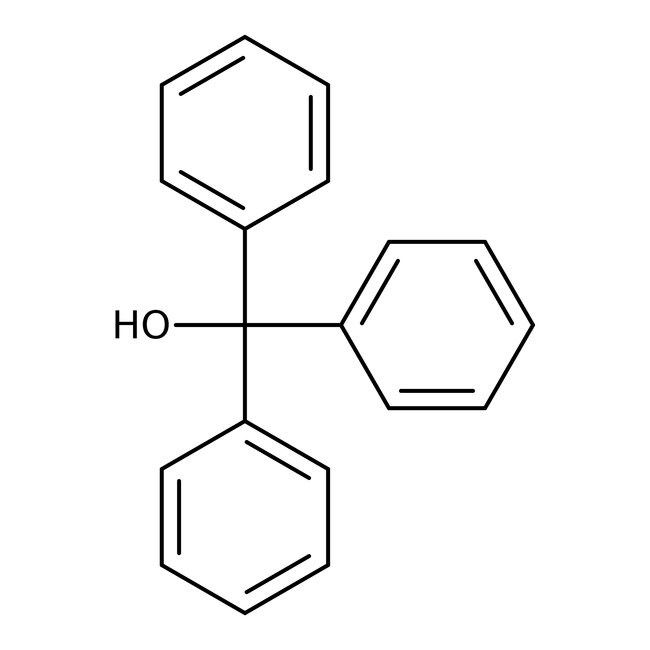
Triphenylmethanol, 98%
CAS: 76-84-6 | C19H16O | 260.34 g/mol



化学物質識別子
CAS76-84-6
IUPAC Nametriphenylmethanol
Molecular FormulaC19H16O
InChI KeyLZTRCELOJRDYMQ-UHFFFAOYSA-N
SMILESOC(C1=CC=CC=C1)(C1=CC=CC=C1)C1=CC=CC=C1
さらに表示
仕様 スペックシート
Appearance (Color)White to pale cream or pale yellow
FormCrystalline powder or powder
Assay (GC)≥97.5%
Identification (FTIR)Conforms
Melting Point (clear melt)160-165°C
さらに表示
Triphenylmethanol is used as a reagent in the research laboratory. It acts as an intermediate in the production of the commercially useful triarylmethane dyes. It is used in the preparation of triphenylmethane. It is also used as an antiproliferative agent. Further, it is used in the preparation of two-electron reduction product of pyrylogen. In addition to this, it reacts with triphenylphosphine oxide to form a 1:1 molecular complex. It serves as a specific clathrate host for methanol and dimethyl sulphoxide and forms clathrate inclusion complexes.
This Thermo Scientific Chemicals brand product was originally part of the Alfa Aesar product portfolio. Some documentation and label information may refer to the legacy brand. The original Alfa Aesar product / item code or SKU reference has not changed as a part of the brand transition to Thermo Scientific Chemicals.
Applications
Triphenylmethanol is used as a reagent in the research laboratory. It acts as an intermediate in the production of the commercially useful triarylmethane dyes. It is used in the preparation of triphenylmethane. It is also used as an antiproliferative agent. Further, it is used in the preparation of two-electron reduction product of pyrylogen. In addition to this, it reacts with triphenylphosphine oxide to form a 1:1 molecular complex. It serves as a specific clathrate host for methanol and dimethyl sulphoxide and forms clathrate inclusion complexes.
Solubility
Soluble in dioxane, ethanol, water, ether and benzene.
Notes
Incompatible with acids, acid chlorides, acid anhydrides and oxidizing agents.
RUO – Research Use Only
General References:
- Protection of thiols, such as cysteine residues in peptide synthesis, as their S-trityl derivatives can be accomplished in high yield in TFA. Cleavage can be effected with HBr in AcOH: J. Chem. Soc. (C), 2683 (1970), with Hg(II) salts, or by oxidation to the disulfide with I2 in MeOH: Helv. Chim. Acta, 51, 2061 (1968). See also Appendix 6.
- Konshin, V.; Turmasova, A.; Konshina, D. Lewis Acid Catalyzed Reaction of Triphenylmethanol with Acetylacetone. Lett. Org. Chem. 2015, 12 (7), 511-515.
- Drożdż, W.; Kołodziejski, M.; Markiewicz, G.; Jenczak, A.; Stefankiewicz, A. R. Generation of a Multicomponent Library of Disulfide Donor-Acceptor Architectures Using Dynamic Combinatorial Chemistry. Int. J. Mol. Sci. 2015, 16 (7), 16300-16312.