Search
 元素の検索
元素の検索 構造の検索
構造の検索


Thermo Scientific Chemicals
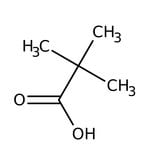
Trimethylacetic acid, 99%
CAS: 75-98-9 | C5H10O2 | 102.133 g/mol



化学物質識別子
CAS75-98-9
IUPAC Name2,2-dimethylpropanoic acid
Molecular FormulaC5H10O2
InChI KeyIUGYQRQAERSCNH-UHFFFAOYSA-N
SMILESCC(C)(C)C(O)=O
さらに表示
仕様 スペックシート
スペックシートAssay (GC)≥98.5%
Identification (FTIR)Conforms
FormCrystals or powder or crystalline powder or fused solid
Appearance (Color)White to pale cream
Trimethylacetic acid can be used as an internal chemical-shift standard for NMR of aqueous solutions. It is a metabolite of oral cephem (β-lactam) antibiotics such as S-1108, containing pivaloyl moieties.
This Thermo Scientific Chemicals brand product was originally part of the Alfa Aesar product portfolio. Some documentation and label information may refer to the legacy brand. The original Alfa Aesar product / item code or SKU reference has not changed as a part of the brand transition to Thermo Scientific Chemicals.
Applications
Trimethylacetic acid can be used as an internal chemical-shift standard for NMR of aqueous solutions. It is a metabolite of oral cephem (β-lactam) antibiotics such as S-1108, containing pivaloyl moieties.
Solubility
Soluble in alcohol, ether. Slightly soluble in water
Notes
Stable under recommended storage conditions. Incompatible with oxidizing agents and bases.
Trimethylacetic acid can be used as an internal chemical-shift standard for NMR of aqueous solutions. It is a metabolite of oral cephem (β-lactam) antibiotics such as S-1108, containing pivaloyl moieties.
Solubility
Soluble in alcohol, ether. Slightly soluble in water
Notes
Stable under recommended storage conditions. Incompatible with oxidizing agents and bases.
RUO – Research Use Only
General References:
- S.Albert; H.S.Gutowsky; J.A.Ripmeester. NMR investigations of solid (CH3)3CCOOH (trimethylacetic acid) and (CH3)3CCOOD. J. Chem. Phys. 1976, 64, (8),3277
- Alfred L.Miller; Newell C.Cook; Frank C.Whitmore. The Ketonic Decarboxylation Reaction1: The Ketonic Decarboxylation of Trimethylacetic Acid2 and Isobutyric Acid. J. Am. Chem. Soc. 1950, 72, (6),2732-2735
- In the presence of an Ag(II) species (from silver nitrate and ammonium persulfate in TFA), tert-butyl radicals are generated. With quinoline, the 2-tert-butyl substituted derivative is formed in high yield: Tetrahedron, 46, 2525 (1990), whereas for most other carboxylic acids, both 2- and 4-substitution usually occur.