Search
 元素の検索
元素の検索 構造の検索
構造の検索




化学物質識別子
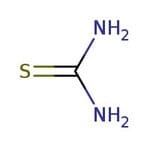
CAS62-56-6
IUPAC Namethiourea
Molecular FormulaCH4N2S
InChI KeyUMGDCJDMYOKAJW-UHFFFAOYSA-N
SMILESNC(N)=S
さらに表示
仕様 スペックシート
スペックシートAppearance (Color)White
FormCrystals or crystalline powder
Assay(by Sulfur EA) : ≥ 98.5 to ≤ 101.5% (dry weight basis)
Assay (unspecified)(by Sulfur EA) : ≥ 98.5 to ≤ 101.5% (dry weight basis)
Elemental AnalysisCarbon content 15.48-16.08% (dry weight basis)
さらに表示
Reagent for organic synthesisUsed as a reagent for organic synthesis. Thiourea is a photographic fixative, and used in manufacture of resins. It acts as a catalyst for asymmetric reactions. It plays an essential role as a catalyst for highly enantio- and diastereoselective additions reaction of oxindoles to nitroolefins. It is also useful to improve the productivity of mung bean.
This Thermo Scientific Chemicals brand product was originally part of the Alfa Aesar product portfolio. Some documentation and label information may refer to the legacy brand. The original Alfa Aesar product / item code or SKU reference has not changed as a part of the brand transition to Thermo Scientific Chemicals.
Applications
Reagent for organic synthesisUsed as a reagent for organic synthesis. Thiourea is a photographic fixative, and used in manufacture of resins. It acts as a catalyst for asymmetric reactions. It plays an essential role as a catalyst for highly enantio- and diastereoselective additions reaction of oxindoles to nitroolefins. It is also useful to improve the productivity of mung bean.
Solubility
Soluble in water.
Notes
Stable. Incompatible with strong acids. Store in cool place. Keep container tightly closed in a dry and well-ventilated place. Handle and store under inert gas.
Reagent for organic synthesisUsed as a reagent for organic synthesis. Thiourea is a photographic fixative, and used in manufacture of resins. It acts as a catalyst for asymmetric reactions. It plays an essential role as a catalyst for highly enantio- and diastereoselective additions reaction of oxindoles to nitroolefins. It is also useful to improve the productivity of mung bean.
Solubility
Soluble in water.
Notes
Stable. Incompatible with strong acids. Store in cool place. Keep container tightly closed in a dry and well-ventilated place. Handle and store under inert gas.
RUO – Research Use Only
General References:
- Reagent for the conversion of alkyl halides to thiols by base hydrolysis of the isothiouronium salts; see also N-Acetyl thiourea, B21198. Cleavage of isothiouronium salts with base and alkylation of the resulting thiolate has been used as a convenient synthesis of unsymmetrical sulfides: Synth. Commun., 14, 209 (1984).
- Epoxides are converted to episulfides: J. Org. Chem., 26, 3467 (1961). The 2,3-epoxy alcohols resulting from the Sharpless enantioselective epoxidation can be converted to the corresponding episulfides with retention at both centers, using Ti(O-i-Pr)4 as mediator: J. Org. Chem., 53, 4114 (1988).
- Widely used in heterocyclic syntheses, e.g. of thiazoles and pyrimidines.
- Has been used in a convenient synthesis of isothiocyanates from oximes via the nitrile oxide: Tetrahedron Lett., 34, 8283 (1993); see also Benzaldoxime, A12053:
- Bui, T.; Syed, S.; Barbas, C. F. Thiourea-Catalyzed Highly Enantio- and Diastereoselective Additions of Oxindoles to Nitroolefins: Application to the Formal Synthesis of (+) -Physostigmine. J. Am. Chem. Soc. 2009, 131 (25), 8758-8759.
- Takemoto, Y. Development of Chiral Thiourea Catalysts and Its Application to Asymmetric Catalytic Reactions. Chem. Pharm. Bull. 2010, 58 (5), 593-601.