Search
 元素の検索
元素の検索 構造の検索
構造の検索


Thermo Scientific Chemicals
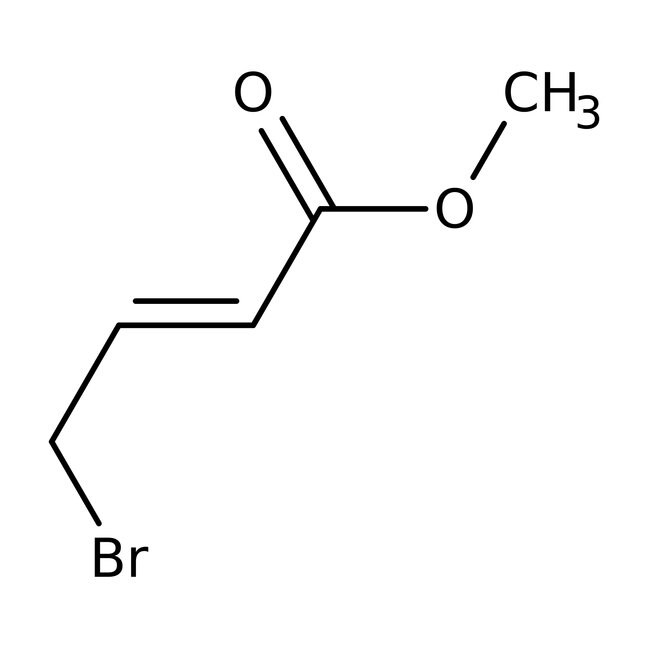
Methyl 4-bromocrotonate, tech. 85%
CAS: 1117-71-1 | C5H7BrO2 | 179.01 g/mol



化学物質識別子
CAS1117-71-1
IUPAC Namemethyl (2E)-4-bromobut-2-enoate
Molecular FormulaC5H7BrO2
InChI KeyRWIKCBHOVNDESJ-NSCUHMNNSA-N
SMILESCOC(=O)\C=C\CBr
さらに表示
仕様 スペックシート
スペックシートAssay (GC)>83.0%
Appearance (Color)Clear colorless to yellow
Refractive Index1.4970-1.5050 @ 20?C
FormLiquid
It is a useful synthetic intermediate. It was used in the synthesis of irreversible inhibitors of EGFR and HER-2 tyrosine kinases with enhanced antitumor activities.
This Thermo Scientific Chemicals brand product was originally part of the Alfa Aesar product portfolio. Some documentation and label information may refer to the legacy brand. The original Alfa Aesar product / item code or SKU reference has not changed as a part of the brand transition to Thermo Scientific Chemicals.
Applications
It is a useful synthetic intermediate. It was used in the synthesis of irreversible inhibitors of EGFR and HER-2 tyrosine kinases with enhanced antitumor activities.
Solubility
Slightly soluble in water.
Notes
Store away from oxidizing agents. Keep the container tightly closed and place it in a cool, dry and well ventilated condition.
It is a useful synthetic intermediate. It was used in the synthesis of irreversible inhibitors of EGFR and HER-2 tyrosine kinases with enhanced antitumor activities.
Solubility
Slightly soluble in water.
Notes
Store away from oxidizing agents. Keep the container tightly closed and place it in a cool, dry and well ventilated condition.
RUO – Research Use Only
General References:
- Pirote Prempree, et al. Reaction of methyl 4-bromocrotonate with lithium ester enolates: direct SN2 displacement vs. Michael-initiated ring closure.J. Org. Chem.,1983,48(20), 3553-3556.
- Gary A. Koppel. γ-Alkylation of methyl 4-bromocrotonate, a vinylogous darzens reaction.Tetrahedron Lett.,1972,13(15), 1507-1509.
- Undergoes a vinylogous Reformatsky reaction with carbonyl compounds, to give δ-hydroxy-ɑß-unsaturated esters: Liebigs Ann. Chem., 709, 29 (1967). Use of a Zn-Ag couple allows Reformatsky coupling to be carried out with or without allylic rearrangement depending on whether ether or THF is used as the solvent: Synth. Commun., 19, 2355 (1989). For a review of the Reformatsky synthesis, see: Synthesis, 571 (1989).