Search


인용 및 참조 문헌 (3)
Thermo Scientific™
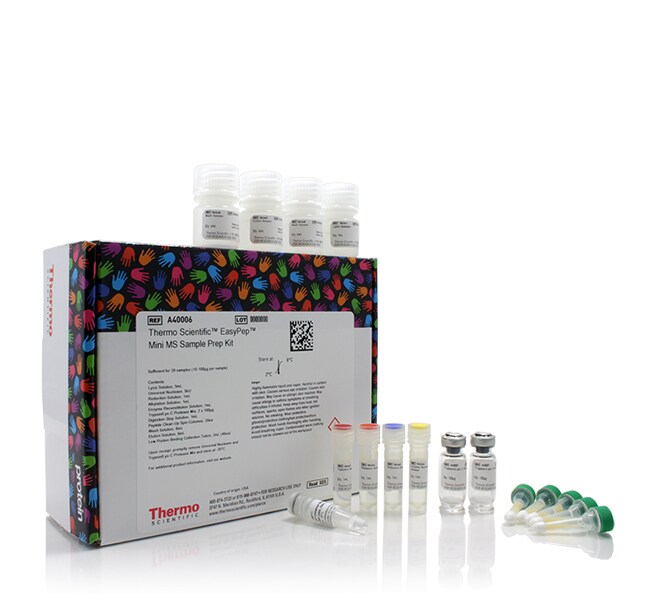
EasyPep™ MS Sample Prep Kits
Generate high quality proteomic samples for MS analysis in less than four hours using optimized EasyPep MS Sample Prep kits.
Have Questions?
보기 방식 변경

| 카탈로그 번호 | 설명 |
|---|---|
| A40006 | Mini MS Sample Prep Kit |
| A57864 | Micro MS Sample Prep Kit |
| A45733 | MS Sample Prep Kit |
| A45734 | Maxi Sample Prep Kit |
| A45735 | Lysis Buffer |
| A57865 | Peptide Clean-up Plate |
카탈로그 번호 A40006
제품 가격(KRW)
947,000
온라인 행사
Ends: 31-Dec-2026
1,052,000할인액 105,000 (10%)
Each
설명:
Mini MS Sample Prep Kit
제품 가격(KRW)
947,000
온라인 행사
Ends: 31-Dec-2026
1,052,000할인액 105,000 (10%)
Each
EasyPep Mini MS Sample Prep Kits enable efficient and reproducible processing of cultured mammalian cells and tissues for proteomic MS analysis. The kit contains pre-formulated buffers, MS-grade enzyme mix, peptide clean-up columns, and an optimized protocol to generate MS-compatible peptide samples in less than three hours. Kits are optimized to process protein samples from 10–100 μg with a high yield of MS-ready peptides.
• Complete—includes pre-formulated reagents for lysis through digestion, peptide clean-up columns, and an optimized protocol for up to 20 samples
• Optimized—streamlined protocol and reagents minimize the number of steps and time time needed to process samples
• Flexible—reagents and protocol have been verified using cells, plasma, and tissue samples for 10 to 100 μg samples
• Time-saving—sample processing time reduced from more than one day to less than three hours
• Compatible—final preparation is ready for direct MS analysis and other downstream applications, including TMT labeling
The sample preparation of peptides for MS analysis is complex, with numerous steps and varied protocols, resulting in sample variability in both quality and quantity. This kit has been designed to improve reproducibility while saving hands-on and processing time. The number of steps and processing time have been reduced through the addition of Universal Nuclease to reduce viscosity from nucleic acids (replacing sonication), a rapid 'one pot' reduction/alkylation solution for cysteine modification (carbamidomethylation, + 57.02), and a trypsin/Lys-C protease mix for more complete digestion. In addition, the kit includes Peptide Clean-up columns and buffers to prepare detergent-free peptide samples for MS analysis. The optimized reagents and protocol produce high-quality peptides that are compatible with TMT labeling and other downstream applications, or are ready for MS analysis.
• Optimized—streamlined protocol and reagents minimize the number of steps and time time needed to process samples
• Flexible—reagents and protocol have been verified using cells, plasma, and tissue samples for 10 to 100 μg samples
• Time-saving—sample processing time reduced from more than one day to less than three hours
• Compatible—final preparation is ready for direct MS analysis and other downstream applications, including TMT labeling
The sample preparation of peptides for MS analysis is complex, with numerous steps and varied protocols, resulting in sample variability in both quality and quantity. This kit has been designed to improve reproducibility while saving hands-on and processing time. The number of steps and processing time have been reduced through the addition of Universal Nuclease to reduce viscosity from nucleic acids (replacing sonication), a rapid 'one pot' reduction/alkylation solution for cysteine modification (carbamidomethylation, + 57.02), and a trypsin/Lys-C protease mix for more complete digestion. In addition, the kit includes Peptide Clean-up columns and buffers to prepare detergent-free peptide samples for MS analysis. The optimized reagents and protocol produce high-quality peptides that are compatible with TMT labeling and other downstream applications, or are ready for MS analysis.
For Research Use Only. Not for use in diagnostic procedures.
사양
설명Mini MS Sample Prep Kit
최종 제품 유형Peptides
용도(장비)Mass Spectrometer
수량20 Reactions
배송 조건Wet Ice
워크플로우 단계Cell Lysis
검출 방법Mass Spectrometry
제품라인EasyPep
제품 유형Sample Preparation Kit
시작 물질Protein Samples
Unit SizeEach
자주 묻는 질문(FAQ)
Are the EasyPep MS Sample Prep Kits compatible with vacuum pumps/dry-down devices?
What is the composition of the Lysis Solution in the EasyPep MS Sample Prep Kits (Cat. Nos. A4006, A45733, A5734, A45735)?
Can I prepare my samples in Laemmli sample buffer for use with EasyPep MS Sample Prep Kits (Cat. Nos. A40006, A45733, A45734)?
After cell lysis, my mass spectrometry sample is very viscous and difficult to pipette. How do I reduce the sample viscosity?
How do I process yeast samples with EasyPep Mini MS Sample prep Kit?
인용 및 참조 문헌 (3)
인용 및 참조 문헌
Abstract
Proteomic and N-glycomic comparison of synthetic and bovine whey proteins and their effect on human gut microbiomes.
Journal:bioRxiv : the preprint server for biology
PubMed ID:39345577
Advances in food production systems and customer acceptance have led to the commercial launch of dietary proteins produced via modern biotechnological approaches as alternatives to traditional agricultural sources. At the same time, a deeper understanding of how dietary components interact with the gut microbiome has highlighted the importance of understanding
Optimized Workflow for Proteomics and Phosphoproteomics With Limited Tissue Samples.
Journal:Current protocols
PubMed ID:38646944
Proteomics and phosphoproteomics play crucial roles in elucidating the dynamics of post-transcriptional processes. While experimental methods and workflows have been established in this field, a persistent challenge arises when dealing with small samples containing a limited amount of protein. This limitation can significantly impact the recovery of peptides and phosphopeptides.
Journal:J Proteome Res
PubMed ID:36006919
Robust, efficient, and reproducible protein extraction and sample processing is a key step for bottom-up proteomics analyses. While many sample preparation protocols for mass spectrometry have been described, selecting an appropriate method remains challenging since some protein classes may require specialized solubilization, precipitation, and digestion procedures. Here, we present a