Search
 元素の検索
 構造の検索

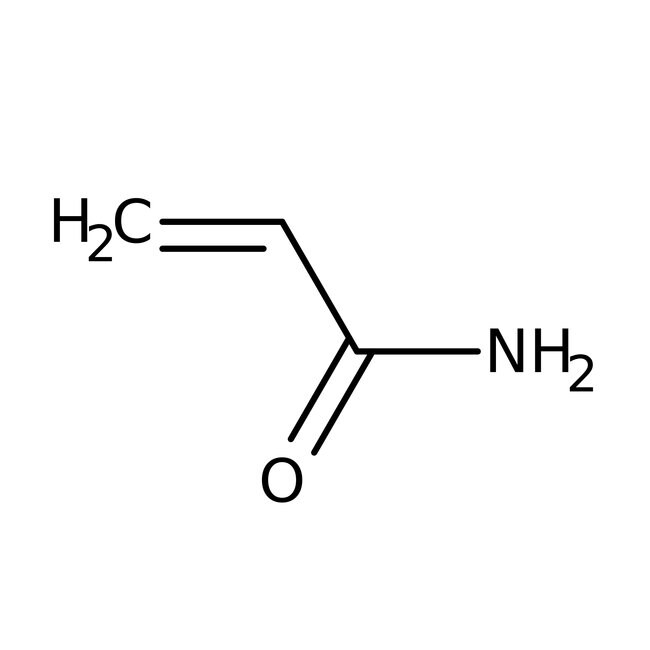


Acrylamide, electrophoresis grade, 99+%, Thermo Scientific Chemicals
Acrylamide / N,N'-Methylenebisacrylamide, CAS # 79-06-1, 7732-18-5, 110-26-9, 79-06-1, is a water soluble compound that cross-links to produce polyacrylamide gels that are widely used in chromatography and the electrophoretic separation of nucleic acids and proteins. | CAS: 79-06-1 | C3H5NO | 71.08 g/mol



化学物質識別子
CAS79-06-1
IUPAC Nameprop-2-enamide
Molecular FormulaC3H5NO
InChI KeyHRPVXLWXLXDGHG-UHFFFAOYSA-N
SMILESNC(=O)C=C
さらに表示
 スペックシート
Acrylamide is used as a monomer in the synthesis of polyacrylamides, which finds application as water-soluble thickeners in waste water treatment, gel electrophoresis, ore processing and dyes production. In molecular biology, it is used as a carrier as well as involved in the precipitation of small amounts of DNA. It plays an important role as an intermediate in the preparation of N-methylol acrylamide and N-butoxyacrylamide.
This Thermo Scientific Chemicals brand product was originally part of the Alfa Aesar product portfolio. Some documentation and label information may refer to the legacy brand. The original Alfa Aesar product / item code or SKU reference has not changed as a part of the brand transition to Thermo Scientific Chemicals.
General Description
- Acrylamide / N,N'-Methylenebisacrylamide is a water-soluble, odorless, white crystalline powder
- This compound polymerizes in the presence of free radicals to generate gels whose pore-size may be regulated by manipulating the relative concentrations of this mixture of compounds
Applications
- Polyacrylamide gels are widely used in biochemistry, forensic chemistry, genetics, molecular biology, and biotechnology to separate proteins or nucleic acids, according to their electrophoretic mobility
- Because of their higher resolution compared to other gels, polyacrylamide gels are also used in the analysis of smaller RNA species from mixed samples
RUO – Research Use Only
General References:
- Petrov, A.; Tsa, A.; Puglisi, J.D. Chapter Sixteen – Analysis of RNA by Analytical Polyacrylamide Gel Electrophoresis. Methods in Enzymology. 2013, 530, 301–313.
- Shapiro, A. L.; Viñuela, E.; Maizel, J. V. Molecular weight estimation of polypeptide chains by electrophoresis in SDS-polyacrylamide gels. Biochem. Biophys. Res. Commun. 1967, 28 (5), 815–20.
- Duchesne, L. G.; Lam, J. S.; MacDonald, L. A.; et al. Effect of pH and acrylamide concentration on the separation of lipopolysaccharides in polyacrylamide gels. Current Microbiology. 1988, 16 (4), 191–4.