Search
 元素の検索
元素の検索 構造の検索
構造の検索

Thermo Scientific Chemicals
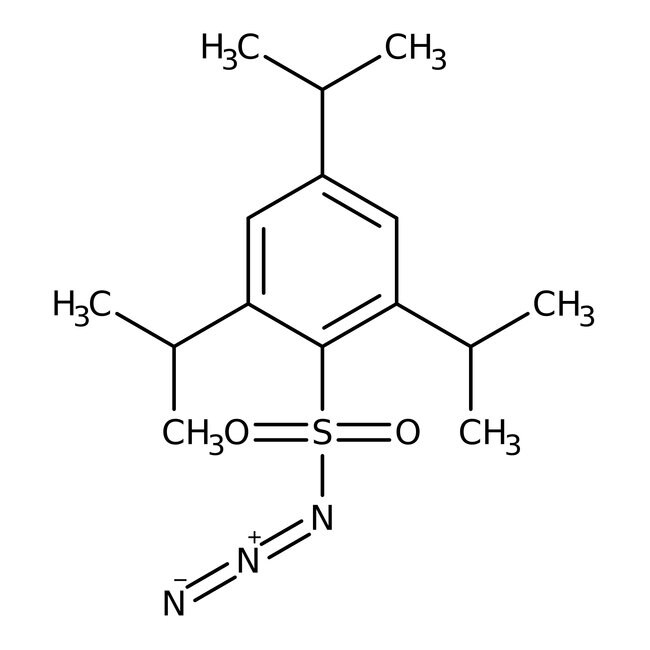
2,4,6-Triisopropylbenzenesulfonyl azide, 98%, stab. with ca 10% water
CAS: 36982-84-0 | C15H23N3O2S | 309.428 g/mol



化学物質識別子
CAS36982-84-0
仕様 スペックシート
スペックシートAppearance (Color)White to pale yellow
Assay (HPLC)>97.5%
Water Content (Karl Fischer Titration)6-12%
Formpowder
2,4,6-Triisopropylbenzenesulfonyl azide is used as a reagent for diazo transfer to ketones, e.g. under phase-transfer conditions, giving better yields of sterically-hindered ?-diazo ketones than other methods. It is also used for azide transfer to potassium enolates (KHMDS) to form the ?-azido derivatives.
This Thermo Scientific Chemicals brand product was originally part of the Alfa Aesar product portfolio. Some documentation and label information may refer to the legacy brand. The original Alfa Aesar product / item code or SKU reference has not changed as a part of the brand transition to Thermo Scientific Chemicals.
Applications
2,4,6-Triisopropylbenzenesulfonyl azide is used as a reagent for diazo transfer to ketones, e.g. under phase-transfer conditions, giving better yields of sterically-hindered ɑ-diazo ketones than other methods. It is also used for azide transfer to potassium enolates (KHMDS) to form the ɑ-azido derivatives.
Solubility
Insoluble in water.
Notes
Store in cool place. Keep container tightly closed in a dry and well-ventilated place. Containers which are opened must be carefully resealed and kept upright to prevent leakage. Recommended storage temperature is 2 - 8°C.
2,4,6-Triisopropylbenzenesulfonyl azide is used as a reagent for diazo transfer to ketones, e.g. under phase-transfer conditions, giving better yields of sterically-hindered ɑ-diazo ketones than other methods. It is also used for azide transfer to potassium enolates (KHMDS) to form the ɑ-azido derivatives.
Solubility
Insoluble in water.
Notes
Store in cool place. Keep container tightly closed in a dry and well-ventilated place. Containers which are opened must be carefully resealed and kept upright to prevent leakage. Recommended storage temperature is 2 - 8°C.
RUO – Research Use Only
General References:
- Joshua V. Ruppel.; Rajesh M. Kamble.; X. Peter Zhang. Cobalt-Catalyzed Intramolecular C-H Amination with Arylsulfonyl Azides. Org. Lett. 2007, 9 (23), 4889-4892.
- David A. Evans.; Thomas C. Britton. Electrophilic azide transfer to chiral enolates. A general approach to the asymmetric synthesis of .alpha.-amino acids. J. Am. Chem. Soc. 1987, 109 (22), 6881-6883.
- Reagent for diazo transfer to ketones, e.g. under phase-transfer conditions, giving better yields of sterically-hindered ɑ-diazo ketones than other methods: Synthesis, 368 (1980); J. Am. Chem. Soc., 102, 6626 (1980); 113, 2598 (1991); Tetrahedron, 43, 5677 (1987).
- Also used for azide transfer to potassium enolates (KHMDS) to form the ɑ-azido derivatives: J. Am. Chem. Soc., 109, 6881 (1987); 112, 4011 (1990); Tetrahedron Lett., 28, 6141 (1987). Other bases tend to favor diazo transfer. For further discussion and examples, see: Encyclopedia of Reagents for Organic Synthesis, L. A. Paquette, Ed., Wiley, Chichester (1995), vol. 7, p. 5174.