Search


Citations & References (4)
Invitrogen™
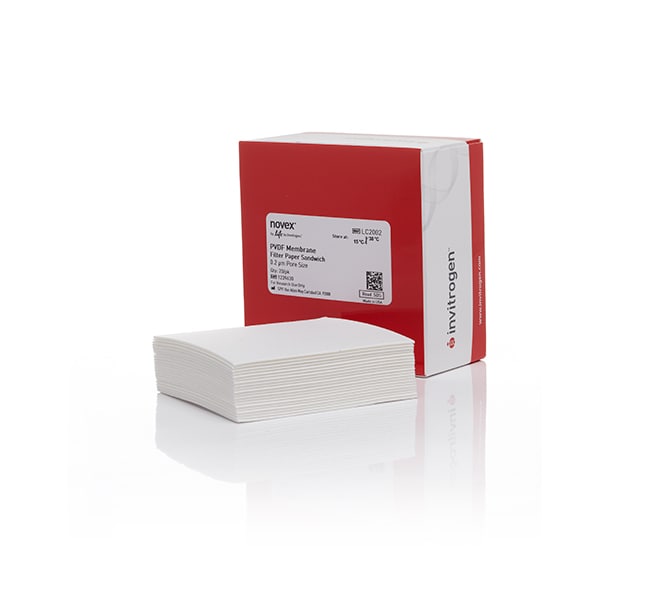
PVDF/Filter Paper Sandwich, 0.2 μm, 8.3 x 7.3 cm
PVDF/Filter Paper Sandwiches, 0.2 μm, have excellent binding properties for western blotting, dot-blot assays, and other protein or nucleic acidRead more
| Catalog Number | Quantity |
|---|---|
| LC2002 | 20 membrane/filter paper sandwiches |
Catalog number LC2002
Price (USD)
326.00
Each
Quantity:
20 membrane/filter paper sandwiches
Price (USD)
326.00
Each
PVDF/Filter Paper Sandwiches, 0.2 μm, have excellent binding properties for western blotting, dot-blot assays, and other protein or nucleic acid methods such as protein sequencing. The 0.2-μm pore size makes these membranes ideal for protein analysis of small amounts of proteins (as little as 10 pmoles), amino acid analysis, and transfer of small molecular weight proteins and peptides.
See all membranes and filter papers ›
Features
• Membrane: polyvinylidene difluoride (PVDF)
• Filter paper thickness: 0.8 mm
• Binding capacity: 50–150 μg/cm2 for large, globular proteins; >150 μg/cm2 for smaller peptides
• Re-probe characteristics: yes
• Pre-activation: required with 100% alcohol (methanol, ethanol, or isopropanol)
• Compatibility: compatible with commonly used transfer conditions and detection methods such as staining, chemiluminescence, and radiolabeling
• Durability: compatible with most organic solvents, acids, and mild bases
See all membranes and filter papers ›
Features
• Membrane: polyvinylidene difluoride (PVDF)
• Filter paper thickness: 0.8 mm
• Binding capacity: 50–150 μg/cm2 for large, globular proteins; >150 μg/cm2 for smaller peptides
• Re-probe characteristics: yes
• Pre-activation: required with 100% alcohol (methanol, ethanol, or isopropanol)
• Compatibility: compatible with commonly used transfer conditions and detection methods such as staining, chemiluminescence, and radiolabeling
• Durability: compatible with most organic solvents, acids, and mild bases
For Research Use Only. Not for use in diagnostic procedures.
Specifications
Quantity20 membrane/filter paper sandwiches
Shipping ConditionRoom Temperature
Dimensions (LxW)7.3 cm x 8.3 cm
FormatSandwich
Length (Metric)8.3 cm
MaterialPVDF
Pore Size0.2 μm
Product LineNovex
Thickness0.8 mm
Width (Metric)7.3 cm
Unit SizeEach
Contents & Storage
Store at room temperature.
Frequently asked questions (FAQs)
How can I store, strip, and reuse my western blot?
Why must Invitrolon PVDF membranes be dried before staining?
How do I destain proteins on a PVDF membrane that were stained with SimplyBlue SafeStain?
Can I use ethanol instead of methanol in the NuPAGE transfer buffer (and in transfer buffers in general)?
How can I reduce high background on PVDF Western blots?
Citations & References (4)
Citations & References
Abstract
Reaction mechanism, evolutionary analysis, and role of zinc in Drosophila methionine-R-sulfoxide reductase.
Journal:J Biol Chem
PubMed ID:12145281
Methionine residues in proteins are susceptible to oxidation, and the resulting methionine sulfoxides can be reduced back to methionines by methionine-S-sulfoxide reductase (MsrA) and methionine-R-sulfoxide reductase (MsrB). Herein, we have identified two MsrB families that differ by the presence of zinc. Evolutionary analyses suggested that the zinc-containing MsrB proteins are
The brain-derived neurotrophic factor enhances synthesis of Arc in synaptoneurosomes.
Journal:Proc Natl Acad Sci U S A
PubMed ID:11842217
Protein synthesis in neurons is essential for the consolidation of memory and for the stabilization of activity-dependent forms of synaptic plasticity such as long-term potentiation (LTP). Activity-dependent translation of dendritically localized mRNAs has been proposed to be a critical source of new proteins necessary for synaptic change. mRNA for the
CREB-binding protein/p300 co-activation of crystallin gene expression.
Journal:J Biol Chem
PubMed ID:11943779
Although some of the transcription factors that are required for expression of crystallins during lens development have been identified, the molecular interactions that contribute to enhanced crystallin expression are not yet well defined. In this study, we designed experiments to test whether the co-activators CREB-binding protein (CBP) and/or p300 interact
Oligomeric and fibrillar species of amyloid-beta peptides differentially affect neuronal viability.
Journal:J Biol Chem
PubMed ID:12058030
Genetic evidence predicts a causative role for amyloid-beta (A beta) in Alzheimer's disease. Recent debate has focused on whether fibrils (amyloid) or soluble oligomers of A beta are the active species that contribute to neurodegeneration and dementia. We developed two aggregation protocols for the consistent production of stable oligomeric or