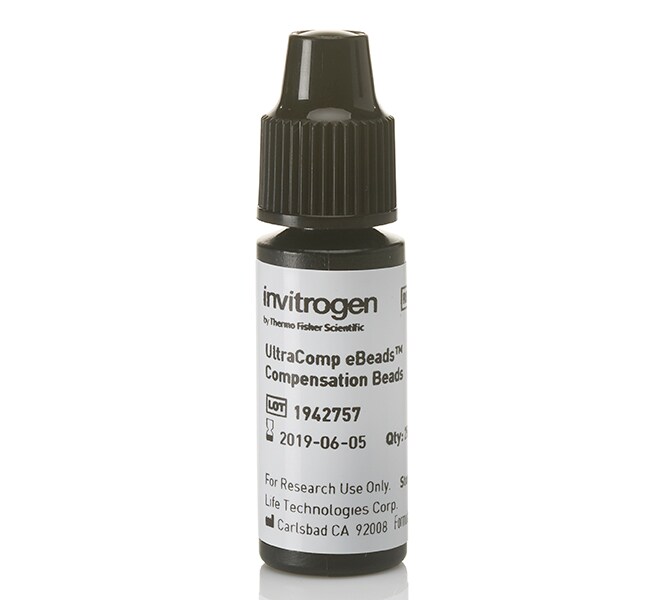
How long are UltraComp eBeads Compensation Beads (Cat. No. 01-2222-41, 01-2222-42) stable after staining?
After staining, UltraComp eBeads Compensation Beads (Cat. No. 01-2222-41, 01-2222-42) are stable for up to 3 days if the samples are stored in a fixative. If the samples are stored in FACS buffer, they are stable for 1 week.
Find additional tips, troubleshooting help, and resources within our Flow Cytometry Support Center.
I am performing flow cytometry. My compensation matrix has values over 100. That's not possible is it?
It is possible. But if you have a lot of values over 100, you probably need to look at the voltages that you are using for your data collection.
Find additional tips, troubleshooting help, and resources within our Cell Analysis Support Center.
I’ve been told that I need to compensate my data for flow cytometry analysis. What does that mean?
By running single-color controls, it is possible to remove signal of one fluorophore that spills over into the collection channel for another fluorophore.
Find additional tips, troubleshooting help, and resources within our Cell Analysis Support Center.
What kind of controls do I need for flow cytometry?
For compensation, you need to prepare a singly stained sample (or compensation beads) for each color parameter that you are using. In addition, we recommend that you use FMO (flow minus one) controls. These are controls in which you label cells or beads with every color in your panel, omitting one. Make one FMO control for each color. These controls are important for helping you properly set gates on your data.
Find additional tips, troubleshooting help, and resources within our Cell Analysis Support Center.
Why should I worry about compensation in flow cytometry analysis?
In a perfect world, the fluorescence emission profile for each individual fluorophore would be a very intense, narrow peak, well separated from all other emission peaks. In reality, organic dyes and fluorescent proteins have broad emission peaks, and compensation must be employed (during or after data acquisition) to correctly assign fluorescence signal to each fluorophore. Compensation is important because it removes fluorescent signal from overlapping spectra so you know that the signal you see is only the signal from the fluorophore of interest.
Find additional tips, troubleshooting help, and resources within our Cell Analysis Support Center.