Search



Citations & References (3)
Invitrogen™
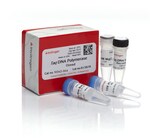
Taq DNA Polymerase, recombinant
Taq DNAポリメラーゼは熱安定性の高い酵素で、dNTPおよびプライマーの存在下でファーストストランドテンプレートからDNAを合成します。この酵素は、分子量94 kDaの単一ポリペプチドで構成されています。5´→3´DNAポリメラーゼ活性と5´→3´エキソヌクレアーゼ活性を有しています。当社のTaq DNAポリメラーゼを使用すると、以下のことが可能になります詳細を見る


製品番号(カタログ番号) 10342046
価格(JPY)
106,400
Online offer
Ends: 25-Dec-2026
177,400割引額 71,000 (40%)
Each
反応数:
1500 Reactions
Taq DNAポリメラーゼは熱安定性の高い酵素で、dNTPおよびプライマーの存在下でファーストストランドテンプレートからDNAを合成します。この酵素は、分子量94 kDaの単一ポリペプチドで構成されています。5´→3´DNAポリメラーゼ活性と5´→3´エキソヌクレアーゼ活性を有しています。
当社のTaq DNAポリメラーゼを使用すると、以下のことが可能になります。
• 組み換え型酵素または天然酵素を選択可能
• 最大5 kbのPCR製品の増幅
• PCR用のライセンスを取得した酵素
アプリケーション
Taq DNAポリメラーゼは、複雑なゲノム、ウイルス、プラスミドなどの鋳型からのDNAの増幅、RT-PCR、ssDNAの配列決定、サイクルシーケンシングなどに適しています。
ソース
大腸菌で発現させたクローン化Thermus aquaticus DNAポリメラーゼ遺伝子から精製した組み換え型酵素です。
ユニット定義
Taq DNAポリメラーゼは、10 nmoleのデオキシリボヌクレオチドを74℃で30分間かけてDNAに組み込むのに必要な酵素量です。
優れたPCR性能を得るためには、DreamTaq DNA Polymeraseをお勧めします。
当社のTaq DNAポリメラーゼを使用すると、以下のことが可能になります。
• 組み換え型酵素または天然酵素を選択可能
• 最大5 kbのPCR製品の増幅
• PCR用のライセンスを取得した酵素
アプリケーション
Taq DNAポリメラーゼは、複雑なゲノム、ウイルス、プラスミドなどの鋳型からのDNAの増幅、RT-PCR、ssDNAの配列決定、サイクルシーケンシングなどに適しています。
ソース
大腸菌で発現させたクローン化Thermus aquaticus DNAポリメラーゼ遺伝子から精製した組み換え型酵素です。
ユニット定義
Taq DNAポリメラーゼは、10 nmoleのデオキシリボヌクレオチドを74℃で30分間かけてDNAに組み込むのに必要な酵素量です。
優れたPCR性能を得るためには、DreamTaq DNA Polymeraseをお勧めします。
研究用にのみ使用できます。診断用には使用いただけません。
仕様
エキソヌクレアーゼ活性5' - 3'
フィデリティ(vs. Taq)1倍
フォーマットスタンドアローン酵素
ホットスタート不可
反応数1500 Reactions
オーバーハング3'-A
ポリメラーゼTaq DNAポリメラーゼ
製品タイプDNAポリメラーゼ
数量3×500ユニット
反応形態別のコンポーネント
出荷条件ドライアイス
サイズ(最終製品)5 kb以下
原料DNA
濃度5 U/μL
使用対象(アプリケーション)Standard PCR
GC-Rich PCR Performance低
PCR法qPCR, Standard PCR
反応速度スタンダード
Unit SizeEach
組成および保存条件
内容:
• Taq DNAポリメラーゼ(5 U/µL、1,500ユニット)、3 × 100 µL
• 10X PCRバッファー(200 mMトリス-HCl pH 8.4、500 mM KCl)、7.5 mL
• 塩化マグネシウム(50 mM)、3 mL
霜取り機能のないフリーザーに入れて-30~-10℃で保存します。適切に保管した場合、6カ月間の安定性を保証します。
• Taq DNAポリメラーゼ(5 U/µL、1,500ユニット)、3 × 100 µL
• 10X PCRバッファー(200 mMトリス-HCl pH 8.4、500 mM KCl)、7.5 mL
• 塩化マグネシウム(50 mM)、3 mL
霜取り機能のないフリーザーに入れて-30~-10℃で保存します。適切に保管した場合、6カ月間の安定性を保証します。
よくあるご質問(FAQ)
My oligonucleotide does not appear to be the right length when I checked by gel electrophoresis. Why is this?
The primers I am using worked for PCR initially, but over time, have stopped working. What happened?
I don't see a pellet in my oligo tube order. Should I ask for a replacement?
There is a ball-shaped pellet at the bottom of my oligo tube. What is this and can I still use my oligo?
There is a green color in my lyophilized oligo. Can I still use it?
引用および参考文献 (3)
引用および参考文献
Abstract
alpha-Methylacyl coenzyme A racemase as a tissue biomarker for prostate cancer.
Journal:JAMA
PubMed ID:11926890
'Edited due to space constraints: CONTEXT: Molecular profiling of prostate cancer has led to the identification of candidate biomarkers and regulatory genes. Discoveries from these genome-scale approaches may have applicability in the analysis of diagnostic prostate specimens. OBJECTIVES: To determine the expression and clinical utility of alpha-methylacyl coenzyme A racemase
Molecular cross-talk between the TRAIL and interferon signaling pathways.
Journal:J Biol Chem
PubMed ID:11677236
TRAIL/APO-2L induces apoptosis in a variety of transformed cells and has potential as an anti-cancer therapeutic. The physiologic role of TRAIL is presumably more complex than merely activating caspase-mediated cell death. To shed light into TRAIL-mediated signaling, we used DNA microarrays to profile gene expression mediated by TRAIL in breast
Association between CYP2C9 genetic variants and anticoagulation-related outcomes during warfarin therapy.
Journal:JAMA
PubMed ID:11926893
Edited for space constraints: Warfarin is a commonly used anticoagulant that requires careful clinical management to balance the risks of overanticoagulation and bleeding with those of underanticoagulation and clotting. The principal enzyme involved in warfarin metabolism is CYP2C9, and 2 relatively common variant forms with reduced activity have been identified,