Search


Citations & References (9)
Invitrogen™
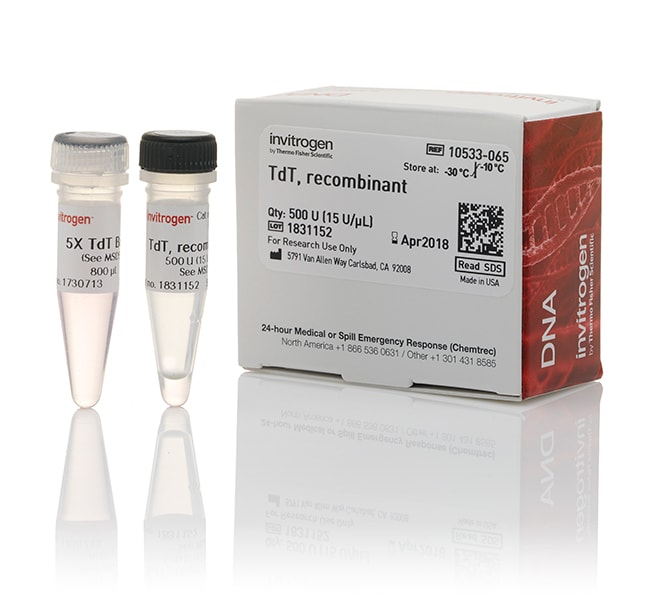
Terminal Deoxynucleotidyl Transferase, recombinant
末端デオキシヌクレオチド転移酵素(rTdT)は、DNAの3fiヒドロキシル末端へのデオキシヌクレオチドの添加を触媒するDNAポリメラーゼです。TdT技術資料をご利用いただけます。アプリケーション:クローニング用のベクターおよびインサートのホモポリマーテーリング。ビオチン(1、2)と32P-標識または35S-標識詳細を見る


製品番号(カタログ番号) 10533065
価格(JPY)
32,400
Each
数量:
500 U
末端デオキシヌクレオチド転移酵素(rTdT)は、DNAの3fiヒドロキシル末端へのデオキシヌクレオチドの添加を触媒するDNAポリメラーゼです。TdT技術資料をご利用いただけます。
アプリケーション:クローニング用のベクターおよびインサートのホモポリマーテーリング。ビオチン(1、2)と32P-標識または35S-標識(3)によるオリゴヌクレオチドの標識、またはアポトーシス(TUNEL)(4、5)。
由来:仔ウシ胸腺TdTの大腸菌クローンから精製。
性能および品質検査:エンドヌクレアーゼ、3´および5´エキソデオキシリボヌクレアーゼ、および導入レベル試験済み。
ユニット定義:1ユニットは、プライマーとしてd(pA)50を使用して、37℃、1時間で1 nmolのdATPを酸沈殿性物質に取り込みます。
有害警告:毒性:反応バッファーに含まれるカコジル酸カリウム。また、高毒性化学物質であるコバルト塩化物も含まれています。
MSDSを参照してください。
ユニット反応条件:0.2 Mカコジル酸カリウム(pH 7.2)、10 mM MgO4 C4 H6、1 mM 2-メルカプトエタノール、0.5 mg/ml BSA、
100 flM d(pA)50、1 mM [3H]dATP、および酵素(0.15 ml、1時間、37℃)。
アプリケーション:クローニング用のベクターおよびインサートのホモポリマーテーリング。ビオチン(1、2)と32P-標識または35S-標識(3)によるオリゴヌクレオチドの標識、またはアポトーシス(TUNEL)(4、5)。
由来:仔ウシ胸腺TdTの大腸菌クローンから精製。
性能および品質検査:エンドヌクレアーゼ、3´および5´エキソデオキシリボヌクレアーゼ、および導入レベル試験済み。
ユニット定義:1ユニットは、プライマーとしてd(pA)50を使用して、37℃、1時間で1 nmolのdATPを酸沈殿性物質に取り込みます。
有害警告:毒性:反応バッファーに含まれるカコジル酸カリウム。また、高毒性化学物質であるコバルト塩化物も含まれています。
MSDSを参照してください。
ユニット反応条件:0.2 Mカコジル酸カリウム(pH 7.2)、10 mM MgO4 C4 H6、1 mM 2-メルカプトエタノール、0.5 mg/ml BSA、
100 flM d(pA)50、1 mM [3H]dATP、および酵素(0.15 ml、1時間、37℃)。
研究用にのみ使用できます。診断用には使用いただけません。
仕様
適合バッファー5Xバッファー、反応バッファー
製品タイプTdT
数量500 U
出荷条件氷水またはドライアイスでの出荷が承認されています
酵素末端デオキシヌクレオチド転移酵素
Unit SizeEach
組成および保存条件
末端デオキシヌクレオチド転位酵素、組み換え(rTdT)は、5倍バッファー(500 mMのカリウムカコジル酸塩(pH 7.2)、10 mMのCoCl2、1 mMのDTT)のバイアルが付属しています。-20℃で保存
よくあるご質問(FAQ)
Is the Terminal Deoxynucleotidyl Transferase (TdT) within the Pierce Biotin 3' End DNA Labeling Kit (Cat. No. 89818) available separately?
引用および参考文献 (9)
引用および参考文献
Abstract
Interaction of human nuclear topoisomerase I with guanosine quartet-forming and guanosine-rich single-stranded DNA and RNA oligonucleotides.
Journal:J Biol Chem
PubMed ID:11756434
'Human nuclear DNA topoisomerase I (top1) plays a crucial role in DNA replication, transcription, and chromosome condensation. In this study, we show that intra- and intermolecular guanosine quartets (G-quartets) can inhibit top1-mediated DNA cleavage at a high affinity site. Top1-mediated DNA cleavage was also inhibited by a 16-mer single-stranded oligodeoxynucleotide
The novel WD-repeat protein MORG1 acts as a molecular scaffold for HIF prolyl-hydroxylase 3 (PHD3).
Journal:J Biol Chem
PubMed ID:16407229
'Hypoxia-inducible factor-1 (HIF-1), a transcriptional complex composed of an oxygen-sensitive alpha- and a beta-subunit, plays a pivotal role in cellular adaptation to low oxygen availability. Under normoxia, the alpha-subunit of HIF-1 is hydroxylated by a family of prolyl hydroxylases (PHDs) and consequently targeted for proteasomal degradation. Three different prolyl hydroxylases
Coordinated transcription of key pathways in the mouse by the circadian clock.
Journal:Cell
PubMed ID:12015981
'In mammals, circadian control of physiology and behavior is driven by a master pacemaker located in the suprachiasmatic nuclei (SCN) of the hypothalamus. We have used gene expression profiling to identify cycling transcripts in the SCN and in the liver. Our analysis revealed approximately 650 cycling transcripts and showed that
DEMETER, a DNA glycosylase domain protein, is required for endosperm gene imprinting and seed viability in arabidopsis.
Journal:Cell
PubMed ID:12150995
'We isolated mutations in Arabidopsis to understand how the female gametophyte controls embryo and endosperm development. For the DEMETER (DME) gene, seed viability depends only on the maternal allele. DME encodes a large protein with DNA glycosylase and nuclear localization domains. DME is expressed primarily in the central cell of
The orphan nuclear receptor REV-ERBalpha controls circadian transcription within the positive limb of the mammalian circadian oscillator.
Journal:Cell
PubMed ID:12150932
Mammalian circadian rhythms are generated by a feedback loop in which BMAL1 and CLOCK, players of the positive limb, activate transcription of the cryptochrome and period genes, components of the negative limb. Bmal1 and Per transcription cycles display nearly opposite phases and are thus governed by different mechanisms. Here, we