Search


Citations & References (38)
Gibco™
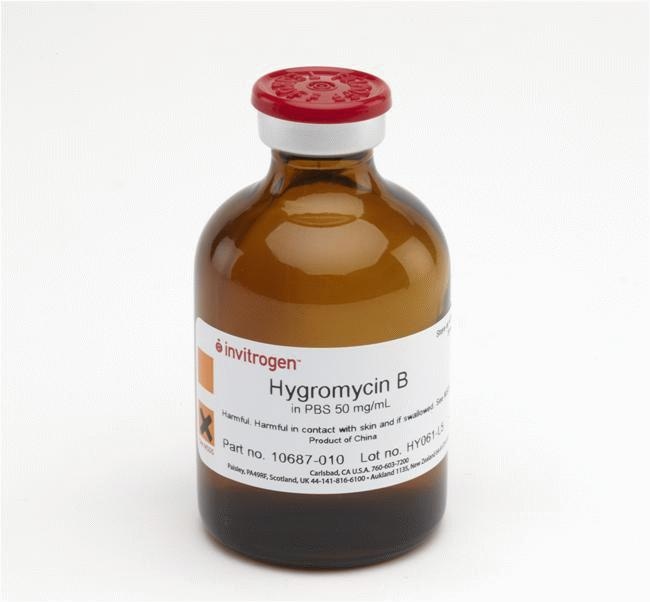
Hygromycin B (50 mg/mL)
ハイグロマイシンBは、細菌ストレプトマイセスヒグロスコピクスから精製された水溶性抗生物質です。ハイグロマイシンBは、細菌リボソームの80Sサブユニットに結合することで作用し、タンパク質の合成を阻害します。Gibco™ハイグロマイシンBは、200–500 µg/mLの濃度範囲の細菌選択抗生物質として使用されます。この製品は、50詳細を見る
| 製品番号(カタログ番号) | 数量 |
|---|---|
| 10687010 | 20 mL |
製品番号(カタログ番号) 10687010
価格(JPY)
52,000
Each
数量:
20 mL
ハイグロマイシンBは、細菌ストレプトマイセスヒグロスコピクスから精製された水溶性抗生物質です。ハイグロマイシンBは、細菌リボソームの80Sサブユニットに結合することで作用し、タンパク質の合成を阻害します。Gibco™ハイグロマイシンBは、200–500 µg/mLの濃度範囲の細菌選択抗生物質として使用されます。この製品は、50 mg/mLの溶液として提供されます。
ハイグロマイシンBに対する耐性は、大腸菌のハイグロマイシン耐性遺伝子(hygまたはhph)によって認められます。ハイグロマイシンBは、Geneticin™、ブラストサイジンS、またはZeocin™選択試薬とは異なる動作モードを有しており、デュアル選択実験に最適です(選択抗生物質をご覧ください)。
その他の選択肢および詳細情報
当社は、粉末および液体の両方のフォーマットで、幅広い抗生物質および抗真菌剤を提供しています。
詳細なリストはこちらをご覧ください。または以下の製品を検索してください。
•汚染防止
• 真核および細菌の選択
選択抗生物質の使用濃度に関する推奨事項をご覧ください。
細胞培養における抗生物質および抗真菌剤の使用の詳細、および培養の汚染除去に関するガイドラインをご覧ください。
ハイグロマイシンBに対する耐性は、大腸菌のハイグロマイシン耐性遺伝子(hygまたはhph)によって認められます。ハイグロマイシンBは、Geneticin™、ブラストサイジンS、またはZeocin™選択試薬とは異なる動作モードを有しており、デュアル選択実験に最適です(選択抗生物質をご覧ください)。
その他の選択肢および詳細情報
当社は、粉末および液体の両方のフォーマットで、幅広い抗生物質および抗真菌剤を提供しています。
詳細なリストはこちらをご覧ください。または以下の製品を検索してください。
•汚染防止
• 真核および細菌の選択
選択抗生物質の使用濃度に関する推奨事項をご覧ください。
細胞培養における抗生物質および抗真菌剤の使用の詳細、および培養の汚染除去に関するガイドラインをご覧ください。
研究用にのみ使用できます。診断用には使用いただけません。
仕様
濃度50 mg/mL
培養タイプMammalian Cell Culture, Insect Cell Culture
使用対象(アプリケーション)Eukaryotic Selection⁄Stable Cell Line Generation
数量20 mL
出荷条件Room Temperature
形状Liquid
製品タイプAntibiotic
無菌性Sterile
Unit SizeEach
組成および保存条件
Storage conditions: 2 to 8°C
Shipping conditions: Ambient
Shipping conditions: Ambient
よくあるご質問(FAQ)
Which of your antibiotics (Geneticin, Zeocin, Hygromycin B, Blasticidin, and Puromycin) can be used together for stable selection in mammalian cells?
What are the recommended concentrations of antibiotics to use for selection in prokaryotes and eukaryotes?
What is the range of specific activity of Hygromycin B?
What solvent is used to prepare your Hygromycin B solution? How should it be stored?
What is the mode of action on the following antibiotics: Blasticidin, Geneticin (G418), Hygromycin, and Zeocin?
引用および参考文献 (38)
引用および参考文献
Abstract
WAF1, a potential mediator of p53 tumor suppression.
Journal:Cell
PubMed ID:8242752
The ability of p53 to activate transcription from specific sequences suggests that genes induced by p53 may mediate its biological role as a tumor suppressor. Using a subtractive hybridization approach, we identified a gene, named WAF1, whose induction was associated with wild- type but not mutant p53 gene expression in
CC chemokine receptor 5-mediated signaling and HIV-1 Co-receptor activity share common structural determinants. Critical residues in the third extracellular loop support HIV-1 fusion.
Journal:J Biol Chem
PubMed ID:9242636
'There is a close correspondence between the ability of RANTES and macrophage inflammatory proteins 1alpha and 1beta to activate CC chemokine receptor 5 (CCR5) and the ability to inhibit CCR5-dependent membrane fusion mediated by the envelope glycoprotein of human immunodeficiency virus (HIV), type 1. This finding suggests that some of
Dimerization of a selectin and its ligand stabilizes cell rolling and enhances tether strength in shear flow.
Journal:Proc Natl Acad Sci U S A
PubMed ID:11526223
'Selectins mediate rolling of leukocytes by rapid formation and dissociation of selectin-ligand bonds, which are assumed to require high mechanical strength to prevent premature dissociation by the forces applied in shear flow. This assumption is based largely on the observation that increasing wall shear stress increases only modestly the dissociation
Reconstitution of stretch-activated cation channels by expression of the alpha-subunit of the epithelial sodium channel cloned from osteoblasts [published erratum appears in Proc Natl Acad Sci U S A 1997 Apr 15;94(8):4233]
Journal:Proc Natl Acad Sci U S A
PubMed ID:9023374
'Osteoblasts respond to repetitive strain by activating stretch- activated, nonselective cation channels (SA-CAT) and increasing matrix protein production. SA-CAT channels are thought to be responsible for mechano-transduction in osteoblasts, although the molecular identity of the SA-CAT channel has previously been unknown. We have demonstrated that both the UMR-106 osteoblast-like cell
Genetic analysis of the herpes simplex virus type 1 UL20 protein domains involved in cytoplasmic virion envelopment and virus-induced cell fusion.
Journal:J Virol
PubMed ID:15220406
'The herpes simplex virus type 1 UL20 protein (UL20p) is an important determinant for cytoplasmic virion morphogenesis and virus-induced cell fusion. To delineate the functional domains of the UL20 protein, we generated a panel of single and multiple (cluster) alanine substitutions as well as UL20p carboxyl-terminal truncations. The UL20 mutant