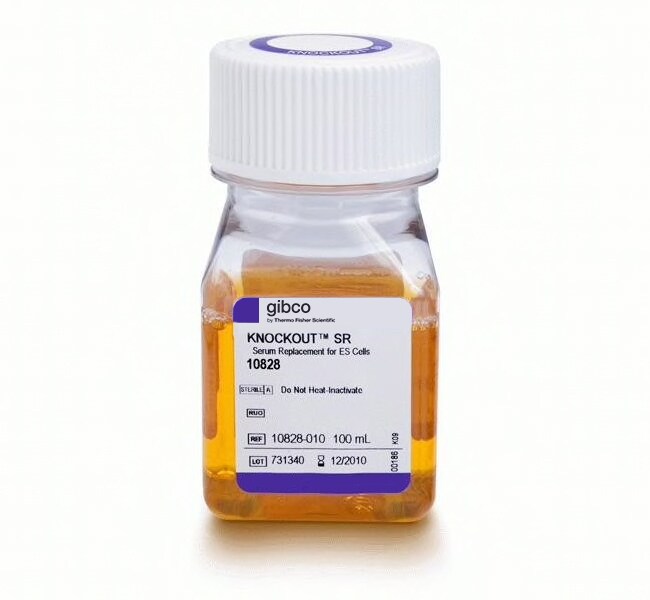
KnockOut™ Serum Replacement
Gibco™

KnockOut™ Serum Replacement

Knockout™血清代替(Knockout™ SR)は胚性幹細胞(ESC)および人工多種由来の多能性幹細胞(iPSC)の無血清でフィーダーベースの培養です。この明確な無血清組成は、既存のプロトコルのFBSに直接代わるものです詳細を見る
製品番号(カタログ番号)数量
10828010100 mL
10828028500 mL
製品番号(カタログ番号) 10828010
価格(JPY)
21,200
Each
お問い合わせください ›
数量:
100 mL
Knockout™血清代替(Knockout™ SR)は胚性幹細胞(ESC)および人工多種由来の多能性幹細胞(iPSC)の無血清でフィーダーベースの培養です。この明確な無血清組成は、既存のプロトコルのFBSに直接代わるものです。

幹細胞培養でFBSを使用する場合の欠点の多く(細胞の分化と熱不活性化)は、KnockOut™血清交換を使用することで軽減できます。KnockOut™ SRが添加された培地で成長したES細胞およびiPS細胞は、FBSが添加された培地で成長した細胞よりも大幅に分化が少なく、生殖細胞の透過が損なわれません。KnockOut™血清交換には、幹細胞培養、分化、iPSC生成、ESC誘導、トランスジェニックモデリングなどのアプリケーションに対応する2000以上の査読済み出版物があり、幹細胞培養のために広く引用されています。
For research use only. Not for use in diagnostic procedures.
仕様
細胞タイプ幹細胞(胚性)
分類血清フリー
培養タイプ哺乳類細胞培養
使用対象(アプリケーション)臨床研究、トランスレーショナル研究
製造品質医療機器、21 CFR、Part 820用cGMP、およびISO 13485
製品ラインKnockOut
純度または品質グレードES細胞適格
血清レベル血清フリー
品質保持期間18カ月
出荷条件ドライアイス
Serum-Free
試験済み成長性能アッセイ
形状凍結
製品タイプ血清代替
数量100 mL
pH6∼8
Unit SizeEach
組成および保存条件
フリーザー(-5~-20℃)で保存し、遮光してください。

よくあるご質問(FAQ)

Can KnockOut SR be used to culture mouse ESCs in feeder-free conditions?

Yes, mouse embryonic stem cells can be cultured using KnockOut SR under feeder-free conditions. Typically, cells are plated at a higher seeding density, in the presence of LIF, on a 0.1% gelatin layer in place of feeder cells.

Find additional tips, troubleshooting help, and resources within our Cell Culture Support Center.

Can KnockOut SR be used to culture mouse ESCs on feeder cells?

Yes, KnockOut SR was designed to culture mouse ES cells in undifferentiated conditions.

Find additional tips, troubleshooting help, and resources within our Cell Culture Support Center.

How do I characterize human embryonic stem ( ES) cells?

Human ES cells are generally characterized by their typical morphology (they grow as tightly packed clusters of small cells with high ratio of nucleus to cytoplasm); surface marker expression; RT-PCR detection of stem cell-specific gene expression (such as Oct3/4, Sox2, and Nanog); alkaline phosphatase staining, and telomerase activity assay. The most commonly used ES specific surface markers include stage-specific embryonic antigens SSEA-3 and SSEA-4 for human ES cells. Other ES-specific surface antigens also include TRA-1-60 and TRA-1-81. (Science 282:1145 (1998).

How are human embryonic stem (ES) cells derived?

Human ES cells are derived from human blastocyst inner cell masses, isolated by immunosurgery with rabbit antiserum to BeWO cells (a human trophoblast cell line) (Science 282:1145 (1998)).

What are ES cells?

Embryonic stem (ES) cells are derived from the early mammalian embryo and are capable of unlimited, undifferentiated proliferation in vitro while maintaining their potential to differentiate into a wide of range of adult tissues including germ cells. The pluripotency of the ES cells is normally demonstrated in vitro by inducing ES cells to differentiate into embryoid bodies and checking lineage-specific markers for differentiated cells in three body layers (endo, meso, and ectoderm), or injecting them into immunodeficient mice and determining the cell types produced in the teratomas.

引用および参考文献 (1)

引用および参考文献
Abstract
Effects of an indole derivative on cell proliferation, transfection, and alternative splicing in production of lentiviral vectors by transient co-transfection.
Authors:Mier NC,Roper DK
Journal:PloS one
PubMed ID:38833479
Lentiviral vectors derived from human immunodeficiency virus type I are widely used to deliver functional gene copies to mammalian cells for research and gene therapies. Post-transcriptional splicing of lentiviral vector transgene in transduced host and transfected producer cells presents barriers to widespread application of lentiviral vector-based therapies. The present study ... More