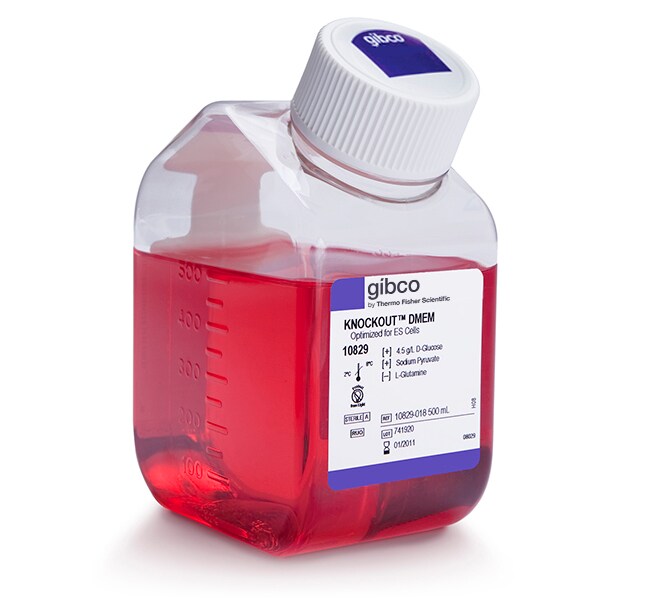
KnockOut™ DMEM
KnockOut™ DMEM
Gibco™

KnockOut™ DMEM

KnockOut™ D-MEMは、未分化胚性幹細胞や人工多能性幹細胞を成長させるために最適化された基礎培地です(1)。オスモル濃度は、マウス胚組織の浸透圧に近くなるように最適化されています。L-グルタミンは含有していません詳細を見る
製品番号(カタログ番号)数量
10829018500 mL
製品番号(カタログ番号) 10829018
価格(JPY)
7,100
Each
お問い合わせください ›
数量:
500 mL
Customize this product
KnockOut™ D-MEMは、未分化胚性幹細胞や人工多能性幹細胞を成長させるために最適化された基礎培地です(1)。オスモル濃度は、マウス胚組織の浸透圧に近くなるように最適化されています。

L-グルタミンは含有していません。
研究用にのみ使用できます。診断用には使用いただけません。
仕様
細胞タイプStem Cells (Embryonic), Stem Cells (iPS - Induced Pluripotent Stem)
製造品質cGMP for medical devices, 21 CFR Part 820 and ISO 13485
製品ラインKnockOut
製品タイプKnockOut DMEM
数量500 mL
出荷条件Room Temperature
形状Liquid
添加剤ありHigh Glucose, Phenol Red
添加剤なしNo Glutamine
Unit SizeEach
組成および保存条件
Store in refrigerator (2–8°C) and protect from light.

よくあるご質問(FAQ)

Can KnockOut SR be used to culture mouse ESCs in feeder-free conditions?

Yes, mouse embryonic stem cells can be cultured using KnockOut SR under feeder-free conditions. Typically, cells are plated at a higher seeding density, in the presence of LIF, on a 0.1% gelatin layer in place of feeder cells.

Find additional tips, troubleshooting help, and resources within our Cell Culture Support Center.

Can KnockOut SR be used to culture mouse ESCs on feeder cells?

Yes, KnockOut SR was designed to culture mouse ES cells in undifferentiated conditions.

Find additional tips, troubleshooting help, and resources within our Cell Culture Support Center.

How do I characterize human embryonic stem ( ES) cells?

Human ES cells are generally characterized by their typical morphology (they grow as tightly packed clusters of small cells with high ratio of nucleus to cytoplasm); surface marker expression; RT-PCR detection of stem cell-specific gene expression (such as Oct3/4, Sox2, and Nanog); alkaline phosphatase staining, and telomerase activity assay. The most commonly used ES specific surface markers include stage-specific embryonic antigens SSEA-3 and SSEA-4 for human ES cells. Other ES-specific surface antigens also include TRA-1-60 and TRA-1-81. (Science 282:1145 (1998).

How are human embryonic stem (ES) cells derived?

Human ES cells are derived from human blastocyst inner cell masses, isolated by immunosurgery with rabbit antiserum to BeWO cells (a human trophoblast cell line) (Science 282:1145 (1998)).

What are ES cells?

Embryonic stem (ES) cells are derived from the early mammalian embryo and are capable of unlimited, undifferentiated proliferation in vitro while maintaining their potential to differentiate into a wide of range of adult tissues including germ cells. The pluripotency of the ES cells is normally demonstrated in vitro by inducing ES cells to differentiate into embryoid bodies and checking lineage-specific markers for differentiated cells in three body layers (endo, meso, and ectoderm), or injecting them into immunodeficient mice and determining the cell types produced in the teratomas.