Search


Citations & References (17)
Invitrogen™
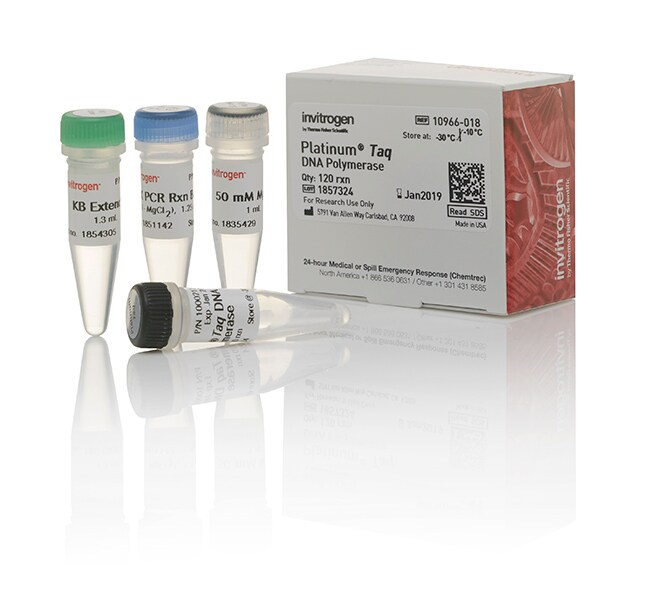
Platinum™ Taq DNA Polymerase
Invitrogen Platinum Taq DNAポリメラーゼは、Taq DNAポリメラーゼよりも高い特異性を提供するPCR用の便利で信頼性の高い「ホットスタート」熱安定性DNAポリメラーゼです。酵素の「ホットスタート」特性は、初期PCR変性ステップまでTaq DNAポリメラーゼを不活性にする熱分解性モノクローナル抗体によって与えられ、非特異的アニーリングプライマーの伸長を防ぎ詳細を見る


製品番号(カタログ番号) 10966018
価格(JPY)
22,300
Each
反応数:
120 Reactions
Invitrogen Platinum Taq DNAポリメラーゼは、Taq DNAポリメラーゼよりも高い特異性を提供するPCR用の便利で信頼性の高い「ホットスタート」熱安定性DNAポリメラーゼです。酵素の「ホットスタート」特性は、初期PCR変性ステップまでTaq DNAポリメラーゼを不活性にする熱分解性モノクローナル抗体によって与えられ、非特異的アニーリングプライマーの伸長を防ぎ、製品収量を改善します。
Platinum Taq DNAポリメラーゼの使用
Platinum Taq DNAポリメラーゼのホットスタート特性により、室温での便利な反応アセンブリが可能になります。Taq DNAポリメラーゼは、Platinum Taq DNAポリメラーゼと同様に、テンプレートに依存しない末端トランスフェラーゼ活性を有しており、製品末端に3' デオキシアデノシンを付加し、5'→3'エキソヌクレアーゼ活性を有します。PlatinumTaq DNAポリメラーゼで生成されるPCR産物は、プロトコルを変更することなく、同じダウンストリームアプリケーションで使用できます。Platinum Taq DNAポリメラーゼは、複雑なゲノム、ウイルス、プラスミドテンプレートからのDNAの増幅、およびRT-PCRに使用できます。
注:優れたPCR性能を得るには、次世代酵素Platinum II TaqホットスタートDNAポリメラーゼをお勧めします。Platinum II TaqホットスタートDNAポリメラーゼは、革新的なバッファー、高性能なTaq DNAポリメラーゼおよび優れたホットスタート技術の独自の組み合わせにより、プライマーアニーリングがあらゆる目的に対応できるように、かつPCRを迅速かつ簡単に実施できるように設計されています。
Platinum Taq DNAポリメラーゼの使用
Platinum Taq DNAポリメラーゼのホットスタート特性により、室温での便利な反応アセンブリが可能になります。Taq DNAポリメラーゼは、Platinum Taq DNAポリメラーゼと同様に、テンプレートに依存しない末端トランスフェラーゼ活性を有しており、製品末端に3' デオキシアデノシンを付加し、5'→3'エキソヌクレアーゼ活性を有します。PlatinumTaq DNAポリメラーゼで生成されるPCR産物は、プロトコルを変更することなく、同じダウンストリームアプリケーションで使用できます。Platinum Taq DNAポリメラーゼは、複雑なゲノム、ウイルス、プラスミドテンプレートからのDNAの増幅、およびRT-PCRに使用できます。
注:優れたPCR性能を得るには、次世代酵素Platinum II TaqホットスタートDNAポリメラーゼをお勧めします。Platinum II TaqホットスタートDNAポリメラーゼは、革新的なバッファー、高性能なTaq DNAポリメラーゼおよび優れたホットスタート技術の独自の組み合わせにより、プライマーアニーリングがあらゆる目的に対応できるように、かつPCRを迅速かつ簡単に実施できるように設計されています。
研究用にのみ使用できます。診断用には使用いただけません。
仕様
エキソヌクレアーゼ活性5' - 3'
フィデリティ(vs. Taq)1X
フォーマットチューブ
ホットスタート内蔵ホットスタート
反応数120 Reactions
オーバーハング3'-A
ポリメラーゼPlatinum Taq DNAポリメラーゼ
製品タイプDNAポリメラーゼ
数量120反応
反応形態別のコンポーネント
出荷条件氷水またはドライアイスでの出荷が承認されています
サイズ(最終製品)5 kb以下
原料DNA
使用対象(アプリケーション)Hot-start PCR
GC-Rich PCR Performance低
反応速度高速または標準
Unit SizeEach
組成および保存条件
各ボックスの内容:
•24 µl Platinum™ Taq DNAポリメラーゼ
• 1.25 mLの10X PCRバッファー(塩化マグネシウム非含有)
• 1 mLの50 mM塩化マグネシウム
•1.3 mLのKBエクステンダー
-30℃~-10℃で非フロストフリーのフリーザーに保管してください。
•24 µl Platinum™ Taq DNAポリメラーゼ
• 1.25 mLの10X PCRバッファー(塩化マグネシウム非含有)
• 1 mLの50 mM塩化マグネシウム
•1.3 mLのKBエクステンダー
-30℃~-10℃で非フロストフリーのフリーザーに保管してください。
よくあるご質問(FAQ)
Can I purchase just the 10X PCR buffer that comes with Platinum Taq?
My oligonucleotide does not appear to be the right length when I checked by gel electrophoresis. Why is this?
The primers I am using worked for PCR initially, but over time, have stopped working. What happened?
I don't see a pellet in my oligo tube order. Should I ask for a replacement?
There is a ball-shaped pellet at the bottom of my oligo tube. What is this and can I still use my oligo?
引用および参考文献 (17)
引用および参考文献
Abstract
De novo ceramide regulates the alternative splicing of caspase 9 and Bcl-x in A549 lung adenocarcinoma cells. Dependence on protein phosphatase-1.
Journal:J Biol Chem
PubMed ID:11801602
'In a recent study, we showed that ceramide induces the dephosphorylation of SR proteins, a family of protein factors that regulate alternative splicing. In this study, the regulation of the alternative processing of pre-mRNA of both caspase 9 and Bcl-x(L) was examined in response to ceramide. Treatment of A549 lung
Quantitative Assessment of Gene Targeting in Vitro and in Vivo by the Pancreatic Transcription Factor, Pdx1. IMPORTANCE OF CHROMATIN STRUCTURE IN DIRECTING PROMOTER BINDING.
Journal:J Biol Chem
PubMed ID:11825903
'The transcription factor Pdx1 is expressed in the pancreatic beta-cell, where it is believed to regulate several beta-cell-specific genes. Whereas binding by Pdx1 to elements of beta-cell genes has been demonstrated in vitro, almost none of these genes has been demonstrated to be a direct binding target for Pdx1 within
Angiotensin II inhibits human trophoblast invasion through AT1 receptor activation.
Journal:J Biol Chem
PubMed ID:11983698
Trophoblast implantation depends, in part, on the controlled production of plasmin from plasminogen, a process regulated by plasminogen activators and plasminogen activator inhibitors. We have determined that angiotensin II (Ang II) stimulates plasminogen activator inhibitor-1 (PAI-1) synthesis and secretion in human trophoblasts in a time- and concentration-dependent manner. Our results
Sensory nerves determine the pattern of arterial differentiation and blood vessel branching in the skin.
Journal:Cell
PubMed ID:12086669
Nerves and blood vessels are branched structures, but whether their branching patterns are established independently or coordinately is not clear. Here we show that arteries, but not veins, are specifically aligned with peripheral nerves in embryonic mouse limb skin. Mutations that eliminate peripheral sensory nerves or Schwann cells prevent proper
Translational regulation of BACE-1 expression in neuronal and non-neuronal cells.
Journal:Nucleic Acids Res
PubMed ID:15034149
As the main beta-secretase of the central nervous system, BACE-1 is a key protein in the pathogenesis of Alzheimer's disease. Excessive expression of the protein might cause an overproduction of the neurotoxic beta-amyloid peptide. Therefore, a tight regulation of BACE-1 expression is expected in vivo. In addition to a possible