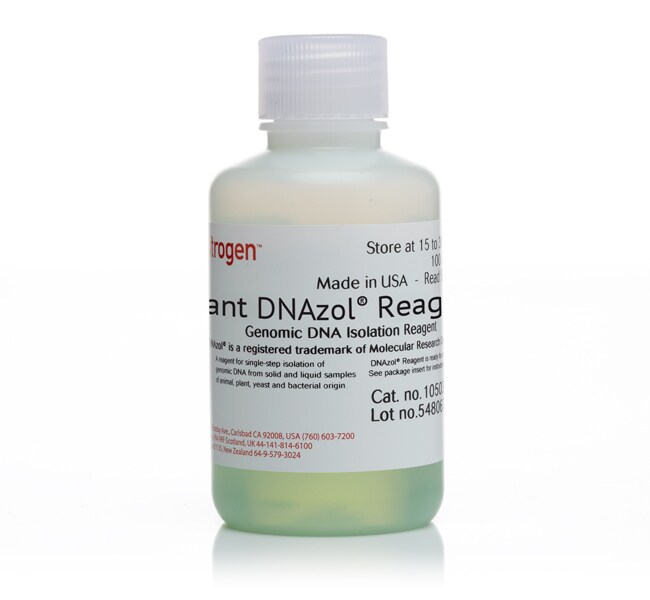
Plant DNAzol™ Reagent
Invitrogen™

Plant DNAzol™ Reagent

植物DNAzol™試薬は、さまざまな植物サンプルから高品質のゲノムDNAを単離するために調製された、すぐに使用できる有機試薬です。•広範な植物材料での使用を可能にします• ゲノムDNAの迅速な単離幅広いサンプルソースからのゲノムDNAの効率的な単離のためのRNA加水分解植物DNAzol™試薬は、葉、種子、幹、根、カルスなどのさまざまな植物組織からゲノムDNAを効率的に単離するために使用できます詳細を見る
製品番号(カタログ番号)数量
10978021100 mL
製品番号(カタログ番号) 10978021
価格(JPY)
28,800
Online offer
Ends: 26-Dec-2025
48,000
割引額 19,200 (40%)
Each
お問い合わせください ›
数量:
100 mL
植物DNAzol™試薬は、さまざまな植物サンプルから高品質のゲノムDNAを単離するために調製された、すぐに使用できる有機試薬です。

•広範な植物材料での使用を可能にします
• ゲノムDNAの迅速な単離

幅広いサンプルソースからのゲノムDNAの効率的な単離のためのRNA加水分解
植物DNAzol™試薬は、葉、種子、幹、根、カルスなどのさまざまな植物組織からゲノムDNAを効率的に単離するために使用できます。植物DNAzol™の手順は、RNAを加水分解してライセートからDNAを選択的に沈殿させる、新しいグアニジン界面活性剤溶解液の使用に基づいています。

約1時間でゲノム植物DNAzolを単離します
植物DNAzol™の手順で、植物サンプルを液体窒素で粉砕するか、またはホモジナイズし、植物DNAzol™試薬でホモジネートからゲノムDNAを抽出します。抽出後、遠心分離機により植物の破片が除去され、エタノールで上清からDNAが沈殿し、TEバッファー(pH 8.0)で可溶化されます。手順全体を約60~70分で完了できます。

短時間、少ない試薬で同等の収量
植物DNA抽出の従来の方法(例:CTAB)とは異なり、植物DNAzol™は迅速で、ゲノムDNA調製からRNAを除去するためにRNase Aを必要とせず、組織の大部分でフェノールを必要としません。さらに、植物DNAzol™を使用すると、植物組織から従来のCTAB方法と同等の収率が実現します。

単離されたDNAは、多くのダウンストリームアプリケーションに使用できます。
増幅断片長ポリモフィズム(AFLP)
制限酵素断片長多型(RFLP)
サザンブロッティング
シーケンシング
PCR
クローニング

研究用にのみ使用できます。動物やヒトの診断や治療には使用できません。
研究用途にのみご使用ください。診断目的には使用できません。
仕様
溶出量70 μL
最終産物タイプゲノムDNA
使用対象(アプリケーション)PCR、サザンブロッティング、シーケンシング、クローニング
高スループット適合性ハイスループット非対応(手動)
数量100 mL
サンプルタイプ植物
出荷条件室温
出発物質量0.1 g
検査時間60分
収量≤300 μg
Isolation Technology有機物抽出
Unit SizeEach
組成および保存条件
室温保存。

よくあるご質問(FAQ)

Will DNAzol Reagent isolate only genomic DNA or will plasmid DNA also be isolated? How about mitochondrial DNA?

The DNA isolated is actually total DNA, so plasmid DNA will be isolated along with genomic DNA. The mitochondrial genome is similar to a plasmid and can be isolated using DNAzol Reagent. The 1 minute room temperature incubation in ethanol before centrifugation should be extended to 5-10 minutes for maximum recovery.

At what temperatures can DNAzol reagent be stored and still be okay to use? Are there possible stopping/storage points in the protocol?

We recommend storing DNAzol Reagent at room temperature. The DNAzol lysate (homogenate) can be stored 1 month at 15-30 degrees C; after 10 months at 4 degrees C or -20 degrees C, the DNAzol lysate (homogenate) has yielded high molecular weight genomic DNA, which can be completely digested with restriction enzymes and works well in PCR. During washes, DNA can be stored in 95% EtOH for at least one week at 15 degrees C to 30 degrees C or for three months at approximately 4 degrees C. DNA can be stored in DNAzol Reagent for one month at room temperature or 10 months at 4 degrees C.

I'm interested in isolating plant DNA, but am worried about the abundance of carbohydrates and complex polysaccharides in the tissue. What kit do you recommend for this?

We offer several kits specifically designed to isolate plant DNA depending on the amount of starting material and chemistry you are interested in using. Please use this link for a comparison of our kits available for plant DNA extraction.

After DNAzol reagent extraction, my OD 260/280 ratio is low. Does this mean I have poor-quality DNA?

Consider the following if you have a low 260/280 ratio:

The correct amount of DNAzol reagent may not have been used. If DNAzol reagent was added to a cell pellet, make sure that the volume of reagent is 20 times that of the cell pellet.

There may have been a problem in pipetting away the viscous supernatant from the DNA pellet, leading to contamination with protein. The DNA may be used with DNAzol reagent again or extracted with phenol to remove the protein.

In some samples dissolved in water, the ratio may be low due to the acidity of the water or the low ion content in the water. The ratios may go up if the sample is dissolved in TE and the spec is zeroed with TE (or 1 to 3 mM Na2PO4, pH ~8.0). [See BioTechniques 22:474-6, 478-81 (1997).]. The molar extinction coefficient of the nucleotides is given at neutral pH, suggesting that the absorbance at 260 nm would be highest at neutral pH. Of course, DNA is not stable under acidic conditions so degradation may occur if the DNA is left in this condition for too long.