Search


Citations & References (3)
Gibco™
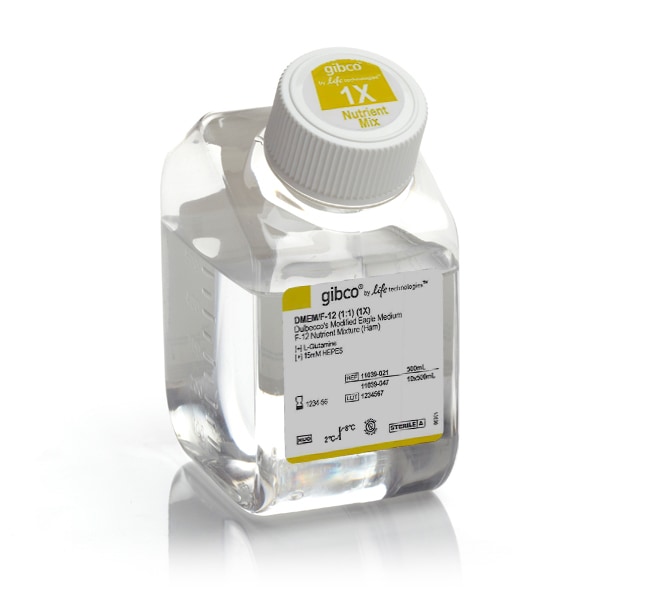
DMEM/F-12, HEPES, no phenol red
DMEM/F-12 (Dulbecco's Modified Eagle Medium/Nutrient Mixture F-12) is a widely used basal medium for supporting the growth of many different詳細を見る


製品番号(カタログ番号) 11039021
価格(JPY)
5,000
Each
数量:
500 mL
DMEM/F-12 (Dulbecco's Modified Eagle Medium/Nutrient Mixture F-12) is a widely used basal medium for supporting the growth of many different mammalian cells. Cells successfully cultured in DMEM/F-12 include MDCK, glial cells, fibroblasts, human endothelial cells, and rat fibroblasts. We offer a variety of DMEM/F-12 modifications for a range of cell culture applications. Find the right formulation using the media selector tool.
This DMEM/F-12 is modified as follows:
With: L-glutamine, HEPES
Without: Phenol Red
The complete formulation is available.
Using DMEM/F-12
DMEM/F-12 is a 1:1 mixture of DMEM and Ham's F-12. This formulation combines DMEM's high concentrations of glucose, amino acids, and vitamins with F-12's wide variety of components. DMEM/F-12 contains no proteins, lipids, or growth factors. Therefore, DMEM/F-12 may require supplementation, commonly with 10% Fetal Bovine Serum (FBS). DMEM/F-12 uses a sodium bicarbonate buffer system and therefore requires a 5–10% CO2 environment to maintain physiological pH.
研究用途にのみご使用ください。診断目的には使用できません。
仕様
細胞株MDCK, glial cells, fibroblasts, human endothelial cells, and rat fibroblasts
濃度1X
製造品質cGMP-compliant under the ISO 13485 standard
製品ラインGibco
製品タイプDMEM (Dulbecco's Modified Eagle Medium)/F-12
数量500 mL
品質保持期間12 Months From Date of Manufacture
出荷条件Room Temperature
分類Animal Origin-free
形状Liquid
Serum LevelStandard Serum Supplementation
無菌性Sterile-filtered
Sterilization MethodSterile-filtered
添加剤ありHigh Glucose, Glutamine, HEPES
添加剤なしNo Phenol Red
Unit SizeEach
組成および保存条件
Storage conditions: 2°C to 8°C (protect from light)
Shipping conditions: Ambient
Shelf life: 12 months from date of manufacture
Shipping conditions: Ambient
Shelf life: 12 months from date of manufacture
よくあるご質問(FAQ)
Do you offer DMEM/F12 medium without folic acid?
How long can I keep my media after supplementing with serum?
My medium was shipped at room temperature but it is supposed to be stored refrigerated. Is it okay?
How can I remove mycoplasma contamination from my cell culture medium?
I see a decrease in growth of my culture. What should I do?
引用および参考文献 (3)
引用および参考文献
Abstract
A comparison between different human hepatocyte models reveals profound differences in net glucose production, lipid composition and metabolism in vitro.
Journal:Experimental cell research
PubMed ID:38499143
Identification of a contractile-responsive element in the cardiac alpha-myosin heavy chain gene.
Journal:J Biol Chem
PubMed ID:8537395
The mechanisms by which the cardiac-specific alpha-myosin heavy chain (alpha-MHC) gene responds to contractile activity was studied in cultured cardiomyocytes and in vivo. Deletion analysis of the alpha-MHC promoter transiently transfected into neonatal rat cardiomyocytes localized the contractile-responsive element within -80 to -40 base pairs of the transcriptional start site.
Activation of the canonical bone morphogenetic protein (BMP) pathway during lung morphogenesis and adult lung tissue repair.
Journal:PLoS One
PubMed ID:22916109
Signaling by Bone Morphogenetic Proteins (BMP) has been implicated in early lung development, adult lung homeostasis and tissue-injury repair. However, the precise mechanism of action and the spatio-temporal pattern of BMP-signaling during these processes remains inadequately described. To address this, we have utilized a transgenic line harboring a BMP-responsive eGFP-reporter