Search


Citations & References (2)
Gibco™
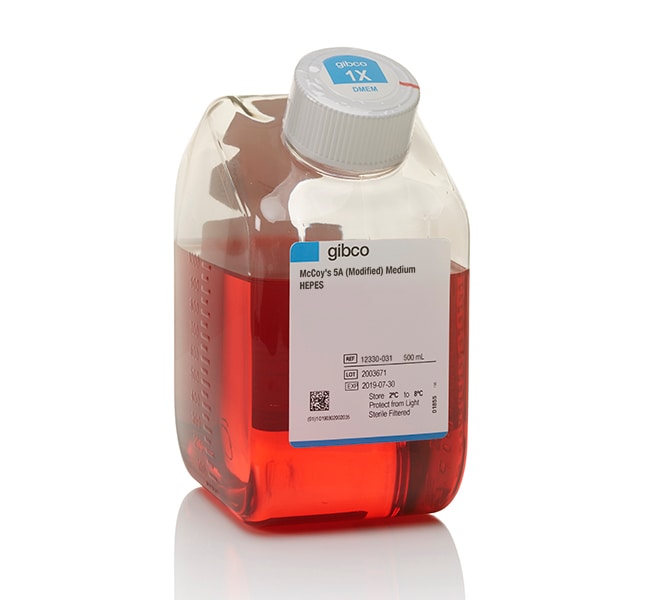
McCoy's 5A (Modified) Medium, HEPES
McCoy's 5A (modified) is a general purpose medium that supports the propagation of many types of primary cells, established cell詳細を見る
| 製品番号(カタログ番号) | 数量 |
|---|---|
| 12330031 | 500 mL |
製品番号(カタログ番号) 12330031
価格(JPY)
4,500
Each
数量:
500 mL
McCoy's 5A (modified) is a general purpose medium that supports the propagation of many types of primary cells, established cell lines, and explants from biopsy tissues. This medium will support the growth of primary mammalian cells derived from normal bone marrow, skin, spleen, kidney, lung, rat embryos, and other tissues.
This McCoy's 5A is modified as follows:
| With | Without |
| • High Glucose | • Sodium Pyruvate |
| • L-glutamine | |
| • Bacto-peptone | |
| • Phenol Red | |
| • HEPES |
The complete formulation is available.
Dr. Thomas McCoy originally formulated McCoy's 5A medium as a modification of Basal Medium 5A. Unlike other media, McCoy's 5A contains the reducing agent glutathione, bacto-peptone, and a high level of glucose. This product also includes Dr. Hsu's addition of Hanks' salts to enable use outside a CO2 incubator.
Not for human or animal therapeutic use. Uses other than the intended use may be a violation of local law. For human ex vivo tissue and cell culture processing applications.
仕様
細胞株Rat fibroblasts
細胞タイプBiopsy Tissues
濃度1 X
製造品質cGMP-compliant under the ISO 13485 standard
製品ラインGibco
製品タイプMcCoy's 5A Modified Medium
数量500 mL
品質保持期間12 Months From Date of Manufacture
出荷条件Room Temperature
分類Animal Origin
形状Liquid
無菌性Sterile-filtered
添加剤ありHigh Glucose, Glutamine, HEPES, Phenol Red
添加剤なしNo Sodium Pyruvate
Unit SizeEach
組成および保存条件
Storage conditions: 2-8° C. Protect from light
Shipping conditions: Ambient
Shelf life: 12 months from date of manufacture
Shipping conditions: Ambient
Shelf life: 12 months from date of manufacture
よくあるご質問(FAQ)
How long can I keep my media after supplementing with serum?
My medium was shipped at room temperature but it is supposed to be stored refrigerated. Is it okay?
How can I remove mycoplasma contamination from my cell culture medium?
I see a decrease in growth of my culture. What should I do?
My cells are not adhering to the culture vessel. What should I do?
引用および参考文献 (2)
引用および参考文献
Abstract
A potential H-DNA element in the MUC1 promoter does not influence transcription.
Journal:J Biol Chem
PubMed ID:8900124
A purine/pyrimidine mirror repeat element (M-PMR3) in the MUC1 promoter has been shown to form H-DNA under in vitro conditions. We investigated this element for biological function in the regulation of transcription of this gene. Chloramphenicol acetyltransferase reporter-promoter constructs were prepared in which the mirror repeat element (PMR3) was intact,
B-Raf is dispensable for K-Ras-mediated oncogenesis in human cancer cells.
Journal:Cancer Res
PubMed ID:15026326
Oncogenic mutations in B-Raf and Kirsten-Ras (K-Ras) are mutually exclusive during human cancer pathogenesis. In an effort to study the biological basis of this epistasis, gene targeting was used to create isogenic sets of human cancer cells differing only in presence or absence of endogenous oncogenic K-Ras or wild-type B-Raf.