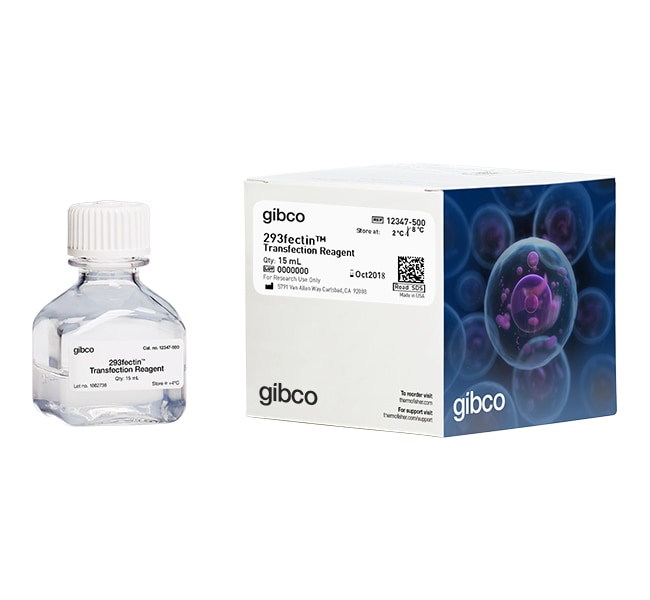
What is the advantage of FreeStyle Max Reagent over 293fectin Transfection Reagent?
Both FreeStyle Max Reagent and 293fectin Transfection Reagent provide similar levels of high transfection efficiency; however, FreeStyle Max Reagent has lower cytotoxicity and hence results in higher protein yields. Additionally, FreeStyle Max Reagent is animal-origin free.
Find additional tips, troubleshooting help, and resources within our Transfection Support Center.
I accidentally left my lipid reagent at room temperature. Can I still use it?
Yes, all of our lipid transfection reagents are stable at room temperature for months.
Find additional tips, troubleshooting help, and resources within our Lipid-Based Transfection Support Center.
What is the difference between reverse transfection and forward transfection? What should I use?
In forward transfection, cells are seeded to appropriate confluence or cell density in wells or dishes, and the lipid-DNA complexes are added the next day. In reverse transfection, the transfection complexes are prepared inside the wells, after which cells and medium are added. Reverse transfection is faster to perform than forward transfection, and is the method of choice for high-throughput transfection. For non-high-throughput transfections, generally forward transfections have better efficiency for most cell types.
Find additional tips, troubleshooting help, and resources within our Transfection Support Center.
Is there a place where I can find references from other researchers who have used your transfection reagents?
Visit the product page for each reagent type and you will see a list of references at the bottom of the page. A table that lists specific cell line references is also accessible. We also recommend www.highwire.org as a search engine to find a large selection of up-to-date research articles using our transfection products. Simply include the name of the transfection reagent and your cell line/application of interest in your search criteria.
Find additional tips, troubleshooting help, and resources within our Transfection Support Center.
Can I use antibiotics in the medium during transfection?
Antibiotics can be used in the medium for culturing of cell lines. However, we do not recommend using antibiotics in the transfection medium unless previously tested in the cell type and payload being transfected. This is because presence of antibiotics during transfection may adversely affect transfection efficiency (i.e., positively charged antibiotics binding to the DNA being transfected) and overall health of cells being transfected.
For stable transfection, we recommend waiting wait 24-48 hrs after transfection before adding selected antibiotics.
Find additional tips, troubleshooting help, and resources within ourTransfection Basics Support Center.