Search


Citations & References (3)
Gibco™
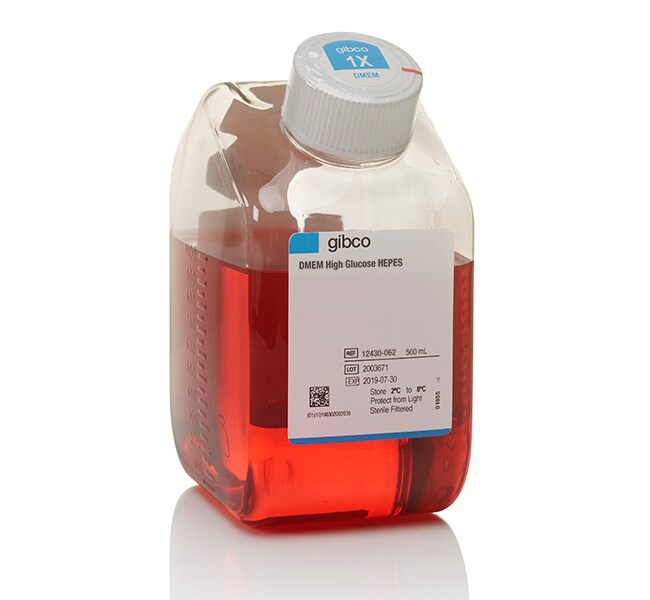
DMEM, high glucose, HEPES
DMEM (Dulbecco's Modified Eagle Medium) is a widely used basal medium for supporting the growth of many different mammalian cells.


製品番号(カタログ番号) 12430054
価格(JPY)
5,000
Each
数量:
1 x 500 mL
DMEM (Dulbecco's Modified Eagle Medium) is a widely used basal medium for supporting the growth of many different mammalian cells. Cells successfully cultured in DMEM include primary fibroblasts, neurons, glial cells, HUVECs, and smooth muscle cells, as well as cell lines such as HeLa, 293, Cos-7, and PC-12. We offer a variety of DMEM modifications for a range of cell culture applications. Find the right formulation using the media selector tool.
This DMEM is modified as follows:
With: High Glucose, L-glutamine, HEPES, Phenol Red
Without: Sodium Pyruvate
Using DMEM
DMEM is unique from other media as it contains 4 times the concentration of amino acids and vitamins than the original Eagle's Minimal Essential Medium. DMEM was originally formulated with low glucose (1 g/L) and sodium pyruvate, but is often used with higher glucose levels, with or without sodium pyruvate. DMEM contains no proteins, lipids, or growth factors. Therefore, DMEM requires supplementation, commonly with 10% Fetal Bovine Serum (FBS). DMEM uses a sodium bicarbonate buffer system (3.7 g/L), and therefore requires a 5–10% CO2 environment to maintain physiological pH.
For Research Use or Further Manufacturing. Not for diagnostic use or direct administration into humans or animals.
仕様
細胞株HeLa, 293, Cos-7, and PC-12
細胞タイプMammalian Cells
濃度1X
培養環境CO2
使用対象(アプリケーション)Mammalian Cell Culture
フォーマットBottle
グルコース濃度4500 mg/L
製造品質cGMP-compliant under the ISO 13485 standard
製品ラインGibco
製品タイプDMEM (Dulbecco's Modified Eagle Medium)
数量1 x 500 mL
品質保持期間12 Months From Date of Manufacture
出荷条件Ambient
分類Animal Origin-free
Culture TypeMammalian Cell Culture
形状Liquid
Serum LevelStandard Serum Supplementation
無菌性Sterile-filtered
Sterilization MethodSterile-filtered
添加剤ありHigh Glucose, Glutamine, HEPES, Phenol Red
添加剤なしNo Sodium Pyruvate
Unit SizeEach
組成および保存条件
Storage conditions: 2°C to 8°C (protect from light)
Shipping conditions: Ambient
Shelf life: 12 months from date of manufacture
Shipping conditions: Ambient
Shelf life: 12 months from date of manufacture
よくあるご質問(FAQ)
What is the manganese concentration in DMEM? Do you offer manganese-free DMEM?
How long can I keep my media after supplementing with serum?
My medium was shipped at room temperature but it is supposed to be stored refrigerated. Is it okay?
How can I remove mycoplasma contamination from my cell culture medium?
I see a decrease in growth of my culture. What should I do?
引用および参考文献 (3)
引用および参考文献
Abstract
The connecting segment between both epidermal growth factor-like domains in blood coagulation factor IX contributes to stimulation by factor VIIIa and its isolated A2 domain.
Journal:J Biol Chem
PubMed ID:11925427
The light chain of activated factor IX comprises multiple interactions between both epidermal growth factor-like domains that contribute to enzymatic activity and binding of factor IXa to its cofactor factor VIIIa. To investigate the association between factor IXa-specific properties and surface-exposed structure elements, chimeras were constructed in which the interconnection
Thiazolidinedione activation of peroxisome proliferator-activated receptor gamma can enhance mitochondrial potential and promote cell survival.
Journal:J Biol Chem
PubMed ID:12082115
'Thiazolidinediones (TZDs) are widely used for treatment of type 2 diabetes mellitus. Peroxisome proliferator-activated receptor gamma (PPAR gamma) is the molecular target of TZDs and is believed to mediate the apoptotic effects of this class of drugs in a variety of cell types, including B and T lymphocytes. The finding
Activation of the proteolytic activity of ADAMTS4 (aggrecanase-1) by C-terminal truncation.
Journal:J Biol Chem
PubMed ID:11796708
'Proteolysis of the hyalectans (aggrecan, versican, brevican) in vivo appears to result from the activity of ADAMTS4 (aggrecanase-1, herein referred to as an hyalectanase). To examine the mode of activation of ADAMTS4, a human chondrosarcoma cell line, JJ012, has been stably transfected with the full-length c-DNA for human ADAMTS4. The