Search

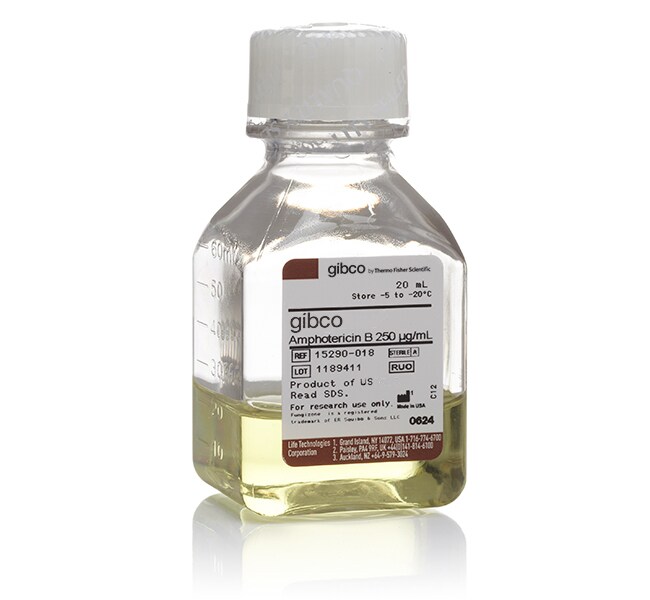


Amphotericin B is the generic version of Fungizone. 'Fungizone' is a trademark of E.R. Squibb & Sons, LLC. Amphotericin B is an antifungal, produced by Streptomyces nodosus. It prevents the growth of fungi by causing an increase in fungal plasma membrane permeability. It actively binds to sterols and leads to the formation of pores. It is used to prevent the contamination of cell cultures by yeast and multicellular fungi. Gibco Amphotericin B contains 250 μg of amphotericin B and 205 μg of sodium deoxycholate per mL of distilled water. The recommended working concentration ranges from 0.25 to 2.50 μg/mL.
Dual-site cGMP manufacturing
For supply chain continuity, we manufacture Gibco Amphotericin B at two separate facilities located in Grand Island, NY and Scotland, UK. Both sites are compliant with cGMP manufacturing requirements, are certified to the ISO 13485 standard, and are registered with the FDA as medical device manufacturers.
Dual-site cGMP manufacturing
For supply chain continuity, we manufacture Gibco Amphotericin B at two separate facilities located in Grand Island, NY and Scotland, UK. Both sites are compliant with cGMP manufacturing requirements, are certified to the ISO 13485 standard, and are registered with the FDA as medical device manufacturers.
研究用途にのみご使用ください。診断目的には使用できません。
仕様
濃度0.25 to 2.5 μg/mL
使用対象(アプリケーション)Prevention of Cell Culture Contamination
製品ラインFungizone
数量20 mL
品質保持期間12 Months
出荷条件Dry Ice
形状Liquid
製品タイプAntifungal
無菌性Sterile-filtered
Unit SizeEach
組成および保存条件
Storage conditions: -5°C to -20°C
Shipping conditions: Frozen on dry ice
Shelf life: 12 months from date of manufacture
Shipping conditions: Frozen on dry ice
Shelf life: 12 months from date of manufacture
よくあるご質問(FAQ)
How many freeze/thaw cycles do you recommend for Amphotericin B?
What is the stability of Amphotericin B when stored at 4 degrees C?
What is the difference between Fungizone and Amphotericin B?
How can I decontaminate my cultures?
What antibiotics do you offer to help control or eliminate cell culture contamination?
引用および参考文献 (8)
引用および参考文献
Abstract
Use of human tissue explants to study human infectious agents.
Journal:Nat Protoc
PubMed ID:19197269
The study of human cell-cell and cell-pathogen interactions that occur in the context of complex tissue cytoarchitecture is critical for deciphering the mechanisms of many normal and pathogenic processes. This protocol describes methods for culturing and infecting explants of human tissues to study the pathogenesis of human infectious agents and
Specific inhibition of ICAM-1 expression mediated by gene targeting with Triplex-forming oligonucleotides.
Journal:J Biol Chem
PubMed ID:12080053
Selected sequences in the DNA double helix can be specifically recognized by oligonucleotides via hydrogen bonding interactions. The resulting triple helix can modulate DNA metabolism and especially interfere with transcription in a gene-specific manner. To explore the potential of triplex-forming oligonucleotides (TFOs) as gene repressors, a TFO was designed to
Endogenous G Protein-coupled Receptor Kinase 6 Regulates M3 Muscarinic Acetylcholine Receptor Phosphorylation and Desensitization in Human SH-SY5Y Neuroblastoma Cells.
Journal:J Biol Chem
PubMed ID:11856737
We have previously shown that overexpression of G protein-coupled receptor kinase 6 (GRK6) enhanced the phosphorylation and desensitization of the endogenously expressed M(3) muscarinic acetylcholine (mACh) receptor in human SH-SY5Y neuroblastoma cells. In this study we have examined the potential role of endogenous GRK6 in the regulation of M(3) mACh
CD40-mediated Activation of NF-kappa B in Airway Epithelial Cells.
Journal:J Biol Chem
PubMed ID:12122011
We have reported previously that airway epithelial cells (AEC) express CD40 and that activation of this molecule stimulates the expression of inflammatory mediators, including the chemokine RANTES (regulated on activation normal T cell expressed and secreted). Because NF-kappaB regulates the expression of many inflammatory mediators, such as RANTES, we utilized
A Dynamic Variation of Pulmonary ACE2 Is Required to Modulate Neutrophilic Inflammation in Response to
Journal:J Immunol
PubMed ID:31645418
'Angiotensin-converting enzyme 2 (ACE2) is a potent negative regulator capable of restraining overactivation of the renin-angiotensin system, which contributes to exuberant inflammation after bacterial infection. However, the mechanism through which ACE2 modulates this inflammatory response is not well understood. Accumulating evidence indicates that infectious insults perturb ACE2 activity, allowing for