ABI PRISM 7000 および Applied Biosystems 7300、7500、7500、7900HT SystemのSDS ソフトウェアでは、"Relative Quantification Plate Assay(ddCt)”を指定した場合、なぜ"ADD DISSOCIATION CURVE"ボタンが無効になってしまうのですか?
旧バージョンのソフトウェアでは、Relative Quantification Plate(⊿⊿Ct)アッセイを行う場合、同一ファイル中に融解曲線を設定することができません。ただし最近の機種や、7500/7500fastの最新のsofware( ver.2.0.5)では、サイクルステージの直後にmelt curve(融解曲線)が設定可能となっています。
なお旧バージョンのソフトウェアの場合は、Relative Quantification Plate(⊿⊿Ct)アッセイを行った後に、新しいRunファイルを作成し、融解曲線のみのプログラムでRunを行ってください。
融解曲線のみのRunを行う場合、"File"から "New"を選択します。展開された" New Document Wizard"画面中の"Assay"のプルダウンメニューから"DISSOCIATION"を選択し、融解曲線のみのRunを行ってください。この場合、解析ファイルとは別に融解曲線のみのSDSファイルが作成されます。
Which components of the SuperScript III First Strand Synthesis System for RT-PCR are available for purchase separately?
The following components are available as stand-alone items:
- Superscript III Reverse Transcriptase (Cat. Nos. 18080093, 18080044, 18080085)
- Oligo (dT)20 Primer (Cat. No. 18418020)
- Random hexamers (Cat. No. 48190011)
- 10 mM dNTP Mix (Cat. Nos. 18427013, 18427088)
- RNAseOUT Recombinant Ribonuclease Inhibitor (Cat. No. 10777019)
- E. coli RNAse H (Cat. Nos. 18021014, 18021071)
I am interested in generating cDNA from total RNA. What is the difference between SuperScript III Reverse Transcriptase and SuperScript III First Strand Synthesis System for RT-PCR?
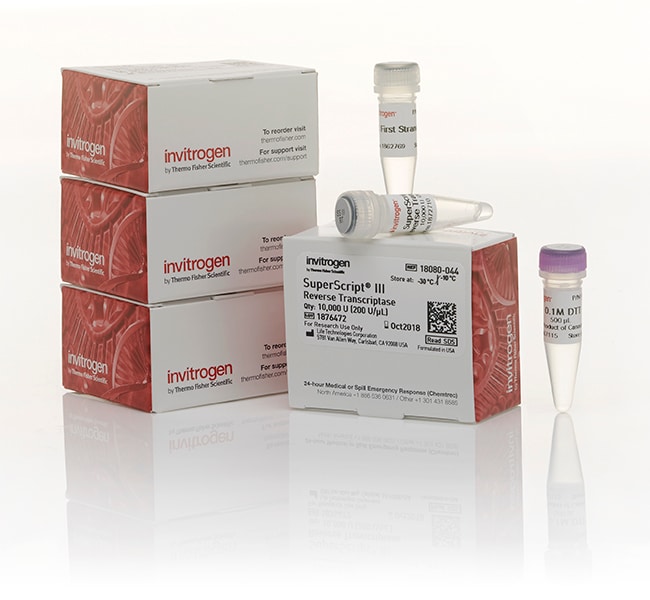
SuperScript III Reverse Transcriptase (Cat. Nos. 18080093, 18080044, 18080085) contains the stand-alone enzyme and a vial each of 5X first-strand buffer and 100 mM DTT.
SuperScript III First Strand Synthesis System for RT-PCR is a complete kit that provides the SuperScript III Reverse Transcriptase and all the other components required for synthesis of first-strand cDNA from total or poly(A)- RNA. It includes:
- Superscript III Reverse Transcriptase
- Oligo (dT)20 Primer
- Random hexamers
- 10X RT buffer
- 25 mM MgCl2
- 0.1 M DTT
- 10 mM dNTP Mix
- RNAseOUT Recombinant Ribonuclease Inhibitor
- E. coli RNAse H
- DEPC-treated water
- Total HeLa RNA control
- Sense control primer
- Anti-sense control primer
Note: The kit does not include the PCR amplification enzyme.
How can I remove genomic DNA contamination from my sample prior to performing RT-PCR?
If amplification products are generated in the control tube/well that contains no reverse transcriptase (i.e., the no-RT control), it may be necessary to eliminate residual genomic DNA from the RNA sample. Use the following protocol to remove genomic DNA from the total RNA preparation.Random primers are the best choice for degraded RNA, RNA with heavy secondary structure, non-polyadenylated RNA, or prokaryotic RNA. It is recommended only for two-step RT-PCR, and typically gives the highest yields, although the cDNA may not necessarily be full length. Oligo(dT) primers are good to use when trying to recover full-length cDNA from 2-step RT-PCR. The reaction is influenced by secondary structure and RNA quality. Gene specific primers should be used for very specific, mainly one-step RT-PCR reactions.
Random primers are the best choice for degraded RNA, RNA with heavy secondary structure, non-polyadenylated RNA, or prokaryotic RNA. It is recommended only for two-step RT-PCR, and typically gives the highest yields, although the cDNA may not necessarily be full length. Oligo(dT) primers are good to use when trying to recover full-length cDNA from 2-step RT-PCR. The reaction is influenced by secondary structure and RNA quality. Gene specific primers should be used for very specific, mainly one-step RT-PCR reactions.
Add the following to an autoclaved 0.5 mL microcentrifuge tube on ice:
1.Total RNA, ideally, less than or equal to 1 µg. (See Note 1 below.)
2.1.0 µL of 10X DNase buffer (200 mM Tris, pH 8.3, 500 mM KCl, 20 mM MgCl2).
3.0.1 U-3.0 U of DNase I (RNase-free, Cat. No. 18047019) or 1.0 U Dnase I, Amplification Grade (Cat. No. 18068015. (See Note 2 below.)
4.Bring volume up to 10 µL with DEPC-treated water.
5.Incubate at room temperature for 15 min. (See Note 3 below.)
6.Terminate the reaction by adding 1 µL 25 mM EDTA and heat 10 min at 65 degrees C. (See Note 4 below.)
7.Place on ice for 1 minute.
8.Collect by brief centrifugation. This mixture can be used directly for reverse transcription.
Please note the following:
1.To work with higher quantities of RNA, scale up the entire reaction linearly. Do not exceed 2 µg RNA in the 10 µL reaction. More RNA will increase the viscosity of the solution and prevent the DNAse I from diffusing and finding the DNA.
2.DNAse I, Amplification Grade has been extensively purified to remove trace ribonuclease activities commonly associated with other "RNAse-free" enzyme preparations and does not require the addition of placental RNAse inhibitor.
3.It is important not to exceed the 15 minute incubation time or the room temperature incubation. Higher temperatures and longer times could lead to Mg2+-dependent hydrolysis of the RNA.
4.This procedure requires careful pipetting of all solutions so that the concentration of divalent metal cation (Mg2+) is controlled.
5.Because the DNAse I must be heated to 65 degrees C to inactivate the enzyme, the concentration of free divalent metal ions must be low enough (less than 1 mM) after addition of the EDTA to prevent chemical hydrolysis of the RNA. See references below.
After the addition of EDTA, there is an approximately 1:1 molar ratio of Mg2+ :EDTA. EDTA chelates Mg2+ molecules on a 1:1 molar basis. Therefore, this RNA can be directly used in a reverse transcription reaction. First-strand reverse transcription buffers typically result in a final concentration of 2.5 mM Mg2+. If the reverse transcription buffer does not contain MgCl2, add it to the reaction at a final concentration of 2.5 mM. This results in a net final concentration of approximately 2.25 to 2.5 mM MgCl2.
References on RNA hydrolysis:
Molekulyarnaya Biologiya (1987) 21:1235-1241.
References on the mechanism of hydrolysis by other cations:
Eichorn GL and Butzov JY (1965) Biopolymers 3:79.
Butzov JY and Eichorn GL (1965) Biopolymers 3:95.
Farkas WR (1968) Biochim Biophys Acta 155:401.
The authors of the first paper express the opinion that the mechanism of the nonspecific hydrolysis by cations which proceeds through 2',3' cyclic phosphate formation is similar to that of specific hydrolysis such as RNA splicing.
How much RNA should be employed for first-strand cDNA synthesis?
The amount of RNA template for a cDNA synthesis is highly flexible and depends upon the amount of sample available and an individual's need. In general, 1 µg total RNA is used in a typical 20-µL RT reaction.
Find additional tips, troubleshooting help, and resources within ourReverse Transcription and RACE Support Center.