Search


Citations & References (3)
Invitrogen™
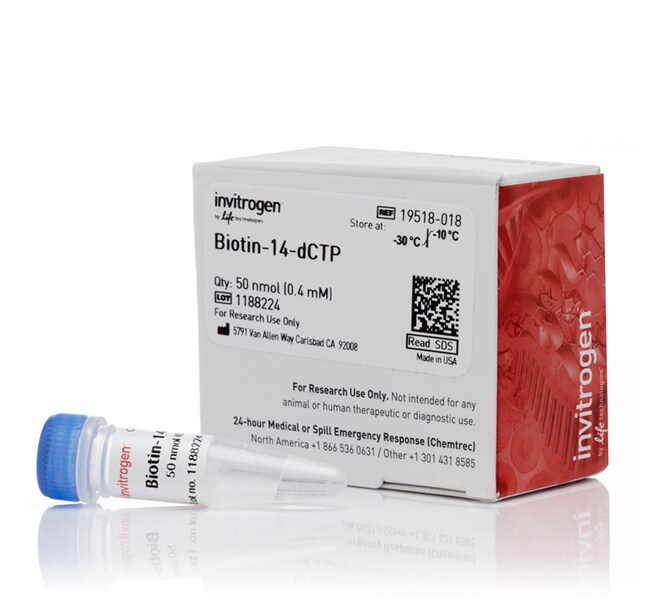
Biotin-14-dCTP
ビオチン-14 dCTPは、DNAビオチン化に使用されます。これは、従来の放射性同位体標識に代わる非常に優れた製品で、場合によってはより優れた代替品となります。ビオチン化DNAプローブを使用する利点は以下のとおりです:•利便性と安全性—プローブの調製では放射性廃棄物が発生しません。•安定性—プローブは同位体標識プローブよりも長期間アクティブな状態を維持します。•汎用性—ビオチン化DNAは、ストレプトアビジン結合を介した固定化および回収手順に使用できます詳細を見る
| 製品番号(カタログ番号) | 数量 |
|---|---|
| 19518018 | 50 nmol |
製品番号(カタログ番号) 19518018
価格(JPY)
62,000
Each
数量:
50 nmol
ビオチン-14 dCTPは、DNAビオチン化に使用されます。これは、従来の放射性同位体標識に代わる非常に優れた製品で、場合によってはより優れた代替品となります。ビオチン化DNAプローブを使用する利点は以下のとおりです:
•利便性と安全性—プローブの調製では放射性廃棄物が発生しません。
•安定性—プローブは同位体標識プローブよりも長期間アクティブな状態を維持します。
•汎用性—ビオチン化DNAは、ストレプトアビジン結合を介した固定化および回収手順に使用できます。
ビオチン-14-dCTPについて
ビオチン-14-dCTPは、14-atomリンカーによってピリミジン塩基のN4位にビオチンが結合した特許取得済みのdCTPアナログです。このヌクレオチドは、dATP、dGTP、およびdTTPが存在する場合にニックトランスレーションによって効率的に DNA に取り込まれ、DNAに末端デオキシヌクレオチドトランスフェラーゼを標識したり、ランダムプライマー合成を行うことができます。提供される物質の量は、最大50µgのDNAを標識するのに十分です。
パフォーマンス試験および品質試験
純度は、逆相HPLCで評価されます。
•利便性と安全性—プローブの調製では放射性廃棄物が発生しません。
•安定性—プローブは同位体標識プローブよりも長期間アクティブな状態を維持します。
•汎用性—ビオチン化DNAは、ストレプトアビジン結合を介した固定化および回収手順に使用できます。
ビオチン-14-dCTPについて
ビオチン-14-dCTPは、14-atomリンカーによってピリミジン塩基のN4位にビオチンが結合した特許取得済みのdCTPアナログです。このヌクレオチドは、dATP、dGTP、およびdTTPが存在する場合にニックトランスレーションによって効率的に DNA に取り込まれ、DNAに末端デオキシヌクレオチドトランスフェラーゼを標識したり、ランダムプライマー合成を行うことができます。提供される物質の量は、最大50µgのDNAを標識するのに十分です。
パフォーマンス試験および品質試験
純度は、逆相HPLCで評価されます。
研究用にのみ使用できます。診断用には使用いただけません。
仕様
濃度0.4 mM
形状液体
標識法直接標識
標識または色素ビオチン&その他のハプテン
製品タイプ標識ヌクレオチド
数量50 nmol
出荷条件ドライアイス
Unit SizeEach
組成および保存条件
ビオチン-14-dCTPは、100 mMのトリス塩酸(pH 7.5)、0.1 mM EDTAを溶媒とし、0.4 mMで提供されます。-20℃で保存
引用および参考文献 (3)
引用および参考文献
Abstract
Novel biotinylated nucleotide--analogs for labeling and colorimetric detection of DNA.
Journal:Nucleic Acids Res
PubMed ID:3588302
'A series of dATP and dCTP nucleotide analogs have been synthesized which are modified by attachment of aliphatic linkers containing a functional group to the amino-nitrogen at the hydrogen bonding positions of the bases, that is, at the 6-position of adenine and the 4-position of cytosine. These nucleotides are incorporated
Differential incorporation of biotinylated nucleotides by terminal deoxynucleotidyl transferase.
Journal:Nucleic Acids Res
PubMed ID:1317552
Comparison of detection and signal amplification methods for DNA microarrays.
Journal:Mol Cell Probes
PubMed ID:18675897
One of the factors limiting the use of DNA microarray technology for the detection of pathogenic organisms from clinical and environmental matrices has been inadequate assay sensitivity. To assess the effectiveness of post-hybridization secondary detection steps to enhance the sensitivity of DNA microarray-based pathogen detection, we evaluated a panel of