Search

Thermo Scientific™
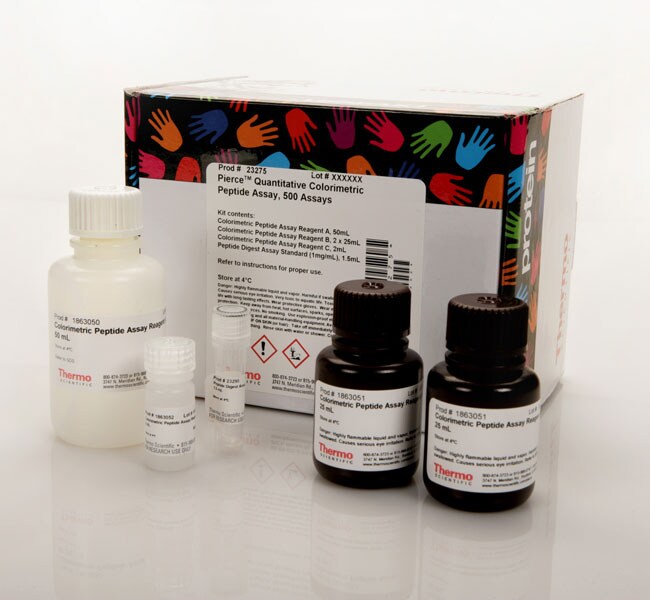
Pierce™ Quantitative Peptide Assays & Standards
Pierce colorimetric or fluorescent quantitative peptide assays and standards are easy-to-use microplate assays designed specifically to improve the sensitivity and reproducibility of peptide quantitation for use with mass spectrometry analysis.


製品番号(カタログ番号) 23275
価格(JPY)
87,800
Each
製品タイプ:
ペプチドアッセイ
検出法:
比色法
Pierce colorimetric or fluorescent quantitative peptide assays are easy mix-and-read microplate assays with stable signals for accurate and robust measurement of peptide digest samples. A high-quality peptide digest reference standard is provided as a stand-alone, or in the kits for use in the generation of linear standard curves for improved accuracy and reproducibility. The increased sensitivity, low sample assay volume, and included reference standard are essential for accurate and robust measurement of peptide digest samples for normalization of sample injection amount for MS analysis.
• Sensitive—accurately detect as little as 5 μg/mL (fluorometric) or 25 μg/mL (colorimetric) of peptide mixture
• Reproducible—assay performance rigorously tested using peptide digest mixtures
• Robust peptide digest standard—kit includes a validated peptide digest standard for improved reproducibility of quantitation
• Compatible—works with many reagents, including MS sample preparation reagents and TMT-labeled peptides (fluorometric assay)
• Convenient—easy, mix-and-read format with stable signal that may be read in as little as 5 minutes (fluorometric) or 15 minutes (colorimetric)
Pierce Quantitative Colorimetric Peptide Assay provides modified BCA reagents for the reduction of Cu+2 to Cu+1, a proprietary chelator optimized for the quantitation of peptide mixtures, and peptide digest reference standard for use in the generation of control linear standard curves. This colorimetric peptide assay requires a small amount of sample (20 μL) and has a working peptide concentration range of 25–1000 μg/mL. In the reaction, the copper is first reduced by the amide backbone of peptides under alkaline conditions (Biuret reaction), followed by the chelator coupling with the reduced copper to form a bright red complex (absorbs at 480 nm) that can be read in as little as 15 minutes. The signal produced from this reaction is 3–4 fold more sensitive than the Micro-BCA Protein Assay for peptide analysis. Colorimetric peptide assay is compatible with TMT-labeled peptides but is not recommended for synthetic peptides because the assay is affected by peptide amino acid content.
Pierce Quantitative Fluorescent Peptide Assay reagents include peptide assay buffer, fluorescent peptide labeling reagent, and a peptide digest assay standard for the quantitative measurement of peptide concentrations. This sensitive assay requires only 10 μL of sample, produces a linear response with increasing peptide concentrations (5–1000 μg/mL), and results in a stable final fluorescence that can be detected in as little as 5 minutes. In this assay, peptides are specifically labeled at the amino-terminus using an amine-reactive fluorescent reagent that is non-fluorescent until reacted with tryptic peptides. The fluorescently labeled peptides are detected on a microplate reader (ex390/em475). This assay is suitable for the quantitative measurement of peptide digest mixtures and synthetic peptides with an unblocked amino terminus. Fluorescent assays are not compatible with TMT-labeled peptides.
Thermo Scientific Peptide Digest Assay Standard was designed as a reference standard for use with the Pierce quantitative fluorometric and colorimetric peptide assays to improve reproducibility and accuracy of peptide quantitation. The Peptide Digest Assay Standard is provided in ready-to-use liquid format at 1 mg/mL. The reference protein has been digested with MS-grade trypsin to minimize missed cleavages. To help ensure consistent performance, digestion efficiency of the protein is monitored to help ensure lot-to-lot consistency, and quality is assessed by comparison to a reference standard.
Applications
• Normalizing sample concentrations for quantitative downstream applications
• Normalizing sample loading volumes for LC, MS, and LC/MS applications
• Measuring recovery after peptide clean-up procedures
• Reproducible—assay performance rigorously tested using peptide digest mixtures
• Robust peptide digest standard—kit includes a validated peptide digest standard for improved reproducibility of quantitation
• Compatible—works with many reagents, including MS sample preparation reagents and TMT-labeled peptides (fluorometric assay)
• Convenient—easy, mix-and-read format with stable signal that may be read in as little as 5 minutes (fluorometric) or 15 minutes (colorimetric)
Pierce Quantitative Colorimetric Peptide Assay provides modified BCA reagents for the reduction of Cu+2 to Cu+1, a proprietary chelator optimized for the quantitation of peptide mixtures, and peptide digest reference standard for use in the generation of control linear standard curves. This colorimetric peptide assay requires a small amount of sample (20 μL) and has a working peptide concentration range of 25–1000 μg/mL. In the reaction, the copper is first reduced by the amide backbone of peptides under alkaline conditions (Biuret reaction), followed by the chelator coupling with the reduced copper to form a bright red complex (absorbs at 480 nm) that can be read in as little as 15 minutes. The signal produced from this reaction is 3–4 fold more sensitive than the Micro-BCA Protein Assay for peptide analysis. Colorimetric peptide assay is compatible with TMT-labeled peptides but is not recommended for synthetic peptides because the assay is affected by peptide amino acid content.
Pierce Quantitative Fluorescent Peptide Assay reagents include peptide assay buffer, fluorescent peptide labeling reagent, and a peptide digest assay standard for the quantitative measurement of peptide concentrations. This sensitive assay requires only 10 μL of sample, produces a linear response with increasing peptide concentrations (5–1000 μg/mL), and results in a stable final fluorescence that can be detected in as little as 5 minutes. In this assay, peptides are specifically labeled at the amino-terminus using an amine-reactive fluorescent reagent that is non-fluorescent until reacted with tryptic peptides. The fluorescently labeled peptides are detected on a microplate reader (ex390/em475). This assay is suitable for the quantitative measurement of peptide digest mixtures and synthetic peptides with an unblocked amino terminus. Fluorescent assays are not compatible with TMT-labeled peptides.
Thermo Scientific Peptide Digest Assay Standard was designed as a reference standard for use with the Pierce quantitative fluorometric and colorimetric peptide assays to improve reproducibility and accuracy of peptide quantitation. The Peptide Digest Assay Standard is provided in ready-to-use liquid format at 1 mg/mL. The reference protein has been digested with MS-grade trypsin to minimize missed cleavages. To help ensure consistent performance, digestion efficiency of the protein is monitored to help ensure lot-to-lot consistency, and quality is assessed by comparison to a reference standard.
Applications
• Normalizing sample concentrations for quantitative downstream applications
• Normalizing sample loading volumes for LC, MS, and LC/MS applications
• Measuring recovery after peptide clean-up procedures
For Research Use Only. Not for use in diagnostic procedures.
仕様
最終産物タイプペプチド
使用対象 (装置)マイクロプレートリーダー
数量500アッセイ
ワークフローステップインプロセステスト
検出法比色法
フォーマットKit
製品ラインPierce
製品タイプペプチドアッセイ
原料ペプチド, プロテアーゼ消化タンパク質
Unit SizeEach
組成および保存条件
比色アッセイ試薬A、50 mL
比色アッセイ試薬B、2 x 25 mL
比色アッセイ試薬C、2 mL
ペプチド消化アッセイ標準液、1.5 mL
冷蔵庫で保存してください(2~8℃)。
比色アッセイ試薬B、2 x 25 mL
比色アッセイ試薬C、2 mL
ペプチド消化アッセイ標準液、1.5 mL
冷蔵庫で保存してください(2~8℃)。