Search


Citations & References (6)
Invitrogen™
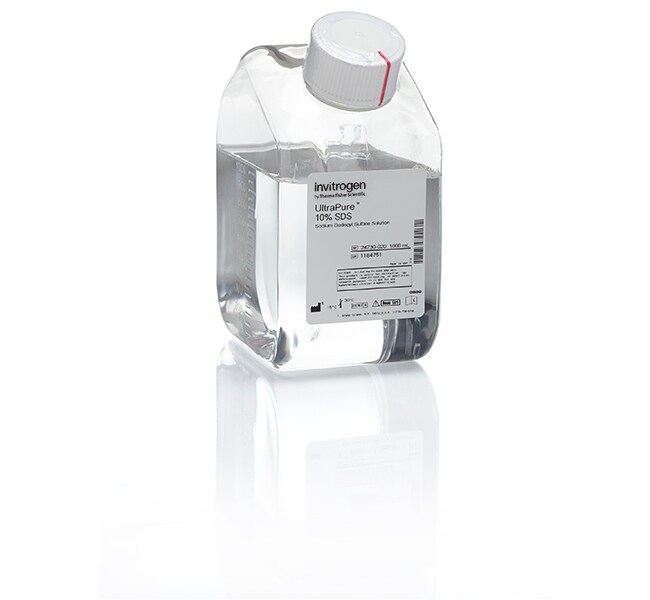
UltraPure™ SDS Solution, 10%
UltraPure™ 10% SDS溶液は、10%のドデシル硫酸ナトリウム(SDS)を含む混合前水溶液です。SDSは、分子量測定のためのポリアクリルアミドゲル電気泳動で使用されるタンパク質変性剤です。また、DNA抽出プロトコルでの核酸-タンパク質複合体の解離詳細を見る


製品番号(カタログ番号) 24730020
価格(JPY)
29,100
Each
数量:
1 L
UltraPure™ 10% SDS溶液は、10%のドデシル硫酸ナトリウム(SDS)を含む混合前水溶液です。SDSは、分子量測定のためのポリアクリルアミドゲル電気泳動で使用されるタンパク質変性剤です。また、DNA抽出プロトコルでの核酸-タンパク質複合体の解離、細胞膜の破壊、およびプレハイブリダイゼーション溶液およびハイブリダイゼーション溶液の調製にも使用されます。UltraPure™ 10 % SDS溶液はろ過されており、すぐに使用できます。
研究用にのみ使用できます。診断用には使用いただけません。
仕様
濃度0.1
使用対象(アプリケーション)核酸ゲル電気泳動、ブロッティング
形状液体
数量1 L
試薬タイプSDS
出荷条件室温
製品ラインUltraPure
製品タイプSDS溶液
Unit SizeEach
組成および保存条件
10%濃度(w/v)のUltrapure SDSボトル(1 L)1本。室温保存。
よくあるご質問(FAQ)
Why do solutions containing SDS form precipitates?
引用および参考文献 (6)
引用および参考文献
Abstract
Diversity of human small intestinal Streptococcus and Veillonella populations.
Journal:FEMS Microbiol Ecol
PubMed ID:23614882
'Molecular and cultivation approaches were employed to study the phylogenetic richness and temporal dynamics of Streptococcus and Veillonella populations in the small intestine. Microbial profiling of human small intestinal samples collected from four ileostomy subjects at four time points displayed abundant populations of Streptococcus spp. most affiliated with S. salivarius, S. thermophilus,
Determine the effect of p53 on chemosensitivity.
Journal:Methods Mol Biol
PubMed ID:23150441
'The p53 tumor suppressor protein plays a central role in mediating the cellular response to a variety of stresses. Activation of p53 signaling will trigger cell cycle arrest or apoptosis in normal cells, depending on such factors as cell type and genetic context. The ability of a cell to circumvent
Visualization of fas-mediated death-inducing signaling complex formation by immunoprecipitation.
Journal:Methods Mol Biol
PubMed ID:23397387
The prototypical death receptor Fas (also known as CD95 or Apo-1) plays an essential role in the maintenance of lymphocyte homeostasis. Propagation of cell death through Fas relies on the formation of a multiprotein complex at the receptor level known as the death-inducing signaling complex (DISC). Here, we describe an
Collagen I confers gamma radiation resistance.
Journal:Appl Radiat Isot
PubMed ID:22705234
The effect of collagen on the response of somatomammotroph tumor cells (GH3) to gamma, radiation therapy was studied in vitro. After incubating confluent GH3 cell monolayers in a serum-free, maintaining medium, either with or without collagen, the monolayers were irradiated with 137Cs, gamma radiation. Collagen reduces cell mortality via ERK1/2
Microarray-based CGH and copy number analysis of FFPE samples.
Journal:Methods Mol Biol
PubMed ID:21370011
Over the past decade, utilization of microarray technology has flourished in biomedical research. It has evolved rapidly into a revolutionary tool that offers deeper insight into the molecular basis associated with complex diseases, especially in the field of cancer. Specifically, array-based Comparative Genomic Hybridization (aCGH) permits the detection of genome-wide