Search


Citations & References (4)
Invitrogen™
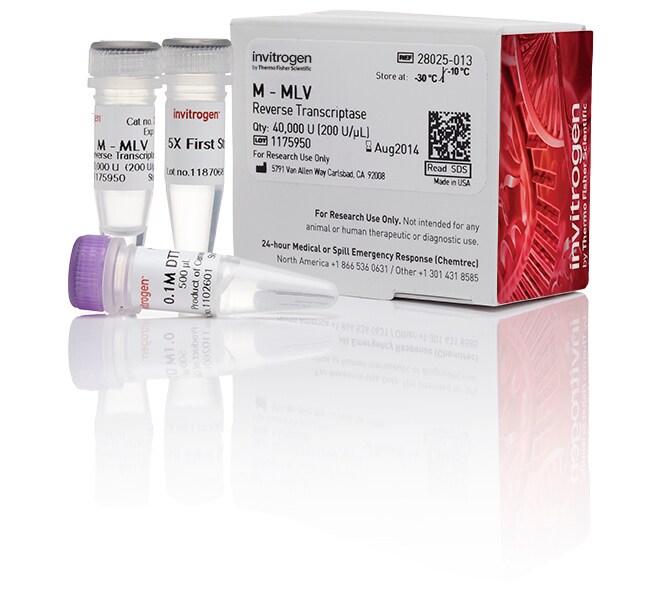
M-MLV Reverse Transcriptase (200 U/μL)
M-MLV Reverse Transcriptaseは、ファーストストランドRNA、DNA、または RNA:DNAハイブリッドから相補的なDNA鎖を合成する組み換え DNAポリメラーゼです。AMV RTと比較すると詳細を見る


製品番号(カタログ番号) 28025021
価格(JPY)
286,100
Each
反応数:
1000反応
M-MLV Reverse Transcriptaseは、ファーストストランドRNA、DNA、または RNA:DNAハイブリッドから相補的なDNA鎖を合成する組み換え DNAポリメラーゼです。AMV RTと比較すると、モロニーマウス白血病ウイルス逆転写酵素(M-MLV RT)は、DNAエンドヌクレアーゼ活性を持たず、RNase H 活性は低くなります。この酵素の特長:
•熱安定性—37°℃で最適な活性を示します
• cDNAのサイズ—M-MLVは、7 kbまでの第一鎖cDNAを合成することができます
• アプリケーション—第一鎖cDNAの合成、プライマーの伸長、dsDNAのシーケンシング、cDNAライブラリ、 RT-PCR
ソース
プラスミド上でM-MLVのpoli遺伝子を発現している大腸菌から精製
性能および品質検査
SDS-PAGE純度、Endodedoxyribonuclease, exodedoxyribonuclease, リボヌクレアーゼアッセイ, およびcDNA生成物の収量と長さ
ユニット定義
M-MLV RTの1ユニットは、37°℃で10分の条件下で、ポリ(A)オリゴ(dT)25をテンプレートプライマーとして、1 nmoleのデオキシリボヌクレアーゼを酸沈降物に組み込むために必要な酵素の量です。
最適な反応条件
50 mM Tris-HCl(pH 8.3)、40 mM KCl、6 mM MgCl2、1 mM DTT、0.5 mM [3H]dTTP、0.1 mM poly(A)、0.1 mM オリゴ(dT)25、0.1 mg/mL BSA、および50 µLの酵素(37°℃で10分間)
•熱安定性—37°℃で最適な活性を示します
• cDNAのサイズ—M-MLVは、7 kbまでの第一鎖cDNAを合成することができます
• アプリケーション—第一鎖cDNAの合成、プライマーの伸長、dsDNAのシーケンシング、cDNAライブラリ、 RT-PCR
ソース
プラスミド上でM-MLVのpoli遺伝子を発現している大腸菌から精製
性能および品質検査
SDS-PAGE純度、Endodedoxyribonuclease, exodedoxyribonuclease, リボヌクレアーゼアッセイ, およびcDNA生成物の収量と長さ
ユニット定義
M-MLV RTの1ユニットは、37°℃で10分の条件下で、ポリ(A)オリゴ(dT)25をテンプレートプライマーとして、1 nmoleのデオキシリボヌクレアーゼを酸沈降物に組み込むために必要な酵素の量です。
最適な反応条件
50 mM Tris-HCl(pH 8.3)、40 mM KCl、6 mM MgCl2、1 mM DTT、0.5 mM [3H]dTTP、0.1 mM poly(A)、0.1 mM オリゴ(dT)25、0.1 mg/mL BSA、および50 µLの酵素(37°℃で10分間)
研究用にのみ使用できます。診断用には使用いただけません。
仕様
最終産物タイプcDNA(ファーストストランド)
フォーマットスタンドアローン酵素
反応数1000反応
最適反応温度37℃
数量1000反応
反応形態分離コンポーネント
試薬タイプ逆転写反応試薬
逆転写酵素M-MLV
リボヌクレアーゼH活性可
出荷条件湿氷
サイズ(最終製品)7 kb以下
原料RNA
技術Reverse Transcription
濃度200 U/μL
反応速度スタンダード
Unit SizeEach
組成および保存条件
内容:
• M-MLV RT(200 U/μL)、1 x 1 mL
• ファーストストランドバッファー[250 mMトリス-HCl(pH 8.3)、375 mM KCl、15 mM塩化マグネシウム]、4 x 1 mL
• 100 mM DTT、4 x 500 μL
-20℃で保存。
• M-MLV RT(200 U/μL)、1 x 1 mL
• ファーストストランドバッファー[250 mMトリス-HCl(pH 8.3)、375 mM KCl、15 mM塩化マグネシウム]、4 x 1 mL
• 100 mM DTT、4 x 500 μL
-20℃で保存。
よくあるご質問(FAQ)
ABI PRISM 7000 および Applied Biosystems 7300、7500、7500、7900HT SystemのSDS ソフトウェアでは、"Relative Quantification Plate Assay(ddCt)”を指定した場合、なぜ"ADD DISSOCIATION CURVE"ボタンが無効になってしまうのですか?
How much of the first-strand cDNA reaction should I load for PCR?
What is the highest temperature that SuperScript III , SuperScript II, MMLV, or ThermoScript can be used?
Can I use a DNA-RNA hybrid as a template for M-MLV Reverse Transcriptase (Cat. No. 28025013, 28025021)? Can other reverse transcriptases, such as SuperScript reverse transcriptase, be used in the same way?
Can I use elevated temperatures for reverse transcription with Moloney Murine Leukemia Virus (M-MLV)?
引用および参考文献 (4)
引用および参考文献
Abstract
Raloxifene Upregulated Mesangial Cell MMP-2 Activity via ER-ß Through Transcriptional Regulation.
Journal:Cell Biochem Biophys
PubMed ID:23471663
'Raloxifene, a second-generation selective estrogen receptor modulator, exerts estrogen-like effects in specific tissues. In this present study, we examined the effect of raloxifene on mesangial cell matrix metalloproteinase-2 (MMP-2) activity in streptozotocin-induced diabetic mice. Raloxifene increased the MMP-2 level in a dose-dependent and receptor-mediated manner. An antibody against estrogen receptor-ß
Single cell rt-PCR identification of odorant receptors expressed by olfactory neurons.
Journal:Methods Mol Biol
PubMed ID:23585038
'Mammals have between 400 and 1,300 functional odorant receptor (OR) genes in their genomes. Each olfactory sensory neuron in the nose expresses only one single type of OR out of this vast repertoire. The OR expressed by an olfactory sensory neuron determines its functional activity and wiring to the olfactory
Fast-mode duplex qPCR for BCR-ABL1 molecular monitoring: innovation, automation, and harmonization.
Journal:Am J Hematol
PubMed ID:22566190
Reverse transcription quantitative polymerase chain reaction (RTqPCR)is currently the most sensitive tool available for the routine monitoring of disease level in patients undergoing treatment for BCRABL1 associated malignancies. Considerable effort has been invested at both the local and international levels to standardise the methodology and reporting criteria used to assess
Transforming growth factor-ß is required for vasculogenic mimicry formation in glioma cell line U251MG.
Journal:Cancer Biol Ther
PubMed ID:22104964
Both vasculogenic mimicry (VM) and transforming growth factor-ß (TGFß) are positively correlated with malignancy in glioma. Accordingly, we supposed that TGFß might be related with VM, and aimed to detect whether TGFß could influence VM formation in two glioma cell lines U251MG and SHG44, which were different in malignancy. We