Search


Citations & References (3)
Thermo Scientific™
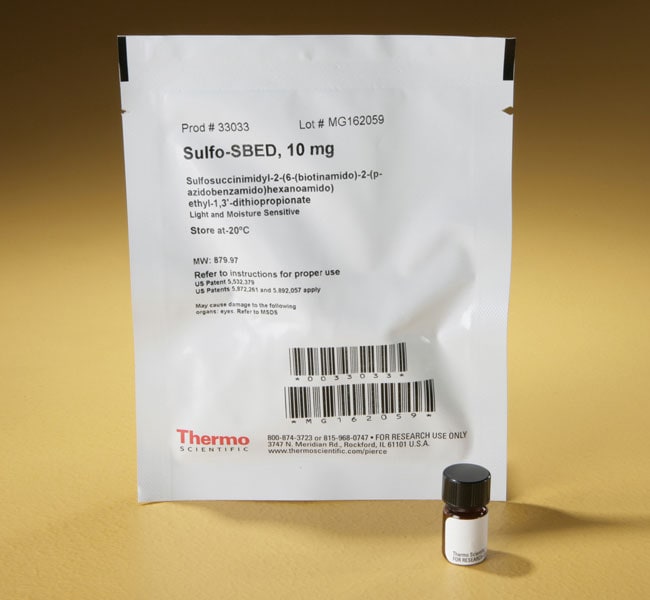
Sulfo-SBED Biotin Label Transfer Reagent, No-Weigh™ Format
Thermo Scientific Pierce Sulfo-SBED Biotin Label Transfer Reagentは、精製タンパク質を標識して、そのタンパク質の相互作用に結合ビオチンタグを転移するための多機能試薬です詳細を見る


製品番号(カタログ番号) 33033
価格(JPY)
54,100
온라인 행사
Ends: 25-Dec-2026
77,400割引額 23,300 (30%)
Each
数量:
10 mg
Thermo Scientific Pierce Sulfo-SBED Biotin Label Transfer Reagentは、精製タンパク質を標識して、そのタンパク質の相互作用に結合ビオチンタグを転移するための多機能試薬です。
Sulfo-SBEDは、Sulfo-N-hydroxysuccinimidyl-2-(6-[biotinamido]-2-(p-azido benzamido)-hexanoamido) ethyl-1,3'-dithioproprionateの略です。これはヘテロ二官能性の化学クロスリンク剤で、一方の末端で1級アミンに、もう一方の末端でほぼすべてのタンパク質官能基に共有結合できます。Sulfo-SBEDは一般的なクロスリンカーとは異なり、ビオチン基と切断可能なジスルフィドスペーサーアームも含んでいます。これらの特性の組み合わせにより、相互作用するタンパク質を連続的にクロスリンクし、ビオチンアフィニティータグをあるタンパク質(精製された「誘引」タンパク質)から別のタンパク質(未知の「被誘引」タンパク質)に転移できます。ラベルトランスファーは、タンパク質相互作用の発見に有用な強力なin vitro法です。ますます多くの論文で、Sulfo-SBED Biotin Label Transfer Reagentが、これまでは未知のタンパク質相互作用の結合パートナーの同定や、他のタンパク質相互作用の特異的なタンパク質結合ドメインのより詳細な特性評価が使用されています。
Sulfo-SBEDは、Sulfo-N-hydroxysuccinimidyl-2-(6-[biotinamido]-2-(p-azido benzamido)-hexanoamido) ethyl-1,3'-dithioproprionateの略です。これはヘテロ二官能性の化学クロスリンク剤で、一方の末端で1級アミンに、もう一方の末端でほぼすべてのタンパク質官能基に共有結合できます。Sulfo-SBEDは一般的なクロスリンカーとは異なり、ビオチン基と切断可能なジスルフィドスペーサーアームも含んでいます。これらの特性の組み合わせにより、相互作用するタンパク質を連続的にクロスリンクし、ビオチンアフィニティータグをあるタンパク質(精製された「誘引」タンパク質)から別のタンパク質(未知の「被誘引」タンパク質)に転移できます。ラベルトランスファーは、タンパク質相互作用の発見に有用な強力なin vitro法です。ますます多くの論文で、Sulfo-SBED Biotin Label Transfer Reagentが、これまでは未知のタンパク質相互作用の結合パートナーの同定や、他のタンパク質相互作用の特異的なタンパク質結合ドメインのより詳細な特性評価が使用されています。
ラベルトランスファー実験の一般的なプロトコル:
• 数マイクロリットルの溶解したSulfo-SBED試薬をPBS中の精製済み誘引タンパク質0.5~1 mLに添加。
•混合物を暗所で氷上または室温で30~120分間インキュベーション。
•(薄明かりの下で)脱塩または透析して、標識済み誘引タンパク質から余分な未反応のSulfo-SBEDを除去。
•標識誘引タンパク質を、細胞ライセート、またはその他の推定標的相互作用タンパク質(「被誘引」)を含む溶液に添加。
•相互作用複合体が形成されたら、溶液に紫外線(365 nm)を数分間照射。
•以下のいずれかの方法で生成物を分析:
•ウェスタンブロッティング:DTT中のクロスリンクを切断し、SDS-PAGEでタンパク質を分離した後、ストレプトアビジン-HRPを用いたウェスタンブロッティングによりビオチン化バンドを検出。
•精製と質量分析、またはシーケンシング:トリプシン消化の後にビオチン化タンパク質またはペプチド断片をアフィニティー精製し、MSまたはシーケンシングにより、関連するタンパク質を特性評価。
関連製品
Sulfo-SBED Biotin Label Transfer Kit - Western Blot Application
研究用途にのみご使用ください。診断目的には使用できません。
仕様
フォーマットPowder
標識法Chemical Labeling, Label Transfer
製品タイプCrosslinker
数量10 mg
反応性部分スルホ-NHSエステル、アリルアジド
溶解性水
製品ラインPierce
Unit SizeEach
組成および保存条件
受け取り後4℃で保存。
よくあるご質問(FAQ)
What makes Sulfo-SBED Biotin Label Transfer Reagent useful for investigation of protein interactions?
Should the Sulfo-SBED coupling reaction be protected from light?
Which reaction should take place first during Sulfo-SBED crosslinking?
What is the appropriate wavelength for the conjugation of the photoactivatable group in Sulfo-SBED Biotin Label Transfer Reagent ?
Is the Sulfo-SBED crosslinker soluble in organic solutions as well as aqueous solutions?
引用および参考文献 (3)
引用および参考文献
Abstract
Retagging identifies dendritic cell-specific intercellular adhesion molecule-3 (ICAM3)-grabbing non-integrin (DC-SIGN) protein as a novel receptor for a major allergen from house dust mite.
Journal:J Biol Chem
PubMed ID:22205703
Dendritic cells (DCs) have been shown to play a key role in the initiation and maintenance of immune responses to microbial pathogens as well as to allergens, but the exact mechanisms of their involvement in allergic responses and Th2 cell differentiation have remained elusive. Using retagging, we identified DC-SIGN as
Structural basis of molecular recognition of the Leishmania small hydrophilic endoplasmic reticulum-associated protein (SHERP) at membrane surfaces.
Journal:J Biol Chem
PubMed ID:21106528
The 57-residue small hydrophilic endoplasmic reticulum-associated protein (SHERP) shows highly specific, stage-regulated expression in the non-replicative vector-transmitted stages of the kinetoplastid parasite, Leishmania major, the causative agent of human cutaneous leishmaniasis. Previous studies have demonstrated that SHERP localizes as a peripheral membrane protein on the cytosolic face of the endoplasmic
The interaction between cell adhesion molecule L1, matrix metalloproteinase 14, and adenine nucleotide translocator at the plasma membrane regulates L1-mediated neurite outgrowth of murine cerebellar neurons.
Journal:J Neurosci
PubMed ID:22423112
We have identified the adenine nucleotide translocator (ANT) isoforms ANT1 and ANT2 that are present in the plasma membrane of mouse cerebellar neurons as novel binding partners of the cell adhesion molecule L1. The direct interaction between ANT and L1 is mediated by sites within the fibronectin type III domains