Search

Applied Biosystems™
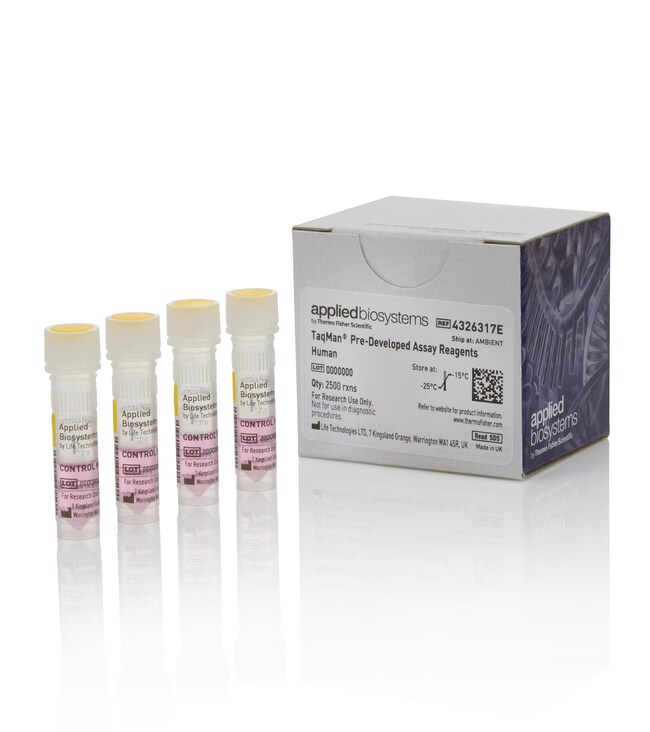
Eukaryotic 18S rRNA Endogenous Control (FAM™/MGB probe, non-primer limited)
The Applied Biosystems™ Eukaryotic 18S rRNA Endogenous Control (FAM™ ⁄ MGB Probe, Non-Primer Limited) is intended as an endogenous control.詳細を見る


製品番号(カタログ番号) 4352930E
価格(JPY)
145,300
Each
反応数:
反応2500回分
The Applied Biosystems™ Eukaryotic 18S rRNA Endogenous Control (FAM™ ⁄ MGB Probe, Non-Primer Limited) is intended as an endogenous control. It allows relative gene expression quantification in cDNA samples when used with other gene expression assays. Probe is labeled with 6FAM™ dye - MGB and the primers are not limited. Can be used for singleplex PCR reactions. Endogenous control is to be used with Inventoried and Non-Inventoried TaqMan™ Gene Expression Assays, Custom TaqMan™ Gene Expression Assays, and⁄or Custom TaqMan™ Primers and Probes.
Assay Details:
Gene Symbol: 18S
RefSeq: X03205.1
Probe Exon Location: NA
Amplicon Size: 187
Corresponding TaqMan Assay ID: Hs99999901_s1
TaqMan™ Endogenous Controls
Eliminate months of assay design, formulation, and testing by using TaqMan™ Endogenous Controls as your controls to quantify gene expression. This convenient collection of pre-designed probe and primer sets enables you to normalize the amount of sample RNA or DNA in a reaction.
Complete Solution for Quantitative Gene Expression
Having a hard time deciding what controls to use to quantify gene expression — even with detailed information on biological systmes?Now, with TaqMan™ Endogenous Controls, you can avoid all the trial-and-error of selecting controls for most common human, mouse, rat, and eukaryotic genes.
Simple to Use
All components of the TaqMan™ Endogenous Controls are QC tested, formulated into a single 20X mix, and functionally tested. The controls are not only simple to use, but they are also fully compatible with universal conditions for two-step RT-PCR. Just add TaqMan™ Universal PCR Master Mix (with or without AmpErase™ UNG) and your cDNA sample to generate sensitive, reproducible, and truly quantitative gene expression data on Applied Biosystems instruments including the Applied Biosystems 7900HT, 7300, 7500 Real-Time PCR Systems, and the 7000 and 7700 Sequence Detection Systems.
Flexible Offering
We build each endogenous control using our proven 5' nuclease chemistry. For maximum flexibility, you can choose between two different reporter dyes and two quenchers:
• A FAM™ dye-labeled TaqMan™ MGB probe (250nM, final concentration) and two unlabeled PCR primers (900nM each)
• A VIC™ dye-labeled TaqMan™ MGB probe (250nM, final concentration) and two unlabeled PCR primers (150nM each y primer limited)
• A VIC™ dye-labeled TAMRA™ probe (250nM, final concentration) and two unlabeled PCR primers (150nM each y primer limited)
Choosing the Right Endogenous Control
Endogenous controls can normalize the expression levels of target genes by correcting differences in the amount of cDNA that is loaded into PCR reaction wells. For best results, verify that the endogenous control is consistently expressed in the sample set to be tested. Endogenous control expression must be uniform across all samples in the study. For multiplexing, ensure that the gene expression level of the endogenous control is greater than that of the target.
Multiplex vs. Singleplex PCR
All TaqMan™ Endogenous Controls that contain probes labeled with the VIC™ reporter dye are primer limited. This allows multiplexing of TaqMan™ Endogenous Controls with target gene expression assays, provided that the control gene is more abundantly expressed than the target gene. All TaqMan™ Endogenous Controls that contain probes labeled with the FAM™ reporter dye are not primer limited and are not intended for multiplexing .
For Research Use Only. Not for use in diagnostic procedures.
Assay Details:
Gene Symbol: 18S
RefSeq: X03205.1
Probe Exon Location: NA
Amplicon Size: 187
Corresponding TaqMan Assay ID: Hs99999901_s1
TaqMan™ Endogenous Controls
Eliminate months of assay design, formulation, and testing by using TaqMan™ Endogenous Controls as your controls to quantify gene expression. This convenient collection of pre-designed probe and primer sets enables you to normalize the amount of sample RNA or DNA in a reaction.
Complete Solution for Quantitative Gene Expression
Having a hard time deciding what controls to use to quantify gene expression — even with detailed information on biological systmes?Now, with TaqMan™ Endogenous Controls, you can avoid all the trial-and-error of selecting controls for most common human, mouse, rat, and eukaryotic genes.
Simple to Use
All components of the TaqMan™ Endogenous Controls are QC tested, formulated into a single 20X mix, and functionally tested. The controls are not only simple to use, but they are also fully compatible with universal conditions for two-step RT-PCR. Just add TaqMan™ Universal PCR Master Mix (with or without AmpErase™ UNG) and your cDNA sample to generate sensitive, reproducible, and truly quantitative gene expression data on Applied Biosystems instruments including the Applied Biosystems 7900HT, 7300, 7500 Real-Time PCR Systems, and the 7000 and 7700 Sequence Detection Systems.
Flexible Offering
We build each endogenous control using our proven 5' nuclease chemistry. For maximum flexibility, you can choose between two different reporter dyes and two quenchers:
• A FAM™ dye-labeled TaqMan™ MGB probe (250nM, final concentration) and two unlabeled PCR primers (900nM each)
• A VIC™ dye-labeled TaqMan™ MGB probe (250nM, final concentration) and two unlabeled PCR primers (150nM each y primer limited)
• A VIC™ dye-labeled TAMRA™ probe (250nM, final concentration) and two unlabeled PCR primers (150nM each y primer limited)
Choosing the Right Endogenous Control
Endogenous controls can normalize the expression levels of target genes by correcting differences in the amount of cDNA that is loaded into PCR reaction wells. For best results, verify that the endogenous control is consistently expressed in the sample set to be tested. Endogenous control expression must be uniform across all samples in the study. For multiplexing, ensure that the gene expression level of the endogenous control is greater than that of the target.
Multiplex vs. Singleplex PCR
All TaqMan™ Endogenous Controls that contain probes labeled with the VIC™ reporter dye are primer limited. This allows multiplexing of TaqMan™ Endogenous Controls with target gene expression assays, provided that the control gene is more abundantly expressed than the target gene. All TaqMan™ Endogenous Controls that contain probes labeled with the FAM™ reporter dye are not primer limited and are not intended for multiplexing .
For Research Use Only. Not for use in diagnostic procedures.
研究用途にのみご使用ください。診断目的には使用できません。
仕様
受入番号X03205.1
アンプリコンサイズ187
フォーマットTube
遺伝子記号18S
反応数反応2500回分
製品ラインFAM, TaqMan
数量2500 reactions
出荷条件Room Temperature
種Eukaryotic, Rat, Mouse, Human
ターゲット18S rRNA
濃度20X
検出法Primer-probe
使用対象(アプリケーション)遺伝子発現解析
標識または色素FAM
PCR法2ステップRT-qPCR
Unit SizeEach
組成および保存条件
Control Primer-Probe Set(s)