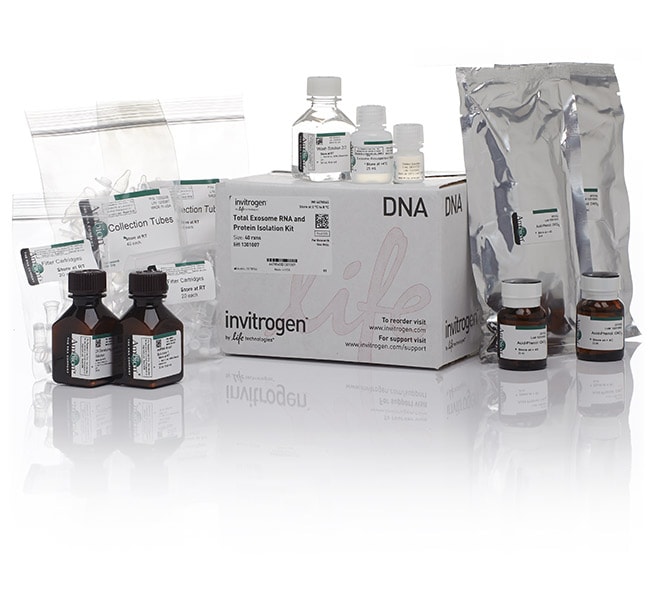
Total Exosome RNA & Protein Isolation Kit
Invitrogen™

Total Exosome RNA & Protein Isolation Kit

トータルエキソソームRNAタンパク質単離キットは、(トータルエキソソーム単離試薬(細胞培養培地用)、トータルエキソソーム単離試薬(血清用)などを使用して)生体液から抽出したエキソソームサンプルからトータルRNAやタンパク質を単離します。•エキソソームから高純度のトータルRNA詳細を見る
製品番号(カタログ番号)数量
447854540 preps
製品番号(カタログ番号) 4478545
価格(JPY)
60,500
Each
お問い合わせください ›
数量:
40 preps
トータルエキソソームRNAタンパク質単離キットは、(トータルエキソソーム単離試薬(細胞培養培地用)トータルエキソソーム単離試薬(血清用)などを使用して)生体液から抽出したエキソソームサンプルからトータルRNAやタンパク質を単離します。
•エキソソームから高純度のトータルRNA(small RNA画分を含む)を抽出
• タンパク質とRNAを同一のサンプルから回収
• すべてのエキソソーム単離プロトコルに対応

トータルエキソソームRNAタンパク質単離キットは、あらかじめ単離または濃縮したエキソソーム(同梱されていません)からタンパク質とRNAの両方を単離できるようにデザインされています。RNA発現(特にmiRNA)、RNAプロセシング、機能などの研究に最適です。このキットは、精製済みエキソソーム溶液からタンパク質とRNAの両方を回収します。サンプルの一部に有機抽出を行った後、ガラス繊維フィルターを使用してRNAを固定化し、トータルRNAを精製するかsmall RNAを濃縮します。サンプルの残りは、ウェスタンブロッティングなどの一般的なタンパク質アプリケーションに直接使用します。

高収量かつ超高純度のRNAが約30–60分で回収できます。RNAは、qRT-PCRや(Ion Torent™、PGM™、Ion Torrent™ Proton™、SOLiD™などのシーケンシング装置を使用した)ハイスループットシーケンシング、マイクロアレイ解析、液相ハイブリダイゼーション、ブロットハイブリダイゼーションなど、多様な下流アプリケーションに使用できます。

研究用途にのみご使用ください。ヒトまたは動物の治療もしくは診断目的には使用できません。
研究用にのみ使用できます。診断用には使用いただけません。
仕様
最終産物タイプトータルRNA、タンパク質、microRNA
高スループット適合性ハイスループット非対応(手動)
単離技術スピンカラム(ガラス繊維フィルター)、有機抽出
精製標的トータルRNA、タンパク質、RNA&タンパク質、miRNA
数量40 preps
サンプルタイプオルガネラ&小胞関連サンプル、エキソソーム
出荷条件室温
使用対象(アプリケーション)次世代シーケンス, リアルタイム定量PCR(qPCR), ウェスタンブロット, MicroRNA解析
製品タイプTotal Exosome RNA & Protein Isolation Kit
Unit SizeEach
組成および保存条件
2~8℃で保存します。

よくあるご質問(FAQ)

What is the best way to store my exosomes?

For the short-term, exosomes can be stored at 4 degrees C for up to 1 week. For the long-term, exosomes can be stored at -20 degrees C or -80 degrees C. When storing exosomes for the long term, it is important to consider whether they will need to be thawed more than once for the target application. If multiple applications (and thus multiple thaws) will be used for analysis, then we recommend aliquoting the exosome resuspensions into multiple tubes so that each tube will only undergo one freeze/thaw cycle. We have found that multiple freeze thaw cycles can cause damage to the exosomes and reduce their numbers.

There are two protocol options for exosome isolation from plasma samples, which one should I choose?

Unlike serum, plasma contains numerous clotting factors and some additional proteins that can make it difficult to work with. We‘ve provided two protocol options, one with proteinase K (PK) and one without, in order to ease this difficulty. The protocol using PK is most useful when the end goal is analysis of the RNA or protein cargo contained inside the exosomes. It can also be used to isolate exosomes for use in other downstream applications, but it is most useful for RNA and protein analysis. The protocol without PK also isolates good quality exosomes, just not quite as pure as the PK protocol. The “no PK” protocol is more useful for isolating exosomes that will be used for surface protein analysis or electron microscopy identification.

My Westerns do not seem to work after exosome isolation. Can you help?

There are several possible reasons why Western blotting analysis is challenging:

1. Not enough sample volume added. Exosomes can contain a fairly low amount of protein cargo, so for an initial experiment we recommend adding as much of the sample as possible.
2. Antibody concentration should be titrated. Also, they should ideally be used fresh and need to be stored properly.
3. Depending on the exosomal surface marker, certain gel conditions might be more optimal for the target antibody (e.g., reducing/nonreducing and denaturing/nondenaturing). We suggest checking with the manufacturer and exosome community about which Western blotting conditions are recommended for the specific marker you are targeting and the specific antibody you are using.
4. General Western techniques. Westerns can be tricky so we recommend the use of a positive control for initial testing to make sure the entire workflow is functioning as it should. Any protein or antibody can be used as long as they meet the conditions you need (e.g., denaturing vs. non-denaturing). In addition, when picking the protein, try to steer clear of those that are present at very high or very low concentrations in your sample to prevent overloading the blot or total absence of signal.

How much RNA can be recovered from the exosomes?

This can vary depending on the sample type, volume of sample, isolation method, and exosome content/concentration. Listed below are some examples:

1) When exosomes are isolated from 30 mL of HeLa cell culture medium using the Total Exosome Isolation Reagent, it is possible to recover approximately 8 ng exosomal RNA.
2) For exosomes recovered from 4 mL serum, approximately 2 ng exosomal RNA can be obtained.

In both cases, these amounts of RNA are sufficient for RNA library prep for Ion PGM or Ion Proton sequencing. For real-time PCR analysis, substantially smaller amounts of RNA are needed and much lower sample volumes can be used. For example, RNA recovered from 3 µL serum or 30 µL medium is enough for one qRT-PCR reaction.

I'm using the Total Exosome RNA & Protein Isolation Kit. When ethanol is added to buffer 2/3, the solution turns turbid. Does this affect the efficiency of RNA recovery?

No, the described effect does not have a negative impact on the RNA recovery.