Search


Citations & References (6)
Invitrogen™
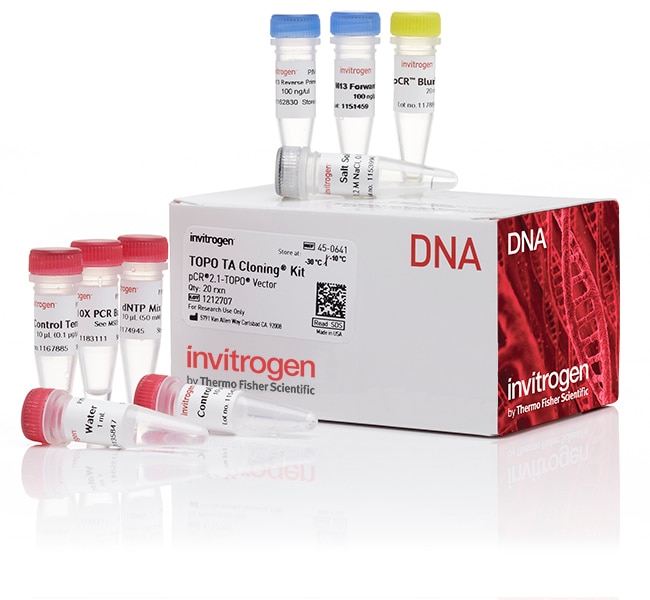
TOPO™ TA Cloning™ Kit for Subcloning, without competent cells
TOPO™ TA Cloning™ Kits for Subcloningは、Taqポリメラーゼ増幅PCR産物をサブクローニング用のプラスミドベクターに直接挿入するための、5分間の高効率ワンステップクローニング戦略(「TOPO™クローニング」)を提供します詳細を見る


製品番号(カタログ番号) 450641
価格(JPY)
83,600
Each
数量:
25反応
TOPO™ TA Cloning™ Kits for Subcloningは、Taqポリメラーゼ増幅PCR産物をサブクローニング用のプラスミドベクターに直接挿入するための、5分間の高効率ワンステップクローニング戦略(「TOPO™クローニング」)を提供します。各キットは、サブクローニングに便利な制限部位を含むpCR™ 2.1-TOPO™ TAベクターを使用します。クローニングキットは、お客様のニーズや予算に応じて、さまざまなコンピテントセル付きまたはコンピテントセルなしでご利用になれます。TOPO™ TA Cloning™ Kits for Subcloningの特長:
•迅速かつ簡単—PCRからクローンへの移行はわずか3ステップで完了し、ハンズオン時間はわずか5分
• 効率的—正確なインサートを使用して最大95%のクローンを取得
• 実証済み—10年以上にわたる4,000を超える引用による信頼性の高い性能
• シンプル—リガーゼ、PCR後の処理、特定の配列を含むPCRプライマーは不要
TOPO™ TA Cloning™ Kits for Subcloning—概要
• ベクター:pCR™ 2.1-TOPO™ TAベクター—インサートに隣接する15の便利な制限部位を含むサブクローニングベクターで、簡単で方向性の高いサブクローニングを実現
• クローニング法:TOPO™ TA Cloning™—3′Aオーバーハング(Taqポリメラーゼ増幅)を含むPCR産物のTオーバーハングを含むTOPO™ベクターへのトポイソメラーゼIベース5分間ライゲーション
• コンピテントセル:さまざまなオプション—一般用、高効率、バクテリオファージT1耐性、急速に増殖するなどのそれぞれの特徴を持つコンピテントセルのいずれかを含むキットから選択するか、または独自のものを使用
pCR™ 2.1-TOPO™ TAベクター—クローニングおよびサブクローニングの簡易性
pCR™ 2.1-TOPO™ TAベクターは、Taqポリメラーゼ増幅PCR産物(TA Cloning™)の直接ライゲーションのために3'-チミジン(T)オーバーハングで線形化され、共有結合したトポイソメラーゼIで「活性化」されます。ライガーゼを追加する必要はなく、クローニングは5分で完了します。PCR産物インサート部位に隣接するEcoRI部位によりインサートの切除が容易になり、PCRインサートに隣接する15の便利な制限部位の任意の組み合わせを使用して簡単で方向性の高いサブクローニングを実現できます。
pCR™ 2.1-TOPO™ TAクローンの選択および操作
pCR™ 2.1-TOPO™ TAベクターには、アンピシリンとカナマイシンの両方の耐性マーカーと、青白スクリーニング用のLacZα遺伝子が含まれています。
簡略化されたTOPO™ベースクローニング
TOPO™クローニング技術を使用すると、特定の配列を含むPCRプライマー、PCR後の処理、ベクター調製、またはその他の時間のかかるDNA操作ステップは不要になります。提供されたトポイソメラーゼ荷電ベクターに直接PCR反応を加え、5分間インキュベートして、大腸菌コンピテントセルを形質転換するだけです。
効率的なクローニング
目的のインサートを含むクローンを最大95%まで使用できるため、スクリーニングするクローンの数を減らし、時間とコストを節約できます。このキットで使用されるpCR™ 2.1-TOPO™ TAベクターには3'-Tオーバーハングが付属しており、3'-Aオーバーハングを含むTaqポリメラーゼ増幅PCR産物を効率的にライゲーションできます。
クローニングの標準
クローニングの分野でTOPO™クローニング技術は10年以上にわたり数千人の科学者にとって信頼性の高いパートナーとなっています。高速で使いやすく効率的なTOPO™クローニングは、さまざまなアプリケーションのために多くの異なるベクターに適用されています。
TOPO™ TA Cloning™ Kit for Subcloning—キットオプション
TOPO™ TA Cloning™ Kit for Sequencingは、お客様のニーズに応じて異なる利点をもたらすさまざまなコンピテントセルとともに購入できます。
• 一般的なクローニング:TOP10細胞(カタログ番号K4500-01、K4500-40)
• 高効率のクローニング:TOP10 Electrocomp™細胞(カタログ番号K4560-01、K4560-40)
• 一般的なクローニング、バクテリオファージT1耐性:DH5α-T1R細胞(カタログ番号K4520-01、K4520-40)
• 迅速な増殖:Mach1™ -T1R化学的コンピテント大腸菌(カタログ番号K4510-20)
•自作のコンピテントセルを使用:柔軟性を高めながらコスト削減が可能(カタログ番号450641)
また、クリーンでシーケンス対応の組み換えプラスミドの分離に使用するためのPureLink™ Quick Plasmid Miniprep Kit(カタログ番号K4500-02およびK4510-02)を含むキットの2バージョンを提供しています。
•迅速かつ簡単—PCRからクローンへの移行はわずか3ステップで完了し、ハンズオン時間はわずか5分
• 効率的—正確なインサートを使用して最大95%のクローンを取得
• 実証済み—10年以上にわたる4,000を超える引用による信頼性の高い性能
• シンプル—リガーゼ、PCR後の処理、特定の配列を含むPCRプライマーは不要
TOPO™ TA Cloning™ Kits for Subcloning—概要
• ベクター:pCR™ 2.1-TOPO™ TAベクター—インサートに隣接する15の便利な制限部位を含むサブクローニングベクターで、簡単で方向性の高いサブクローニングを実現
• クローニング法:TOPO™ TA Cloning™—3′Aオーバーハング(Taqポリメラーゼ増幅)を含むPCR産物のTオーバーハングを含むTOPO™ベクターへのトポイソメラーゼIベース5分間ライゲーション
• コンピテントセル:さまざまなオプション—一般用、高効率、バクテリオファージT1耐性、急速に増殖するなどのそれぞれの特徴を持つコンピテントセルのいずれかを含むキットから選択するか、または独自のものを使用
pCR™ 2.1-TOPO™ TAベクター—クローニングおよびサブクローニングの簡易性
pCR™ 2.1-TOPO™ TAベクターは、Taqポリメラーゼ増幅PCR産物(TA Cloning™)の直接ライゲーションのために3'-チミジン(T)オーバーハングで線形化され、共有結合したトポイソメラーゼIで「活性化」されます。ライガーゼを追加する必要はなく、クローニングは5分で完了します。PCR産物インサート部位に隣接するEcoRI部位によりインサートの切除が容易になり、PCRインサートに隣接する15の便利な制限部位の任意の組み合わせを使用して簡単で方向性の高いサブクローニングを実現できます。
pCR™ 2.1-TOPO™ TAクローンの選択および操作
pCR™ 2.1-TOPO™ TAベクターには、アンピシリンとカナマイシンの両方の耐性マーカーと、青白スクリーニング用のLacZα遺伝子が含まれています。
簡略化されたTOPO™ベースクローニング
TOPO™クローニング技術を使用すると、特定の配列を含むPCRプライマー、PCR後の処理、ベクター調製、またはその他の時間のかかるDNA操作ステップは不要になります。提供されたトポイソメラーゼ荷電ベクターに直接PCR反応を加え、5分間インキュベートして、大腸菌コンピテントセルを形質転換するだけです。
効率的なクローニング
目的のインサートを含むクローンを最大95%まで使用できるため、スクリーニングするクローンの数を減らし、時間とコストを節約できます。このキットで使用されるpCR™ 2.1-TOPO™ TAベクターには3'-Tオーバーハングが付属しており、3'-Aオーバーハングを含むTaqポリメラーゼ増幅PCR産物を効率的にライゲーションできます。
クローニングの標準
クローニングの分野でTOPO™クローニング技術は10年以上にわたり数千人の科学者にとって信頼性の高いパートナーとなっています。高速で使いやすく効率的なTOPO™クローニングは、さまざまなアプリケーションのために多くの異なるベクターに適用されています。
TOPO™ TA Cloning™ Kit for Subcloning—キットオプション
TOPO™ TA Cloning™ Kit for Sequencingは、お客様のニーズに応じて異なる利点をもたらすさまざまなコンピテントセルとともに購入できます。
• 一般的なクローニング:TOP10細胞(カタログ番号K4500-01、K4500-40)
• 高効率のクローニング:TOP10 Electrocomp™細胞(カタログ番号K4560-01、K4560-40)
• 一般的なクローニング、バクテリオファージT1耐性:DH5α-T1R細胞(カタログ番号K4520-01、K4520-40)
• 迅速な増殖:Mach1™ -T1R化学的コンピテント大腸菌(カタログ番号K4510-20)
•自作のコンピテントセルを使用:柔軟性を高めながらコスト削減が可能(カタログ番号450641)
また、クリーンでシーケンス対応の組み換えプラスミドの分離に使用するためのPureLink™ Quick Plasmid Miniprep Kit(カタログ番号K4500-02およびK4510-02)を含むキットの2バージョンを提供しています。
研究用途にのみご使用ください。診断目的には使用できません。
仕様
抗生物質耐性菌アンピシリン(AmpR)、カナマイシン(KanR)
菌株または酵母株含まれない
クローニング法TOPO™-TA
製品ラインTOPO
製品タイプCloning Kit
数量25反応
出荷条件ドライアイス
ベクターPCR、TOPO-TAクローニングベクター
フォーマットキット
Unit SizeEach
組成および保存条件
ボックス1:
•トポイソメラーゼI活性化pCR™2.1-TOPO™ベクター
•PCRバッファー
• 塩溶液
•dNTP
• コントロールテンプレート
•M13フォワードおよび逆プライマー
•コントロールPCRプライマー
•滅菌水
-5~-30℃で保存します。
すべての試薬は、適切に保存すると6カ月間安定しています。
•トポイソメラーゼI活性化pCR™2.1-TOPO™ベクター
•PCRバッファー
• 塩溶液
•dNTP
• コントロールテンプレート
•M13フォワードおよび逆プライマー
•コントロールPCRプライマー
•滅菌水
-5~-30℃で保存します。
すべての試薬は、適切に保存すると6カ月間安定しています。
よくあるご質問(FAQ)
Can I store my competent E. coli in liquid nitrogen?
How should I store my competent E. coli?
What is the difference between the pCR2.1-TOPO and pCR4-TOPO vectors?
What is the difference between the pCR2.1-TOPO and pCRII-TOPO vectors?
Your TOPO cloning kits contain a control template and control primers. Can I obtain the sequence of the control template?
引用および参考文献 (6)
引用および参考文献
Abstract
Efficacy, safety, and pharmacokinetics of imatinib dose escalation to 800 mg/day in patients with advanced gastrointestinal stromal tumors.
Journal:Invest New Drugs
PubMed ID:23591629
'Imatinib dose escalation has been suggested as an effective therapy for advanced gastrointestinal stromal tumors (GIST) after progression on the standard dose. We evaluated the efficacy, tolerability, and pharmacokinetics of imatinib dose escalation. Eighty-four patients with GIST who received imatinib 800 mg/day as second-line therapy were reviewed. In 66 patients, imatinib
Use of cell-SELEX to generate DNA aptamers as molecular probes of HPV-associated cervical cancer cells.
Journal:PLoS One
PubMed ID:22536456
'Disease-specific biomarkers are an important tool for the timely and effective management of pathological conditions, including determination of susceptibility, diagnosis, and monitoring efficacy of preventive or therapeutic strategies. Aptamers, comprising single-stranded or double-stranded DNA or RNA, can serve as biomarkers of disease or biological states. Aptamers can bind to specific
A streamlined method for detecting structural variants in cancer genomes by short read paired-end sequencing.
Journal:PLoS One
PubMed ID:23144753
Defining the architecture of a specific cancer genome, including its structural variants, is essential for understanding tumor biology, mechanisms of oncogenesis, and for designing effective personalized therapies. Short read paired-end sequencing is currently the most sensitive method for detecting somatic mutations that arise during tumor development. However, mapping structural variants
Two CRISPR-Cas systems in Methanosarcina mazei strain Gö1 display common processing features despite belonging to different types I and III.
Journal:RNA Biol
PubMed ID:23619576
The clustered regularly interspaced short palindromic repeats (CRISPR) system represents a highly adaptive and heritable defense system against foreign nucleic acids in bacteria and archaea. We analyzed the two CRISPR-Cas systems in Methanosarcina mazei strain Gö1. Although belonging to different subtypes (I-B and III-B), the leaders and repeats of both
Camphor pathway redux: functional recombinant expression of 2,5- and 3,6-diketocamphane monooxygenases of Pseudomonas putida ATCC 17453 with their cognate flavin reductase catalyzing Baeyer-Villiger reactions.
Journal:Appl Environ Microbiol
PubMed ID:23524667
Whereas the biochemical properties of the monooxygenase components that catalyze the oxidation of 2,5-diketocamphane and 3,6-diketocamphane (2,5-DKCMO and 3,6-DKCMO, respectively) in the initial catabolic steps of (+) and (-) isomeric forms of camphor (CAM) metabolism in Pseudomonas putida ATCC 17453 are relatively well characterized, the actual identity of the flavin