Search


Citations & References (7)
Thermo Scientific™
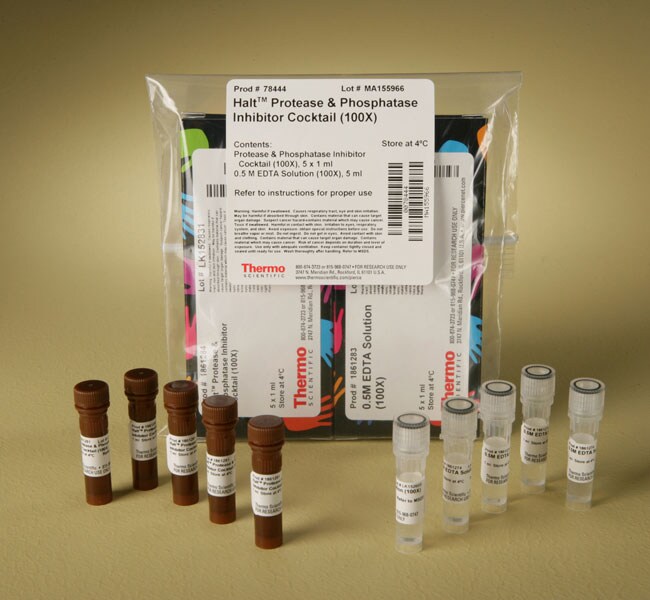
Halt™ Protease and Phosphatase Inhibitor Cocktail (100X)
Thermo Scientific Halt Protease and Phosphatase Inhibitor Cocktail (100X)は、便利な1つの溶液で細胞および組織ライセートのタンパク質サンプルを完全に保護します詳細を見る


製品番号(カタログ番号) 78444
価格(JPY)
178,900
Each
数量:
5 x 1 mL
Thermo Scientific Halt Protease and Phosphatase Inhibitor Cocktail (100X)は、便利な1つの溶液で細胞および組織ライセートのタンパク質サンプルを完全に保護します。
Halt Protease and Phosphatase Inhibitor Cocktail (100X)の特長:
•完全な保護—オールインワンカクテルはプロテアーゼとホスファターゼの両阻害剤を含有
• 複数のパッケージサイズ—4つの便利なパッケージサイズから選択できるため、ほぼすべての実験規模に適合
• 便利—100倍濃縮組成は、個別の阻害剤やその他のフォ=マットよりも使いやすく効果的
• 保存が容易—水性フォーマットはDMSOベースのカクテルとは異なり冷凍する必要がなく、低温室で保存可能
• 適合性—ピークシフトを引き起こす可能性のあるAEBSFを含んでいないため、質量分析(MS)に使用可能
• 検証済み—Thermo Scientific Pierce Cell Lysis Bufferに完全に適合に完全に適合
Halt Protease and Phosphatase Inhibitor Cocktailは、タンパク質の抽出や精製中にタンパク質が分解されるのを防ぐよう、特別に最適化されています。カクテルには、アミノペプチダーゼ、システインおよびセリンプロテアーゼ、セリン/スレオニンおよびタンパク質チロシンホスファターゼを標的とする主要分類のプロテアーゼおよびホスファターゼに対する阻害剤が含まれます。メタロプロテアーゼの阻害を促進するために、0.5 M EDTAが別のチューブで提供されます。
関連製品
Halt™ Protease and Phosphatase Inhibitor Cocktail, EDTA-free (100X)
Halt Protease and Phosphatase Inhibitor Cocktail (100X)の特長:
•完全な保護—オールインワンカクテルはプロテアーゼとホスファターゼの両阻害剤を含有
• 複数のパッケージサイズ—4つの便利なパッケージサイズから選択できるため、ほぼすべての実験規模に適合
• 便利—100倍濃縮組成は、個別の阻害剤やその他のフォ=マットよりも使いやすく効果的
• 保存が容易—水性フォーマットはDMSOベースのカクテルとは異なり冷凍する必要がなく、低温室で保存可能
• 適合性—ピークシフトを引き起こす可能性のあるAEBSFを含んでいないため、質量分析(MS)に使用可能
• 検証済み—Thermo Scientific Pierce Cell Lysis Bufferに完全に適合に完全に適合
Halt Protease and Phosphatase Inhibitor Cocktailは、タンパク質の抽出や精製中にタンパク質が分解されるのを防ぐよう、特別に最適化されています。カクテルには、アミノペプチダーゼ、システインおよびセリンプロテアーゼ、セリン/スレオニンおよびタンパク質チロシンホスファターゼを標的とする主要分類のプロテアーゼおよびホスファターゼに対する阻害剤が含まれます。メタロプロテアーゼの阻害を促進するために、0.5 M EDTAが別のチューブで提供されます。
関連製品
Halt™ Protease and Phosphatase Inhibitor Cocktail, EDTA-free (100X)
研究用途にのみご使用ください。診断目的には使用できません。
仕様
バッファーLysis Buffer
阻害剤プロテアーゼ阻害剤、ホスファターゼ阻害剤
数量5 x 1 mL
試薬タイププロテアーゼ阻害剤、ホスファターゼ阻害剤
形状液体
製品ラインHalt
製品タイプProtease and Phosphatase Inhibitor Cocktail
Unit SizeEach
組成および保存条件
受け取り後、4℃で保存
よくあるご質問(FAQ)
Can I store the 1X solution of the Halt Protease and Phosphatase Inhbitor Cocktail and if so, for how long?
What are the concentrations of the various components of the combined Halt Protease and Phosphatase Inhibitor Cocktail?
Do you offer the components of the Halt Protease and Phosphatase Cocktail individually?
When do I need to add EDTA when using the Halt Protease and Phosphatase Cocktail?
How much of the Halt Protease and Phosphatase Cocktail do I use for my sample?
引用および参考文献 (7)
引用および参考文献
Abstract
Host E3 ubiquitin ligase ITCH mediates Toxoplasma gondii effector GRA35-triggered NLRP1 inflammasome activation and cell-autonomous immunity.
Journal:mBio
PubMed ID:38376248
Toxoplasma gondii is an intracellular parasite that can activate the NLRP1 inflammasome leading to macrophage pyroptosis in Lewis rats, but the underlying mechanism is not well understood. In this study, we performed a genome-wide CRISPR screen and identified the dense granule proteins GRA35, GRA42, and GRA43 as the Toxoplasma effectors
LARP1 binds ribosomes and TOP mRNAs in repressed complexes.
Journal:The EMBO journal
PubMed ID:39533057
Terminal oligopyrimidine motif-containing mRNAs (TOPs) encode all ribosomal proteins in mammals and are regulated to tune ribosome synthesis to cell state. Previous studies have implicated LARP1 in 40S- or 80S-ribosome complexes that are thought to repress and stabilize TOPs. However, a molecular understanding of how LARP1 and TOPs interact with
A KIF1C-CNBP motor-adaptor complex for trafficking mRNAs to cell protrusions.
Journal:Cell reports
PubMed ID:39982819
mRNA localization to subcellular compartments is a widely used mechanism that functionally contributes to numerous processes. mRNA targeting can be achieved upon recognition of RNA cargo by molecular motors. However, our molecular understanding of how this is accomplished is limited, especially in higher organisms. We focus on a pathway that
hCLCA1 and mCLCA3 are secreted non-integral membrane proteins and therefore are not ion channels.
Journal:J Biol Chem
PubMed ID:15919655
'Proteins of the CLCA gene family have been proposed to mediate calcium-activated chloride currents. In this study, we used detailed bioinformatics analysis and found that no transmembrane domains are predicted in hCLCA1 or mCLCA3 (Gob-5). Further analysis suggested that they are globular proteins containing domains that are likely to be
Quantitative PCR analysis of DNA, RNAs, and proteins in the same single cell.
Journal:Clin Chem
PubMed ID:23014600
The single cell represents the basic unit of all organisms. Most investigations have been performed on large cell populations, but understanding cell dynamics and heterogeneity requires single-cell analysis. Current methods for single-cell analysis generally can detect only one class of analytes.