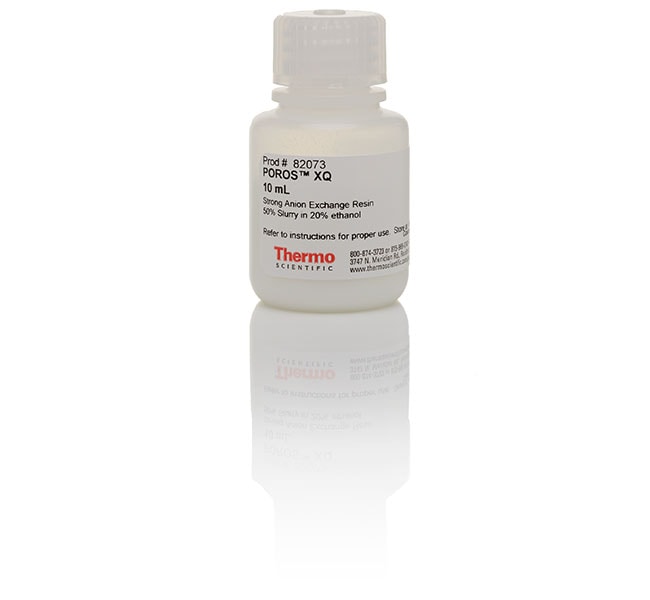
POROS™ XQ Strong Anion Exchange Resin
Thermo Scientific™

POROS™ XQ Strong Anion Exchange Resin

POROS™XQ強陰イオン交換樹脂は、次世代の高容量、高分解能、耐塩性樹脂であり、卓越した分離性能を提供しつつ、最大6.6 mS/cm NaClの存在下で140 mg/mLを超える動的結合能を実現します。従来の陰イオン交換樹脂の性能を大幅に改善した詳細を見る
製品番号(カタログ番号)容量(メートル法)
8207310 mL
8207450 mL
製品番号(カタログ番号) 82073
価格(JPY)
20,000
온라인 행사
Ends: 27-Mar-2026
33,400
割引額 13,400 (40%)
Each
お問い合わせください ›
容量(メートル法):
10 mL
一括またはカスタム形式をリクエストする
POROS™XQ強陰イオン交換樹脂は、次世代の高容量、高分解能、耐塩性樹脂であり、卓越した分離性能を提供しつつ、最大6.6 mS/cm NaClの存在下で140 mg/mLを超える動的結合能を実現します。従来の陰イオン交換樹脂の性能を大幅に改善した POROS XQ 樹脂は、結合および溶出またはフロースルーの両方の運転モードでの強陰イオン交換クロマトグラフィーの標準を確立します。

POROS XQ 樹脂の特長:
•高い動的結合能により、カラムサイズの低減、設置面積の縮小、水およびバッファー使用量の低減、サイクリングの短縮が実現されます。
• 高解像度により、製品の収率と純度が向上し、最終的には生産される分子の製品コストが改善されます。
• 堅牢な耐塩性により、プロセス設計の柔軟性が向上し、プロセスフローの合理化が可能になります。
• 低操作圧で柔軟なスケーラビリティを実現します。
• 共有結合表面の化学的性質を持つ硬質ポリマービーズにより、取り扱いと充填が容易になり、優れた物理的および化学的安定性が得られ、安定した下流精製プロセスが実現されます。

動的結合能
POROS XQ 樹脂は、幅広いプロセス条件において、5% のブレークスルーで 140 mg/mL を超える高い結合能を有し、幅広い pH および塩条件において優れた結合能を発揮します。ベースビーズの細孔構造と表面の化学的性質を最適化することで、より高い動的結合能を実現しています。

高解像度
最適化された50 µmの粒子径を利用して、POROS XQ樹脂は、高力価プロセスに付随する困難な不純物レベルを克服しつつ、POROS樹脂の優れた解像度を維持しています。解像度は、幅広い動作線流速で一貫性を維持します。

堅牢な耐塩性
POROS XQ 樹脂は、50 mM NaCl(導電率 6.6 mS/cm)で最大 140 mg/mL の幅広い塩濃度で一貫性のある高いタンパク質容量を有しています。高導電率でカラムをロードできることは、カラムフィードストリームの希釈の低減または廃止に役立ち、あるいは接線流ろ過などのユニット操作の廃止に役立ちます。
研究用途にのみご使用ください。診断目的には使用できません。
仕様
使用対象(アプリケーション)強陰イオン交換クロマトグラフィー
フォーマットPOROSビーズ
製品ラインPOROS
精製標的タンパク質
数量10 mL
出荷条件室温
標準コンポーネント四級化ポリエチレンイミン
固定相四級化ポリエチレンイミン
容量(メートル法)10 mL
タイプXQ強陰イオン交換レジン
Unit SizeEach
組成および保存条件
冷蔵庫(2~8℃)に保存。

よくあるご質問(FAQ)

Are POROS analytical columns compatible with HPLC systems from Waters or Agilent?

All of the pre-packed POROS columns, regardless of column size or resin, have the same 10-32 female fittings on the column. Columns are compatible with Waters and Agilent HPLC systems. You will need 1/16 inch male fittings for the HPLC to attach the column.

Find additional tips, troubleshooting help, and resources within our Protein Purification and Isolation Support Center.

For any POROS analytical column, is the column compatible with an AKTA or Avant purification system?

All of the pre-packed columns, regardless column size or resin, have the same 10-32 female fittings on the column. They are all compatible with the AKTA instrument platform, however due to the column volume of the 2.1 mmD x 30 mmL columns (0.1 mL), these will not perform well in AKTA or Avant purification systems due to the relative size of the hold- up volume in these systems. The smallest column (PEEK or SS) that could feasibly be used in these systems is the 4.6mmD x 50mmL (0.8 mL) format.

Find additional tips, troubleshooting help, and resources within our Protein Purification and Isolation Support Center.

What is the physical or mechanical stability of POROS resins?

The physical stability of POROS resins is high. Customers have agitated, with overhead mixing and or bottom gassing for long periods of time (5-10 hours) and have performed hundreds of diaphragm pump passes during stall packs. Keep in mind that agitation with any device that creates grinding and sheer, such as with a magnetic stir bar, is not recommended for any type of resin.

Find additional tips, troubleshooting help, and resources within our Protein Purification and Isolation Support Center.

What should I do if a POROS column dries out or air is pumped onto the column?

POROS resins rehydrate quite well. Here is the procedure that we recommend:

1. Flow 5% ethanol over the column at ?350 cm/hour for 3 CVs, followed by water or 0.1 M sodium chloride at 300 cm/hour for 3 CVs.
2. If baseline noise is still present, flow 20% ethanol over the column at 300 cm/hour for 3 CVs, followed by water or 0.1 M sodium chloride at 300 cm/hour for 3 CVs.
3. If you have established column qualification tests and specifications, perform the tests after rewetting.

Find additional tips, troubleshooting help, and resources within our Protein Purification and Isolation Support Center.

Can POROS resins be used to purify large biomolecules?

In general POROS resins have behaved better for large biomolecules such as viral particles, fusion proteins, and globular proteins, where shape (not size) matters due to its unique pore structure and large pore structure as compared to traditional resins. As the target molecule size increases, capacities obtained will decrease. The large pore structure of POROS resins, which allows for convective flow (and therefore enhanced diffusion) is especially well suited for the purification of large biomolecules. POROS resins offer the best blend of high capacity (associated with chromatography beads) and improved chromatography efficiency (typically associated with monoliths or membranes). The average pore size for POROS resins is 1,000-3,600 Angstrom (100-360 nm) depending on the base bead/chemistry being utilized. For example, the molecular weight of IgG is 150 kDa and the molecular radius is 55 Angstrom. The molecular weight of IgM is ~900 kDa (pentamer), and the molecular radius is 120 Angstrom. So both of these biomolecules can interact with the pore structure associated with POROS materials.

Find additional tips, troubleshooting help, and resources within our Protein Purification and Isolation Support Center.