Search


Citations & References (5)
Thermo Scientific™
DyLight™ Microscale Antibody Labeling Kits
蛍光顕微鏡、フローサイトメトリー、IHC、ウェスタンブロット、ELISA、DyLight抗体標識キットなどをご利用ください。


製品番号(カタログ番号) 84536
価格(JPY)
115,300
Each
励起/発光:
652/672
標識または色素:
DyLight 650
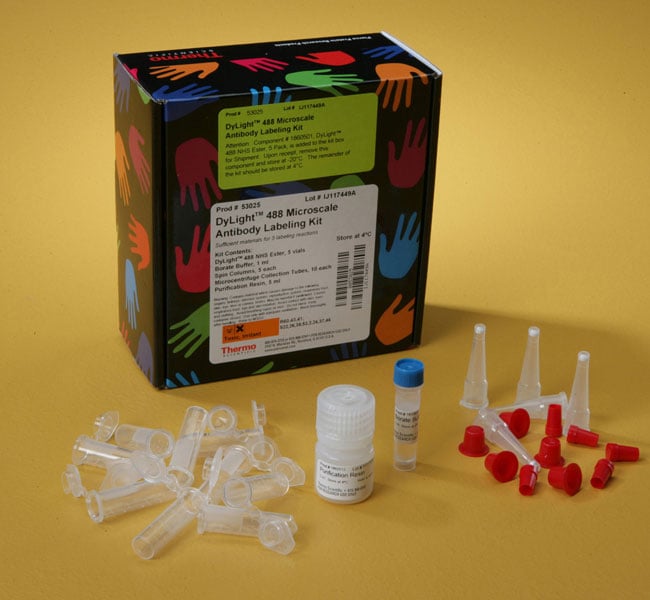
Invitrogen Dylightマイクロスケール抗体標識キットには、100 μgの抗体またはタンパク質をアミン反応性Dylight染料で標識し、その後に遊離色素を除去するために必要な試薬がすべて含まれています。抗体やタンパク質を共有結合で標識するために、さまざまなスペクトルのDylight蛍光色素を選択できます。標識抗体は通常、最小限のハンズオン時間で90分以内に使用可能となります。キットには、100 μgのIgGまたは同等量の他のタンパク質を使用して5回の標識反応を行えるだけの必要なすべてのコンポーネントが含まれます。標識抗体またはタンパク質は、免疫蛍光顕微鏡、フローサイトメトリー、IHC、ウェスタンブロッティング、ELISAなどのさまざまなアプリケーションに使用できます。
Invitrogen DyLight抗体標識キットは、異なるDyLight蛍光色素に共有結合した蛍光抗体の作成を可能にします。蛍光標識抗体は、免疫蛍光顕微鏡、IHC、ウェスタンブロッティング、ELISA、フローサイトメトリー、またはin vitroおよびin vivo蛍光検出法などのさまざまなラボラトリー用途に使用可能です。
DyLight抗体標識キットには、高性能DyLight色素のNHSエステル活性化誘導体が含まれているため、細胞イメージングやその他の蛍光検出法で抗体や他のタンパク質の蛍光標識が可能です。DyLight色素はアミン反応性の色素であり、N-ヒドロキシスクシンイミド(NHS)エステル部分で活性化され、露出したN末端α-アミノ基またはリジン残基のε-アミノ基と反応して安定したアミド結合を形成します。DyLight抗体標識キットには、3種類の標識反応を行うために必要な成分がすべて含まれており、100 µgのIgGまたは同等の量の他のタンパク質を使用して色素を除去できます。
DyLight色素は、各種のアプリケーションでCyDye色素やLI-COR™色素よりも高い蛍光強度と光安定性を示し、広範囲のpH(pH 4~9)で高度に蛍光を維持します。さらに、DyLight蛍光色素は水溶性であるため、コンジュゲートが沈殿することなく高い色素/タンパク質比率を実現できます。このほか、これらの蛍光色素の高い溶解性により、タンパク質溶液を特定量の標識試薬に直接添加できます。
DyLight抗体標識キットのその他の利点:
· 高性能—蛍光強度の高い広範囲のpHを確保します
· マルチカラー—10種類の色素を可視域から赤外域までスペクトル全体に展開します
·特異性—NHSエステル活性化色素により、タンパク質や他の分子を第1級アミン(-NH2)に標識します
· 最適化した手順—標準プロトコルに従うことで優れた色素の抗体を得られます:最適な活性および蛍光標識を得るためのタンパク質比および回収率
当社では、蛍光法に使用する抗体を迅速かつ効率的に蛍光標識するためのDyLight抗体標識キットもご用意しています。DyLight抗体標識キットには、1 mgのIgGまたは同等量の他のタンパク質を使用して3回の標識反応を行えるだけの必要なすべてのコンポーネントが含まれます。標準およびマイクロスケールのキットサイズには、便利なシングルユース用バイアルに含まれるアミン反応性DyLight蛍光色素分子のほか、すぐに使用可能なコンジュゲート調製用の精製レジンおよびスピンカラムが含まれます。
DyLight抗体標識キットには、高性能DyLight色素のNHSエステル活性化誘導体が含まれているため、細胞イメージングやその他の蛍光検出法で抗体や他のタンパク質の蛍光標識が可能です。DyLight色素はアミン反応性の色素であり、N-ヒドロキシスクシンイミド(NHS)エステル部分で活性化され、露出したN末端α-アミノ基またはリジン残基のε-アミノ基と反応して安定したアミド結合を形成します。DyLight抗体標識キットには、3種類の標識反応を行うために必要な成分がすべて含まれており、100 µgのIgGまたは同等の量の他のタンパク質を使用して色素を除去できます。
DyLight色素は、各種のアプリケーションでCyDye色素やLI-COR™色素よりも高い蛍光強度と光安定性を示し、広範囲のpH(pH 4~9)で高度に蛍光を維持します。さらに、DyLight蛍光色素は水溶性であるため、コンジュゲートが沈殿することなく高い色素/タンパク質比率を実現できます。このほか、これらの蛍光色素の高い溶解性により、タンパク質溶液を特定量の標識試薬に直接添加できます。
DyLight抗体標識キットのその他の利点:
· 高性能—蛍光強度の高い広範囲のpHを確保します
· マルチカラー—10種類の色素を可視域から赤外域までスペクトル全体に展開します
·特異性—NHSエステル活性化色素により、タンパク質や他の分子を第1級アミン(-NH2)に標識します
· 最適化した手順—標準プロトコルに従うことで優れた色素の抗体を得られます:最適な活性および蛍光標識を得るためのタンパク質比および回収率
当社では、蛍光法に使用する抗体を迅速かつ効率的に蛍光標識するためのDyLight抗体標識キットもご用意しています。DyLight抗体標識キットには、1 mgのIgGまたは同等量の他のタンパク質を使用して3回の標識反応を行えるだけの必要なすべてのコンポーネントが含まれます。標準およびマイクロスケールのキットサイズには、便利なシングルユース用バイアルに含まれるアミン反応性DyLight蛍光色素分子のほか、すぐに使用可能なコンジュゲート調製用の精製レジンおよびスピンカラムが含まれます。
For Research Use Only. Not for use in diagnostic procedures.
仕様
色遠赤色
励起/発光652/672
標識タイプDyLight™
標識スケール100 μg
製品ラインDyLight
製品タイプLabeling Kit
数量5 reactions
化学反応性アミン
Labeling Target抗体, タンパク質
標識または色素DyLight 650
Unit SizeEach
組成および保存条件
DyLight NHSエステルは、-20℃で保管してください。キットの他のコンポーネントはすべて4℃で保管してください。
引用および参考文献 (5)
引用および参考文献
Abstract
Unraveling mitotic protein networks by 3D multiplexed epitope drug screening.
Journal:Mol Syst Biol
PubMed ID:30104419
'Three-dimensional protein localization intricately determines the functional coordination of cellular processes. The complex spatial context of protein landscape has been assessed by multiplexed immunofluorescent staining or mass spectrometry, applied to 2D cell culture with limited physiological relevance or tissue sections. Here, we present 3D SPECS, an automated technology for 3D
Inducible IFN-? Expression for MHC-I Upregulation in Devil Facial Tumor Cells.
Journal:Front Immunol
PubMed ID:30692995
'The Tasmanian devil facial tumor (DFT) disease has led to an 80% reduction in the wild Tasmanian devil ('
Cell-free protein synthesis as a novel tool for directed glycoengineering of active erythropoietin.
Journal:Sci Rep
PubMed ID:29867209
As one of the most complex post-translational modification, glycosylation is widely involved in cell adhesion, cell proliferation and immune response. Nevertheless glycoproteins with an identical polypeptide backbone mostly differ in their glycosylation patterns. Due to this heterogeneity, the mapping of different glycosylation patterns to their associated function is nearly impossible.
Development by Genetic Immunization of Monovalent Antibodies Against Human Vasoactive Intestinal Peptide Receptor 1 (VPAC1), New Innovative, and Versatile Tools to Study VPAC1 Receptor Function.
Journal:Front Endocrinol (Lausanne)
PubMed ID:29674997
Multi-membrane spanning proteins, such as G protein-coupled receptors (GPCRs) and ion channels, are extremely difficult to purify as native proteins. Consequently, the generation of antibodies that recognize the native conformation can be challenging. By combining genetic immunization, phage display, and biopanning, we identified a panel of monovalent antibodies (nanobodies) targeting
High-Affinity Bent ß
Journal:Cell Rep
PubMed ID:30605669
Leukocyte adhesion requires ß