Search


Citations & References (3)
Thermo Scientific™
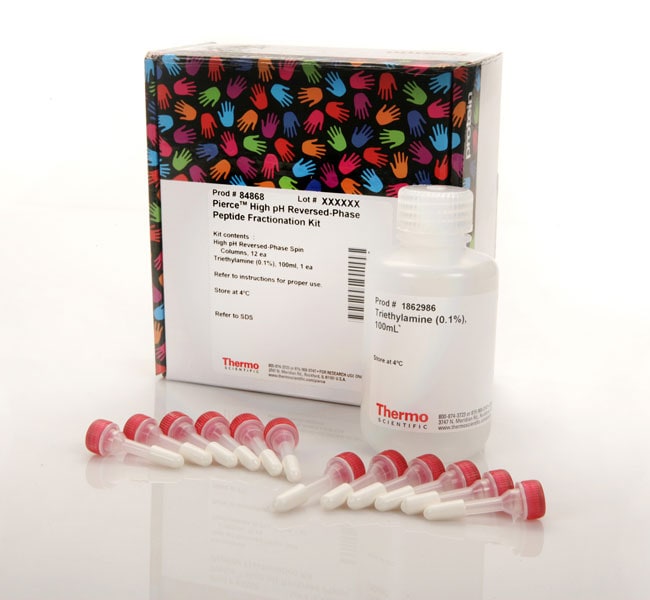
Pierce™ High pH Reversed-Phase Peptide Fractionation Kit
Thermo Scientific™ Pierce™高pH逆相ペプチド分画キットは、混合ペプチドサンプルの直交ペプチド分画により、LC/MS分析のタンパク質同定を改善します。•使いやすい—樹脂はシングルユースのスピンカラム形式で提供されます• タンパク質同定の向上—タンパク質同定が非分画化サンプルよりも50%以上改善されました• 再現可能—溶出プロフィールと分画分解能の変動は20%未満です• 最適化—確実な手法により、分画のオーバーラップを最小限に抑えながら詳細を見る
| 製品番号(カタログ番号) | 数量 |
|---|---|
| 84868 | 12 Reactions |
製品番号(カタログ番号) 84868
価格(JPY)
66,800
Each
数量:
12 Reactions
Thermo Scientific™ Pierce™高pH逆相ペプチド分画キットは、混合ペプチドサンプルの直交ペプチド分画により、LC/MS分析のタンパク質同定を改善します。
•使いやすい—樹脂はシングルユースのスピンカラム形式で提供されます
• タンパク質同定の向上—タンパク質同定が非分画化サンプルよりも50%以上改善されました
• 再現可能—溶出プロフィールと分画分解能の変動は20%未満です
• 最適化—確実な手法により、分画のオーバーラップを最小限に抑えながら、タンパク質同定とペプチド回収率を最大化することができます
• 適合性—試薬は、TMT™で標識されたペプチドなど、さまざまな混合サンプルで検証されています
ディーププロテオームシーケンシング行うために、LC/MS分析の前に直交する次元で分画することで、サンプルの複雑さを軽減する必要が生じる場合がよくあります。Pierce高pH逆相ペプチド分画キットでは、高pH逆相クロマトグラフィーを使用し、疎水性によってペプチドを分割して、低pH逆相LC-MSグラジエントに優れた直交性をもたらします。
キットは、高pH分画プロトコルを使用した、簡単に使用できるスピンカラム形式で、特許取得済みの逆相レジンを使用してタンパク質同定が改善されるように作成されています。強陽イオン交換(SCX)分画とは対照的に、高pH逆相分角ではLC/MS分析の前に脱塩ステップを追加する必要はありません。
高pH逆相ペプチド分画キットには、高pHバッファー(トリエチルアミン0.1 %)と、pH耐性逆相樹脂を含む12個のスピンカラムが含まれています。各逆相分画スピンカラムにより、微量遠心機を使用して、10~100 µgのペプチドサンプルを分画できます。
このキットを使用して、未変性、リン酸化、Tandem Mass Tag(TMTTMT)標識、およびその他の複合ペプチド混合サンプルを分画できます。各分画により生成された検索結果を組み合わせると、タンパク質配列カバー率が改善され、非分画化サンプルよりもタンパク質の同定数が増加します。
用途:
• サンプルの複雑さを低減し、目的のターゲットを同定します
• システム生物学研究を実施します
• サンプルの複雑さを低減し、定量調査を改善します
•使いやすい—樹脂はシングルユースのスピンカラム形式で提供されます
• タンパク質同定の向上—タンパク質同定が非分画化サンプルよりも50%以上改善されました
• 再現可能—溶出プロフィールと分画分解能の変動は20%未満です
• 最適化—確実な手法により、分画のオーバーラップを最小限に抑えながら、タンパク質同定とペプチド回収率を最大化することができます
• 適合性—試薬は、TMT™で標識されたペプチドなど、さまざまな混合サンプルで検証されています
ディーププロテオームシーケンシング行うために、LC/MS分析の前に直交する次元で分画することで、サンプルの複雑さを軽減する必要が生じる場合がよくあります。Pierce高pH逆相ペプチド分画キットでは、高pH逆相クロマトグラフィーを使用し、疎水性によってペプチドを分割して、低pH逆相LC-MSグラジエントに優れた直交性をもたらします。
キットは、高pH分画プロトコルを使用した、簡単に使用できるスピンカラム形式で、特許取得済みの逆相レジンを使用してタンパク質同定が改善されるように作成されています。強陽イオン交換(SCX)分画とは対照的に、高pH逆相分角ではLC/MS分析の前に脱塩ステップを追加する必要はありません。
高pH逆相ペプチド分画キットには、高pHバッファー(トリエチルアミン0.1 %)と、pH耐性逆相樹脂を含む12個のスピンカラムが含まれています。各逆相分画スピンカラムにより、微量遠心機を使用して、10~100 µgのペプチドサンプルを分画できます。
このキットを使用して、未変性、リン酸化、Tandem Mass Tag(TMTTMT)標識、およびその他の複合ペプチド混合サンプルを分画できます。各分画により生成された検索結果を組み合わせると、タンパク質配列カバー率が改善され、非分画化サンプルよりもタンパク質の同定数が増加します。
用途:
• サンプルの複雑さを低減し、目的のターゲットを同定します
• システム生物学研究を実施します
• サンプルの複雑さを低減し、定量調査を改善します
For Research Use Only. Not for use in diagnostic procedures.
仕様
最終産物タイプペプチド
使用対象 (装置)微量遠心機
数量12 Reactions
ワークフローステップ分画
検出法質量分析
フォーマットKit
製品ラインPierce
製品タイプPeptide Fractionation Kit
原料ペプチド, プロテアーゼ消化タンパク質
Unit SizeEach
組成および保存条件
逆相分画スピンカラム、12カラム
トリエチルアミン(0.1%)、100 mL
冷蔵庫で保管してください(2~8℃)。
トリエチルアミン(0.1%)、100 mL
冷蔵庫で保管してください(2~8℃)。
よくあるご質問(FAQ)
Can I purchase the Reversed-Phase Fractionation Spin Columns from the Pierce High pH Reversed-Phase Peptide Fractionation Kit (Cat. No. 84868) separately?
How much starting material is needed to fractionate my samples using the Pierce High pH Reversed Phase Fractionation Kit (Cat. No. 84868)?
I want to fractionate a complex mass spectrometry sample, but my sample is different from the one described in the manual for the Pierce High pH Reversed-Phase Peptide Fractionation Kit. Should I use a customized fractionation gradient?
After running the Pierce TMT11plex Yeast Digest Standard, I observe low signal to noise ratio and poor quantitation accuracy for the Tandem Mass Tag (TMT) reporter ions. What do you recommend?
I have a lower number of peptide/protein identification in my combined TMT-labeled samples compared to the unlabeled sample. What can I do?
引用および参考文献 (3)
引用および参考文献
Abstract
Targeted Protein Degradation through Recruitment of the CUL4 Complex Adaptor Protein DDB1
Journal:ACS Chem Biol
PubMed ID:38192078
Targeted protein degradation has arisen as a powerful therapeutic modality for eliminating proteins. Thus far, most heterobifunctional proteolysis targeting chimeras (PROTACs) have utilized recruiters against substrate receptors of Cullin RING E3 ubiquitin ligases, such as cereblon and VHL. However, previous studies have surprisingly uncovered molecular glue degraders that exploit a
Generating high quality libraries for DIA MS with empirically corrected peptide predictions.
Journal:Nature communications
PubMed ID:32214105
Data-independent acquisition approaches typically rely on experiment-specific spectrum libraries, requiring offline fractionation and tens to hundreds of injections. We demonstrate a library generation workflow that leverages fragmentation and retention time prediction to build libraries containing every peptide in a proteome, and then refines those libraries with empirical data. Our method
Proteomics of prostate cancer serum and plasma using low and high throughput approaches
Journal:Clin Proteomics
PubMed ID:38475692
Despite progress, MS-based proteomics in biofluids, especially blood, faces challenges such as dynamic range and throughput limitations in biomarker and disease studies. In this work, we used cutting-edge proteomics technologies to construct label-based and label-free workflows, capable of quantifying approximately 2,000 proteins in biofluids. With 70µL of blood and a