Search


Citations & References (9)
Invitrogen™
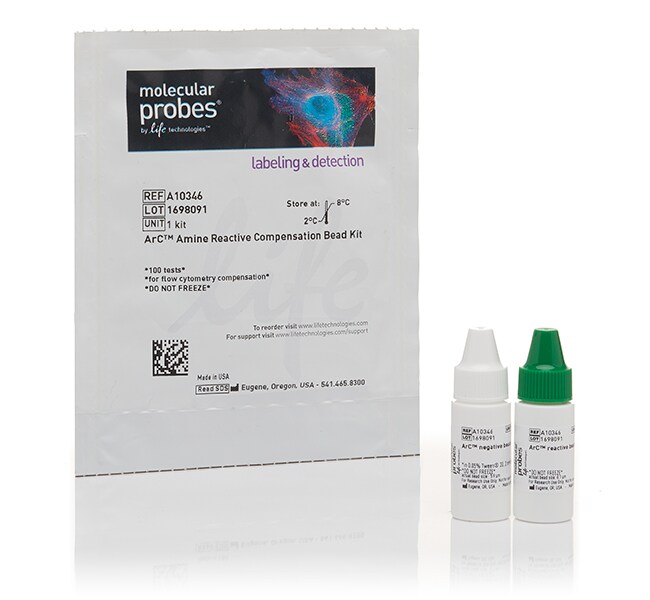
ArC™ Amine Reactive Compensation Bead Kit (for use with LIVE/DEAD™ Fixable dead cell stain kits)
ArC™アミン反応性コンペンセーションビーズキットは、LIVE/DEAD™ Fixableデッドセル染色キット用に最適化されたビーズベースの補正ツールです。•すぐに使用可能なコントロール• コントロールとしての熱処理細胞の手間を省き、貴重なサンプルを節約• 正確で一貫した結果を実現フローサイトメトリー用のすべての固定可能な生存性色素の選択ガイドをご覧ください。すぐに使用可能なコントロール細胞材料を使用して補正コントロールを行うためにサンプル調製が必要な他の方法とは異なり、ArCアミン反応性コンペンセーションビーズキットはドロッパーボトルからすぐに使用できます。キットには詳細を見る


製品番号(カタログ番号) A10346
価格(JPY)
83,500
Each
テスト数:
100
ArC™アミン反応性コンペンセーションビーズキットは、LIVE/DEAD™ Fixableデッドセル染色キット用に最適化されたビーズベースの補正ツールです。
•すぐに使用可能なコントロール
• コントロールとしての熱処理細胞の手間を省き、貴重なサンプルを節約
• 正確で一貫した結果を実現
フローサイトメトリー用のすべての固定可能な生存性色素の選択ガイドをご覧ください。
すぐに使用可能なコントロール
細胞材料を使用して補正コントロールを行うためにサンプル調製が必要な他の方法とは異なり、ArCアミン反応性コンペンセーションビーズキットはドロッパーボトルからすぐに使用できます。キットには、LIVE/DEAD Fixableデッドセル染色キットのアミン反応性色素と反応するように最適化された、特別に修飾された2種類のポリスチレンマイクロスフェアが含まれています。ArC反応性ビーズ(コンポーネントA)は、アミン反応性色素のいずれかに結合し、ポジティブシグナルを提供します。ArCネガティブビーズ(コンポーネントB)は反応性がなく、ネガティブ補正コントロールを提供します。このすぐに使用可能な製品は、元の実験用サンプルを保持します。貴重なサンプルは補正コントロールの作成には使用されません。
正確で一貫性のある結果
疾患や発生状態に応じて発現レベルが変化することがある生物学的コントロールとは異なり、ArCビーズは明るく一貫したシグナルを提供します(下図を参照)。補正コントロールの染色パターンの一貫性は、適切な補正値を得るために重要です。使用するコントロール物質によって信号が変化すれば、補正値に影響が及び、誤った結果をもたらす可能性があります。
キットの仕組み
LIVE/DEAD Fixableデッドセル染色剤の入った試験管に1滴のビーズを加えます。アミン反応性色素でインキュベーションした後、ビーズを染色バッファーで洗浄し、ネガティブコントロールビーズを1滴添加し(必要に応じて)、ビーズを再懸濁してフローサイトメトリーで解析します。2つの成分により、ネガティブビーズよりも50倍以上明るい明確なポジティブビーズが得られ、これを補正の設定に使用できます。
その他の補償製品
ArCアミン反応性コンペンセーションビーズに加えて、マウス抗ヒト抗体を捕捉するためのAbC™抗マウスビーズキットや、ラット抗マウス抗体やハムスター抗マウス抗体を捕捉するためのAbC™抗ラット/ハムスタービーズキットも提供しています。
•すぐに使用可能なコントロール
• コントロールとしての熱処理細胞の手間を省き、貴重なサンプルを節約
• 正確で一貫した結果を実現
フローサイトメトリー用のすべての固定可能な生存性色素の選択ガイドをご覧ください。
すぐに使用可能なコントロール
細胞材料を使用して補正コントロールを行うためにサンプル調製が必要な他の方法とは異なり、ArCアミン反応性コンペンセーションビーズキットはドロッパーボトルからすぐに使用できます。キットには、LIVE/DEAD Fixableデッドセル染色キットのアミン反応性色素と反応するように最適化された、特別に修飾された2種類のポリスチレンマイクロスフェアが含まれています。ArC反応性ビーズ(コンポーネントA)は、アミン反応性色素のいずれかに結合し、ポジティブシグナルを提供します。ArCネガティブビーズ(コンポーネントB)は反応性がなく、ネガティブ補正コントロールを提供します。このすぐに使用可能な製品は、元の実験用サンプルを保持します。貴重なサンプルは補正コントロールの作成には使用されません。
正確で一貫性のある結果
疾患や発生状態に応じて発現レベルが変化することがある生物学的コントロールとは異なり、ArCビーズは明るく一貫したシグナルを提供します(下図を参照)。補正コントロールの染色パターンの一貫性は、適切な補正値を得るために重要です。使用するコントロール物質によって信号が変化すれば、補正値に影響が及び、誤った結果をもたらす可能性があります。
キットの仕組み
LIVE/DEAD Fixableデッドセル染色剤の入った試験管に1滴のビーズを加えます。アミン反応性色素でインキュベーションした後、ビーズを染色バッファーで洗浄し、ネガティブコントロールビーズを1滴添加し(必要に応じて)、ビーズを再懸濁してフローサイトメトリーで解析します。2つの成分により、ネガティブビーズよりも50倍以上明るい明確なポジティブビーズが得られ、これを補正の設定に使用できます。
その他の補償製品
ArCアミン反応性コンペンセーションビーズに加えて、マウス抗ヒト抗体を捕捉するためのAbC™抗マウスビーズキットや、ラット抗マウス抗体やハムスター抗マウス抗体を捕捉するためのAbC™抗ラット/ハムスタービーズキットも提供しています。
研究用にのみ使用できます。診断用には使用いただけません。
仕様
検出法蛍光
直径(メートル法)6 μm
励起波長域任意のレーザー(UV~633/635)
使用対象 (装置)フローサイトメーター
フォーマットチューブ
テスト数100
数量1キット
出荷条件室温
染色構成表面処理
製品ラインCompenFlow、Molecular Probes
製品タイプコンペンセーションビーズ
Unit SizeEach
組成および保存条件
1バイアルのArC™アミン反応性ビーズと1バイアルのネガティブビーズが含まれます。2℃~8℃で保存してください
よくあるご質問(FAQ)
Are the vials of ArC Amine Reactive Compensation Bead Kit (for use with LIVE/DEAD Fixable dead cell stain kits) (Cat. No. A10346, A10648) compatible with Vaporized Hydrogen Peroxide (VHP) sterilization?
What is the stability for the ArC Amine Reactive Compensation Bead Kit (for use with LIVE/DEAD Fixable dead cell stain kits)?
My ArC Amine Reactive Compensation beads are excessively clumped and cannot be resuspended by vortexing or sonication. What may have caused this?
For the ArC Amine Reactive Compensation Bead Kit, why must I use freshly prepared amine-reactive dye?
Besides the Live/Dead Fixable Dead Cell stain, may I conjugate other amine-reactive dyes to the beads in the ArC Amine Reactive Compensation Bead Kit?
引用および参考文献 (9)
引用および参考文献
Abstract
IL-1 family members IL-18 and IL-33 upregulate the inflammatory potential of differentiated human Th1 and Th2 cultures.
Journal:J Immunol
PubMed ID:23028054
'The IL-1 family members IL-1ß, IL-18, and IL-33 are potent cytokines in relationship to amplifying the CD4(+) T cell cytokine production. To evaluate their impact on in vitro-differentiated human Th1 and Th2 cultures, such cultures were established from naive T cells, purified from healthy blood donors, and reactivated in the
Multiparameter flow cytometry and bioanalytics for B cell profiling in systemic lupus erythematosus.
Journal:Methods Mol Biol
PubMed ID:22933067
B lymphocyte involvement in systemic lupus erythematosus has been recognized for several decades, mainly in the context of autoantibody production. Both mouse and human studies reveal that different types of antibody responses, as well as antibody-independent effector functions can be ascribed to distinct subpopulations (subsets) of circulating B cells. Characterizing
Evaluation of pneumonia virus of mice as a possible human pathogen.
Journal:J Virol
PubMed ID:22438539
Pneumonia virus of mice (PVM), a relative of human respiratory syncytial virus (RSV), causes respiratory disease in mice. There is serologic evidence suggesting widespread exposure of humans to PVM. To investigate replication in primates, African green monkeys (AGM) and rhesus macaques (n = 4) were inoculated with PVM by the
A novel aldehyde dehydrogenase-3 activator leads to adult salivary stem cell enrichment in vivo.
Journal:Clin Cancer Res
PubMed ID:21998334
To assess aldehyde dehydrogenase (ALDH) expression in adult human and murine submandibular gland (SMG) stem cells and to determine the effect of ALDH3 activation in SMG stem cell enrichment. Adult human and murine SMG stem cells were selected by cell surface markers (CD34 for human and c-Kit for mouse) and
Targeting GLUT1 and the Warburg effect in renal cell carcinoma by chemical synthetic lethality.
Journal:Sci Transl Med
PubMed ID:21813754
Identifying new targeted therapies that kill tumor cells while sparing normal tissue is a major challenge of cancer research. Using a high-throughput chemical synthetic lethal screen, we sought to identify compounds that exploit the loss of the von Hippel-Lindau (VHL) tumor suppressor gene, which occurs in about 80% of renal