Search
 元素の検索
元素の検索 構造の検索
構造の検索

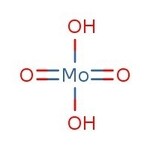

Thermo Scientific Chemicals
Molybdic acid, MoO3 85% min
CAS: 7782-91-4 | H2MoO4 | 161.96 g/mol



化学物質識別子
CAS7782-91-4
IUPAC Namedioxomolybdenumdiol
Molecular FormulaH2MoO4
InChI KeyVLAPMBHFAWRUQP-UHFFFAOYSA-L
SMILESO[Mo](O)(=O)=O
さらに表示
仕様 スペックシート
スペックシートElemental AnalysisChloride content (as Cl) ≤0.01%
Appearance (Color)White to pale cream
Assay (unspecified)MoO3 content >= 85.0 to =< 90.0%
FormPowder
Elemental AnalysisLead content (as Pb) ≤0.003%
Molybdic acid is used as a precursor in the production of ammonium molybdate tetrahydrate and molybdenum(IV) sulfide. The mixture of molybdic acid in concentrated sulfuric acid is called as Froehde reagent, which finds application in analytical chemistry for the detection of alkaloids.
This Thermo Scientific Chemicals brand product was originally part of the Alfa Aesar product portfolio. Some documentation and label information may refer to the legacy brand. The original Alfa Aesar product / item code or SKU reference has not changed as a part of the brand transition to Thermo Scientific Chemicals.
Applications
Molybdic acid is used as a precursor in the production of ammonium molybdate tetrahydrate and molybdenum(IV) sulfide. The mixture of molybdic acid in concentrated sulfuric acid is called as Froehde reagent, which finds application in analytical chemistry for the detection of alkaloids.
Solubility
Soluble in dilute ammonium hydroxide, alkali and ammonia. Slightly soluble in water.
Notes
Incompatible with strong bases and strong oxidizing agents.
Molybdic acid is used as a precursor in the production of ammonium molybdate tetrahydrate and molybdenum(IV) sulfide. The mixture of molybdic acid in concentrated sulfuric acid is called as Froehde reagent, which finds application in analytical chemistry for the detection of alkaloids.
Solubility
Soluble in dilute ammonium hydroxide, alkali and ammonia. Slightly soluble in water.
Notes
Incompatible with strong bases and strong oxidizing agents.
RUO – Research Use Only
General References:
- Ahmed, N.; Siddiqui, Z. N. Silica molybdic acid catalysed eco-friendly three component synthesis of functionalised tetrazole derivatives under microwave irradiation in water. RSC Adv. 2015, 5 (22), 16707-16717.
- Zhou, J.; Lin, N.; Wang, L.; Zhang, K.; Zhu, Y.; Qian, Y. Synthesis of hexagonal MoO3 nanorods and a study of their electrochemical performance as anode materials for lithium-ion batteries. J. Mater. Chem. A 2015, 3 (14), 7463-7468.