Search


Citations & References (9)
Gibco™
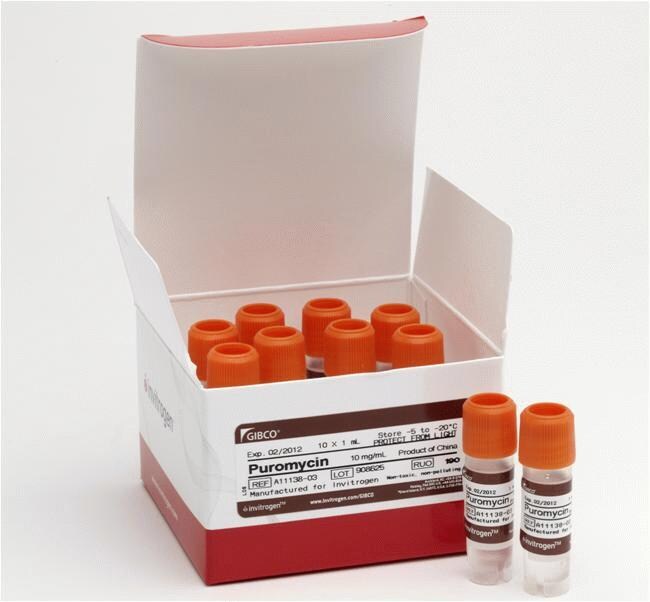
Puromycin Dihydrochloride
ピュロマイシン二塩酸塩は、Streptomyces albonigerによって産生されるアミノヌクレアシド抗生物質です。ピュロマイシンは、原核生物と真核生物の両方のリボソームでペプチジルの転写を阻害することで機能します。pac遺伝子の発現により、耐性がもたらされます。ピュロマイシンは哺乳類細胞培養システムの選択用抗生物質として、細胞生物学で広く使用されています。推奨される使用濃度は0.2~5.0詳細を見る


製品番号(カタログ番号) A1113803
価格(JPY)
50,400
Each
数量:
10 x 1 mL
ピュロマイシン二塩酸塩は、Streptomyces albonigerによって産生されるアミノヌクレアシド抗生物質です。ピュロマイシンは、原核生物と真核生物の両方のリボソームでペプチジルの転写を阻害することで機能します。pac遺伝子の発現により、耐性がもたらされます。
ピュロマイシンは哺乳類細胞培養システムの選択用抗生物質として、細胞生物学で広く使用されています。推奨される使用濃度は0.2~5.0 µg/mLですが、真核細胞には、1 µg/mLほどの低濃度でも毒性を示す可能性があります。Gibco™ピュロマイシン二塩酸塩は、20 mMのHEPESバッファー(pH 6.2~6.8)中に濃度10 mg/mLの10バイアルで提供されます(1バイアルは1 mL)。
その他の選択肢と詳細情報
当社は、粉末と液体の両方で幅広い抗生物質および抗真菌剤を提供しています。
詳細なリストを参照するか、以下の用途の各製品をご覧ください。
•汚染防止
• 真核および細菌の選択
選択抗生物質の使用濃度に関する推奨事項をご覧ください。
細胞培養における抗生物質および抗真菌剤の使用の詳細、および培養の汚染除去に関するガイドラインをご覧ください。
ピュロマイシンは哺乳類細胞培養システムの選択用抗生物質として、細胞生物学で広く使用されています。推奨される使用濃度は0.2~5.0 µg/mLですが、真核細胞には、1 µg/mLほどの低濃度でも毒性を示す可能性があります。Gibco™ピュロマイシン二塩酸塩は、20 mMのHEPESバッファー(pH 6.2~6.8)中に濃度10 mg/mLの10バイアルで提供されます(1バイアルは1 mL)。
その他の選択肢と詳細情報
当社は、粉末と液体の両方で幅広い抗生物質および抗真菌剤を提供しています。
詳細なリストを参照するか、以下の用途の各製品をご覧ください。
•汚染防止
• 真核および細菌の選択
選択抗生物質の使用濃度に関する推奨事項をご覧ください。
細胞培養における抗生物質および抗真菌剤の使用の詳細、および培養の汚染除去に関するガイドラインをご覧ください。
研究用にのみ使用できます。診断用には使用いただけません。
仕様
濃度10 mg/mL
培養タイプMammalian Cell Culture, Insect Cell Culture
使用対象(アプリケーション)Eukaryotic Selection⁄Stable Cell Line Generation
製品ラインGibco
数量10 x 1 mL
品質保持期間12 Months
出荷条件Dry Ice
形状Liquid
製品タイプAntibiotic
無菌性Sterile-filtered
添加剤ありHEPES
Unit SizeEach
組成および保存条件
Storage conditions: -5 to -20°C
Shipping conditions: Frozen
Shelf life: 12 months from date of manufacture
Shipping conditions: Frozen
Shelf life: 12 months from date of manufacture
よくあるご質問(FAQ)
Which of your antibiotics (Geneticin, Zeocin, Hygromycin B, Blasticidin, and Puromycin) can be used together for stable selection in mammalian cells?
How light-sensitive is Puromycin Dihydrochloride?
How can I decontaminate my cultures?
What antibiotics do you offer to help control or eliminate cell culture contamination?
引用および参考文献 (9)
引用および参考文献
Abstract
Trop2 Promotes Multidrug Resistance by Regulating Notch1 Signaling Pathway in Gastric Cancer Cells.
Journal:Med Sci Monit
PubMed ID:31964857
'BACKGROUND Chemotherapy is widely used in gastric cancer treatment, but multidrug resistance remains a leading cause of chemotherapy failure. Trop2 is highly expressed in gastric tumor tissues and greatly influences cancer progression. However, little is known about the relationship between Trop2 and drug resistance in gastric cancer. MATERIAL AND METHODS
mTORC2 contributes to the metabolic reprogramming in EGFR tyrosine-kinase inhibitor resistant cells in non-small cell lung cancer.
Journal:Cancer Lett
PubMed ID:30036610
Non-small cell lung cancer (NSCLC) patients with activating EGFR mutations are often successfully treated with EGFR tyrosine kinase inhibitor (TKI) such as erlotinib; however, treatment resistance inevitably occurs. Given tumor metabolism of glucose and therapeutic response are intimately linked, we explored the metabolic differences between isogenic erlotinib-sensitive and -resistant NSCLC
The Plasmodium falciparum cytoplasmic translation apparatus: a promising therapeutic target not yet exploited by clinically approved anti-malarials.
Journal:Malar J
PubMed ID:30541569
The continued spectre of resistance to existing anti-malarials necessitates the pursuit of novel targets and mechanisms of action for drug development. One class of promising targets consists of the 80S ribosome and its associated components comprising the parasite translational apparatus. Development of translation-targeting therapeutics requires a greater understanding of protein
Modulating eIF6 levels unveils the role of translation in ecdysone biosynthesis during Drosophila development.
Journal:Dev Biol
PubMed ID:31283922
During development, ribosome biogenesis and translation reach peak activities, due to impetuous cell proliferation. Current models predict that protein synthesis elevation is controlled by transcription factors and signalling pathways. Developmental models addressing translation factors overexpression effects are lacking. Eukaryotic Initiation Factor 6 (eIF6) is necessary for ribosome biogenesis and efficient
Cardiac glycosides decrease influenza virus replication by inhibiting cell protein translational machinery.
Journal:Am J Physiol Lung Cell Mol Physiol
PubMed ID:30892074
Cardiac glycosides (CGs) are used primarily for cardiac failure and have been reported to have other effects, including inhibition of viral replication. Here we set out to study mechanisms by which CGs as inhibitors of the Na-K-ATPase decrease influenza A virus (IAV) replication in the lungs. We found that CGs