Search
 元素の検索
元素の検索 構造の検索
構造の検索
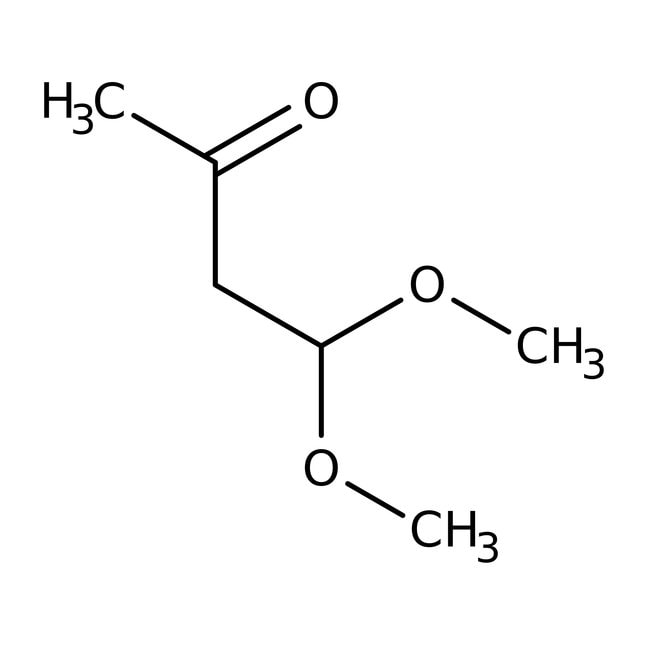


Thermo Scientific Chemicals
Acetylacetaldehyde dimethyl acetal, tech. 90%
CAS: 5436-21-5 | C6H12O3 | 132.16 g/mol



化学物質識別子
CAS5436-21-5
IUPAC Name4,4-dimethoxybutan-2-one
Molecular FormulaC6H12O3
InChI KeyPJCCSZUMZMCWSX-UHFFFAOYSA-N
SMILESCOC(CC(C)=O)OC
さらに表示
仕様 スペックシート
スペックシートFormliquid
Refractive Index1.4110 - 1.4190 @20?C
Appearance (Color)Clear, colourless to yellow
Assay (GC)> 88.0%
Acetaldehyde dimethyl acetal is used as a flavoring agent. It is also used in the preparation of (R)-4,4-dimethoxy-2-butanol, pyrazoles and pyrimidines. Further, it is used in the preparation of N,N-diethyl-[2-(4-fluorophenyl)-5-methylpyrazolo[1,5-a]-pyrimidin-3-yl]acetamide and acetoacetaldehyde.
This Thermo Scientific Chemicals brand product was originally part of the Alfa Aesar product portfolio. Some documentation and label information may refer to the legacy brand. The original Alfa Aesar product / item code or SKU reference has not changed as a part of the brand transition to Thermo Scientific Chemicals.
Applications
Acetaldehyde dimethyl acetal is used as a flavoring agent. It is also used in the preparation of (R)-4,4-dimethoxy-2-butanol, pyrazoles and pyrimidines. Further, it is used in the preparation of N,N-diethyl-[2-(4-fluorophenyl)-5-methylpyrazolo[1,5-a]-pyrimidin-3-yl]acetamide and acetoacetaldehyde.
Solubility
Miscible with alcohol. Immiscible with water.
Notes
Incompatible with acids and strong oxidizing agents
Acetaldehyde dimethyl acetal is used as a flavoring agent. It is also used in the preparation of (R)-4,4-dimethoxy-2-butanol, pyrazoles and pyrimidines. Further, it is used in the preparation of N,N-diethyl-[2-(4-fluorophenyl)-5-methylpyrazolo[1,5-a]-pyrimidin-3-yl]acetamide and acetoacetaldehyde.
Solubility
Miscible with alcohol. Immiscible with water.
Notes
Incompatible with acids and strong oxidizing agents
RUO – Research Use Only
General References:
- Protected form of the keto aldehyde, useful in heterocyclic synthesis, e.g. (formamide to 4-methylpyrimidine): Org. Synth. Coll., 5, 794 (1973).
- Taheri, A.; Liu, C.; Lai, B.; Cheng, C.; Pan, X.; Gu, Y. Brønsted acid ionic liquid catalyzed facile synthesis of 3-vinylindoles through direct C3 alkenylation of indoles with simple ketones. Green Chem. 2014, 16 (8), 3715-3719.
- Acosta, O. B. G.; Hardt, N.; Schink, B. Carbonylation as a key reaction in anaerobic acetone activation by Desulfococcus biacutus. Appl. Environ. Microbiol. 2013, 79 (20), 6228-6235.